
Current evidence supports an association between elevated upper trapezius stiffness and chronic neck pain in office workers, but stiffness is not a standalone predictor of future pain. A 2026 PLOS ONE study of workday trapezius activation reinforces how conditional these links are: asymmetry at near-rest activation levels was positively associated with neck pain intensity, while asymmetry at moderate levels appeared protective, and the authors could not rule out reverse causality. A 2025 shear wave elastography study found office workers with chronic neck pain showed higher trapezius stiffness alongside greater neck disability and fear-avoidance beliefs, which means stiffness is best read as a current-state marker, not a forecast. A separate 2025 shear wave elastography study tied the office-worker posture itself to the tissue, reporting that greater forward head posture was associated with higher upper trapezius stiffness, while subjective complaints did not always match the objective readings.
What does the research actually show?
The most relevant 2025 evidence found stiffness differences between symptomatic and asymptomatic office workers, with the strongest links to disability and psychosocial measures rather than to pain intensity alone. A 2025 study using shear wave elastography on the upper trapezius in office workers with chronic neck pain reported associations between elevated muscle stiffness, neck disability scores, fear-avoidance beliefs, and reduced work ability.
That pattern is consistent with broader systematic-review evidence. A systematic review in Clinical Physiology and Functional Imaging noted that the relationship between musculoskeletal pain and muscle stiffness is inconsistent across pain conditions. Some studies show higher stiffness in painful tissue, some show no difference, and a few show lower values. Trapezius and chronic neck pain tend toward the "higher stiffness in symptomatic side" pattern, but the effect is not universal.
Survey data: In a 2026 survey of 455 patients who stopped chiropractic care, 58% cited perception-based reasons: 36% felt no progress, and 22% felt better and stopped. Neither group was told their stiffness was still elevated.
How is upper trapezius stiffness measured in practice?
Three methods dominate, and they trade off precision against cost and chairside practicality.
| Method | What it produces | Reliability evidence | Chairside practicality |
|---|---|---|---|
| Shear wave elastography (SWE) | Tissue stiffness in kilopascals (kPa) | High in single-operator protocols | Low, requires ultrasound and trained operator |
| Handheld myotonometry | Stiffness in N/m | Good to excellent ICC across muscle groups | High, 30-second measurement |
| Palpation | Subjective grade | Inter-rater reliability typically Kappa ≤ 0.40 | High, but limited reproducibility |
For routine chiropractic and physical therapy use, handheld myotonometry is the practical choice. A 2024 systematic review of MyotonPRO reliability in Medicina covering 48 studies and 31 muscle groups reported ICC values above 0.75 in most measurements. A 2024 reliability study in Frontiers in Sports and Active Living found ICC values from 0.74 to 0.99 across most lower-extremity muscles. The trapezius is among the better-studied muscles for myotonometry.
Is the stiffness causing the pain, or is the pain causing the stiffness?
The directionality is not clear, and current studies cannot answer it from cross-sectional data alone. Three explanations are plausible:
- Protective guarding: Pain may drive a protective increase in resting muscle tone, raising measured stiffness.
- Mechanical contribution: Sustained loading from prolonged sitting and forward head posture may stiffen the trapezius, contributing to pain over time.
- Common driver: Both pain and stiffness may rise together as downstream effects of central sensitization, fascial densification, or psychosocial stress.
A 2025 Frontiers in Pain Research paper on fascia in myofascial pain syndrome argued that fascial densification, fibrosis, and inflammation may contribute to both stiffness and pain in chronic conditions, which supports the common-driver explanation in at least a subset of cases. The honest read for clinical practice is that stiffness is a useful current-state marker without making a strong claim about causation.
What does this mean for chiropractors and physical therapists?
An upper trapezius stiffness reading is a defensible second channel of data alongside pain, range of motion, and validated questionnaires. It is not a diagnostic test for neck pain, and it should not be presented as one. It is a number the patient can see change between visits.
Practical use cases:
- Baseline documentation at intake for office workers presenting with chronic neck pain, so re-exams have a comparison point.
- Response monitoring at the visit-6 or visit-12 re-exam, paired with a pain score and Neck Disability Index.
- Bilateral asymmetry tracking, since many office-worker presentations are asymmetric and asymmetry may shift before either side normalizes.
A 2025 randomized controlled trial in Frontiers in Medicine on chronic non-specific neck pain using Fu's Subcutaneous Needling reported that SWE-measured decreases in muscle stiffness correlated strongly with clinical improvement, with stiffness change detectable alongside or earlier than pain change. That is the clinical value: a measurable channel that may move in parallel with the patient's recovery rather than relying on pain self-report alone.
What are the limitations of using trapezius stiffness clinically?
Three matter for chiropractic and physical therapy practice.
- No universal reference range. "Normal" trapezius stiffness varies with sex, body composition, posture, and time of day. Individual baseline-versus-current comparisons are more defensible than absolute thresholds.
- Stiffness and pain are independent in many conditions. A 2019 PMC study of 40 patients with chronic neck and back pain found no meaningful relationship between the most painful site and the stiffest site. Trapezius is one of the better-correlated muscles, but the rule "stiff = painful" does not generalize.
- Posture and activity skew readings. Trapezius stiffness measured immediately after a desk session reads higher than after a rest period. Standardize the measurement context (patient seated, neck neutral, at least 5 minutes of rest) to keep comparisons valid.
Frequently Asked Questions
Does upper trapezius stiffness predict neck pain in office workers?
Current evidence supports an association, not a predictive relationship. A 2025 shear wave elastography study found elevated trapezius stiffness in office workers with chronic neck pain, with measurable links to neck disability and fear-avoidance beliefs. Stiffness reflects the current state of the tissue, but it has not been shown to forecast future pain on its own.
How is upper trapezius stiffness measured?
Three methods are common: shear wave elastography (research-grade ultrasound, expensive), handheld myotonometry (clinical-grade, portable, gives a stiffness value in N/m), and palpation (subjective, inter-rater reliability is poor). Myotonometry is the most practical method for routine clinical use.
Is trapezius stiffness always higher on the painful side?
No. The relationship between stiffness and pain is inconsistent across pain conditions. Trapezius tends to show higher stiffness on the symptomatic side in chronic neck pain populations, but this does not generalize to all patients or all muscles.
What is a normal trapezius stiffness value?
There is no standardized reference range. Values vary with sex, body composition, posture, and time of day. Individual baseline-versus-follow-up comparisons are more useful than chasing a single normal threshold.
Can stiffness decrease before pain decreases?
Yes. A 2025 randomized controlled trial in Frontiers in Medicine on chronic non-specific neck pain found that decreases in shear wave elastography stiffness correlated strongly with clinical improvement, with stiffness changes detectable in parallel with or earlier than pain change.
Why does posture and recent activity affect trapezius stiffness readings?
The trapezius responds to recent loading, posture, and activation. A measurement taken immediately after a desk session reads higher than one taken after a brief rest period. Standardizing the measurement context, such as seated with neck neutral after 5 minutes of rest, makes baseline comparisons more reliable.
Should every neck pain patient get a stiffness measurement?
Not necessarily. Stiffness measurement is most useful when a patient presents with chronic complaints, plans to commit to a multi-visit care plan, or has a complaint that is hard to track with pain self-report alone. For a single-visit acute presentation, the workflow cost may exceed the clinical value.
Does forward head posture explain the higher trapezius stiffness in office workers?
It is part of it. A 2025 study linked greater forward head posture to higher upper trapezius elastic modulus on shear wave elastography. Notably, subjective complaints did not always align with the objective stiffness, which is one more reason to measure rather than assume.
Does left-right trapezius asymmetry during the workday relate to neck pain?
It depends on the activation level. A 2026 PLOS ONE study found asymmetry at very low activation levels was positively associated with neck pain intensity, while asymmetry at moderate levels showed a protective association. The relationship was not linear, and the authors noted that existing pain could itself drive asymmetric use.
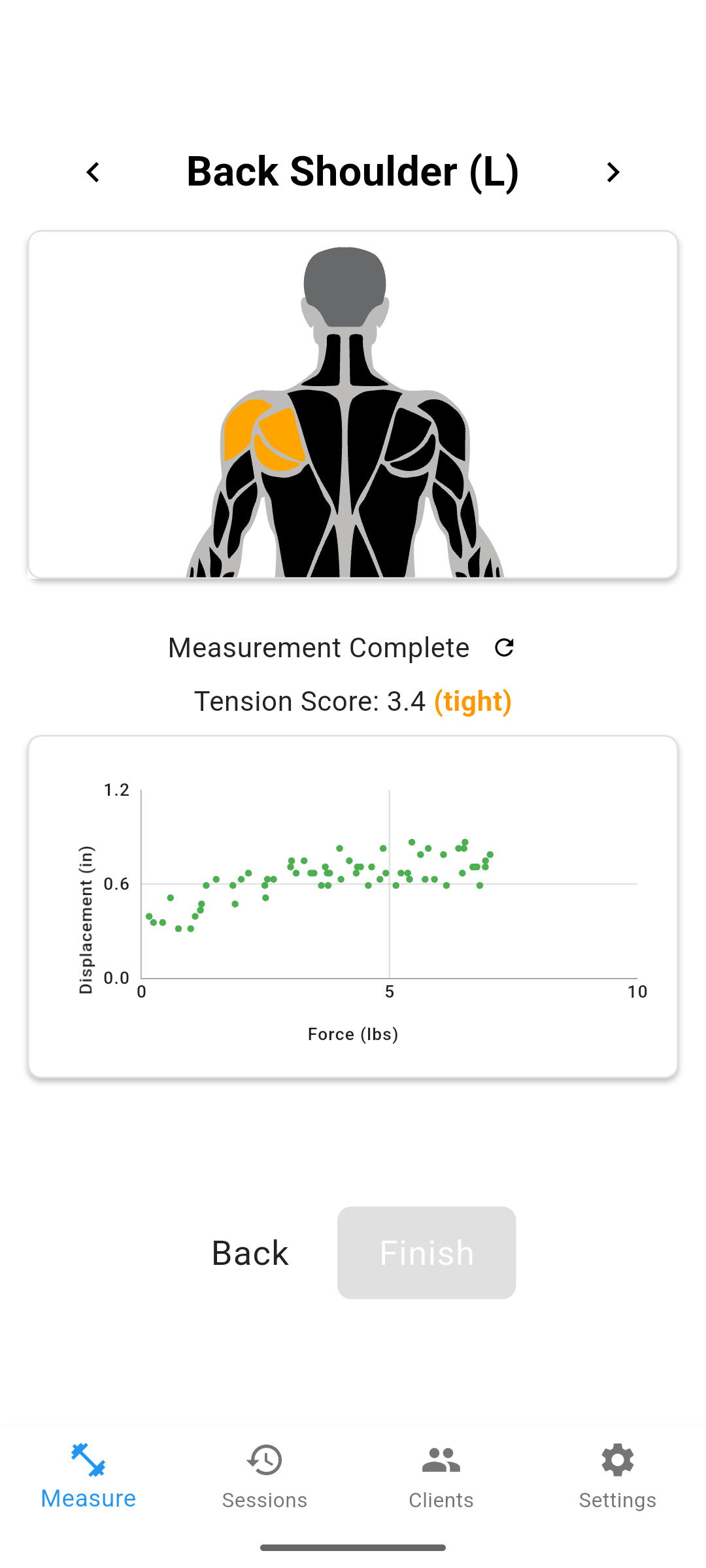
One approach is to add a second channel of objective data alongside subjective pain reports. Options include soft tissue stiffness measurement (such as MuscleMap), range-of-motion testing, and posture analysis. Each gives you something concrete to show the patient rather than asking them to take your word for it.