
Track each region separately and name one primary complaint for the plan. A single blended score hides the region that is actually moving, which is the region you need to show the patient. This matters more than usual here, because multisite pain patients improve less predictably than single-site patients.
Why does more than one complaint change the tracking problem?
Because the regions rarely move at the same speed. Average them and you get a number that describes neither.
A 2024 study analysing multisite musculoskeletal pain and disability in community-dwelling older adults found higher risk of both basic and instrumental disability with multisite pain, with risk rising as the number of painful sites rose. A 2024 longitudinal analysis in Medicina following 4,796 participants reported that having two or more pain sites was associated with long-term declines in physical quality of life, while mental health scores did not follow the same pattern.
A 2025 analysis of outcomes following a standardised exercise and education programme found that participants with pain in several sites showed less favourable improvement than those with pain in one. That is the clinically relevant point for a chiropractic plan. These patients may take longer to show change, which raises the odds they conclude nothing is happening and stop.
Survey data: In a 2026 survey of 455 patients who stopped chiropractic care, 58% cited perception-based reasons: 36% felt no progress, and 22% felt better and stopped. Neither group was shown that their soft tissue stiffness was still elevated.
What does a per-region tracking setup look like?
One primary complaint with full measures, secondary complaints with a short fixed set. The asymmetry is deliberate. It keeps the re-exam finishable.
| Complaint | Questionnaire | Objective measures | Re-measured |
|---|---|---|---|
| Primary (drives the plan) | Region-specific, such as Oswestry or Neck Disability Index | Range of motion, stiffness at two marked sites | Every re-exam |
| Secondary | None, or one general function item | Stiffness at one marked site | Every re-exam |
| Incidental or new | None initially | Baseline reading only | Once, then added if it persists |
The rule that makes this work is that a secondary complaint still gets a baseline. A complaint with no baseline cannot be shown to have improved three months later, and that is usually the one the patient brings up when deciding whether care was worth it.
How do you name the primary complaint without dismissing the others?
Let the patient pick it, then write it down in front of them. The choice is about sequencing, not about which pain is real.
Ask which one, if it improved, would make the biggest difference to their week. That answer sets the primary. Then say plainly that the other regions are being measured too, and that you expect them to move on different timelines. Setting that expectation at the baseline visit is what stops a slower region from reading as failure at week six.
What do you do when the regions disagree?
Show both and treat the disagreement as information. It usually is.
A neck that improves while a low back holds still tells you something about where the plan is working. It may also reflect that the two regions had different starting points, different loads through the day, and different histories. A stiffness reading that drops in one region and not another may reflect a change in local tissue mechanics, not a verdict on the whole case.
What you should not do is present an overall impression of improvement. The patient with two complaints already knows one of them has not changed. An account that skips that is the account they stop believing.
Frequently Asked Questions
How do you track progress for a chiropractic patient with more than one complaint?
Track each region with its own measures and name one primary complaint for the plan. A blended overall score hides which region is responding and makes it impossible to tell the patient anything specific.
Do patients with pain in several regions do worse?
Research on multisite musculoskeletal pain reports higher disability risk and steeper declines in physical function than single-site pain, along with less favourable improvement after standardised exercise and education programmes.
Should you use one questionnaire or several?
Use one region-specific questionnaire for the primary complaint and a general function measure for everything else. Running a separate full questionnaire per region raises the burden enough that completion drops.
What if the neck improves and the low back does not?
Show both and treat the divergence as the finding. A patient who sees one region moving and one holding still is getting a more credible account than a patient told everything is improving.
How many sites should you measure objectively?
Enough to cover each complaint and few enough to repeat identically every time. Consistency of site and position affects a reading more than the total number of sites you collect.
Does a new complaint appearing mid-plan mean treatment failed?
Not on its own. It does mean the baseline needs extending to the new region, because a complaint with no baseline cannot be shown to improve later.
How do you keep a multi-region re-exam from taking too long?
Fix a short protocol per region and repeat it rather than expanding the assessment each visit. Two consistent measures per region repeated on schedule beat a thorough assessment done once.
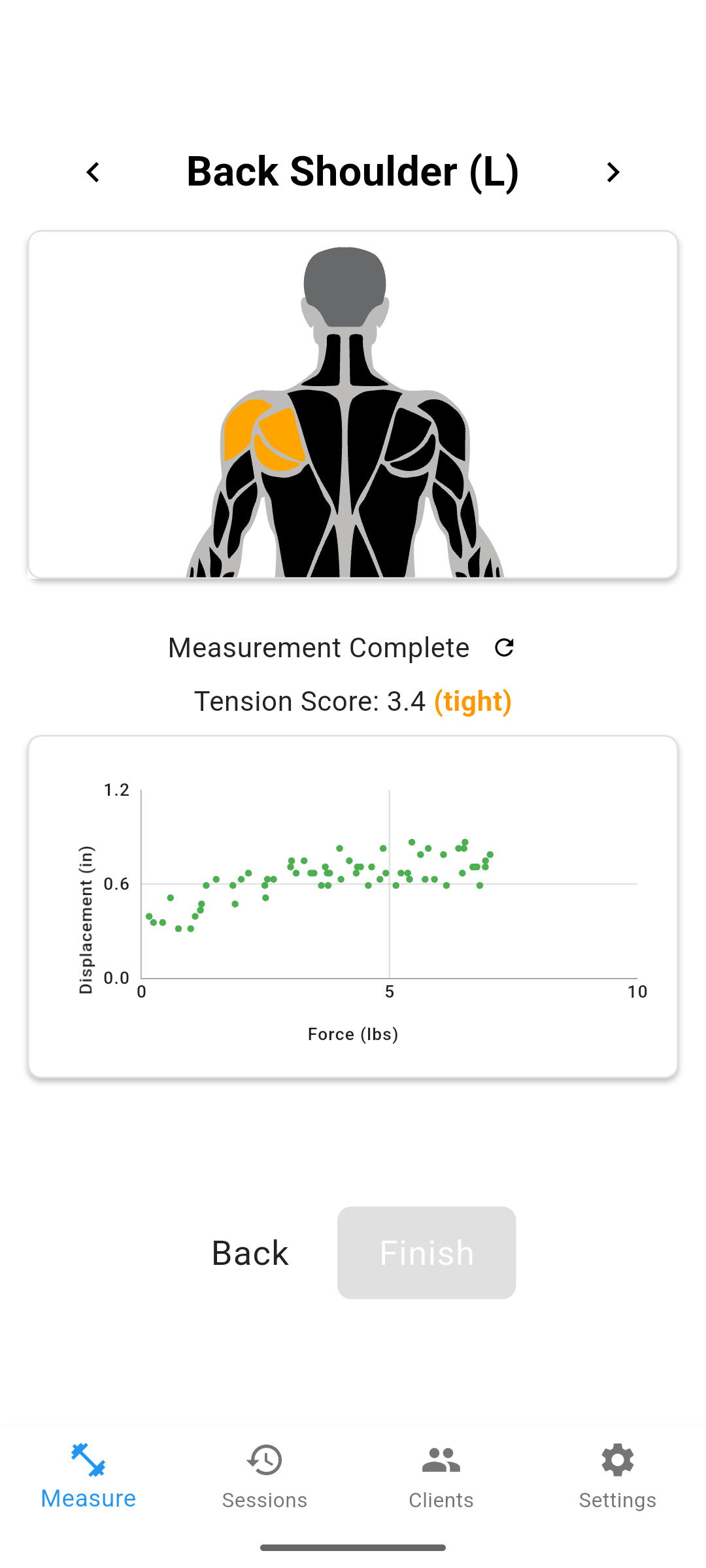
One approach is to add a second channel of objective data alongside subjective pain reports. Options include soft tissue stiffness measurement (such as MuscleMap), range-of-motion testing, and posture analysis. Each gives you something concrete to show the patient rather than asking them to take your word for it.