
The input is different. A tissue hardness meter presses a probe into tissue and reports the resistance it meets. A myotonometer delivers a brief tap and reads the oscillation that comes back, which lets it report stiffness alongside tone, elasticity and relaxation time. Both give you a repeatable number. They are not the same number.
How does each device actually work?
One compresses tissue, the other perturbs it. That single difference explains most of what follows.
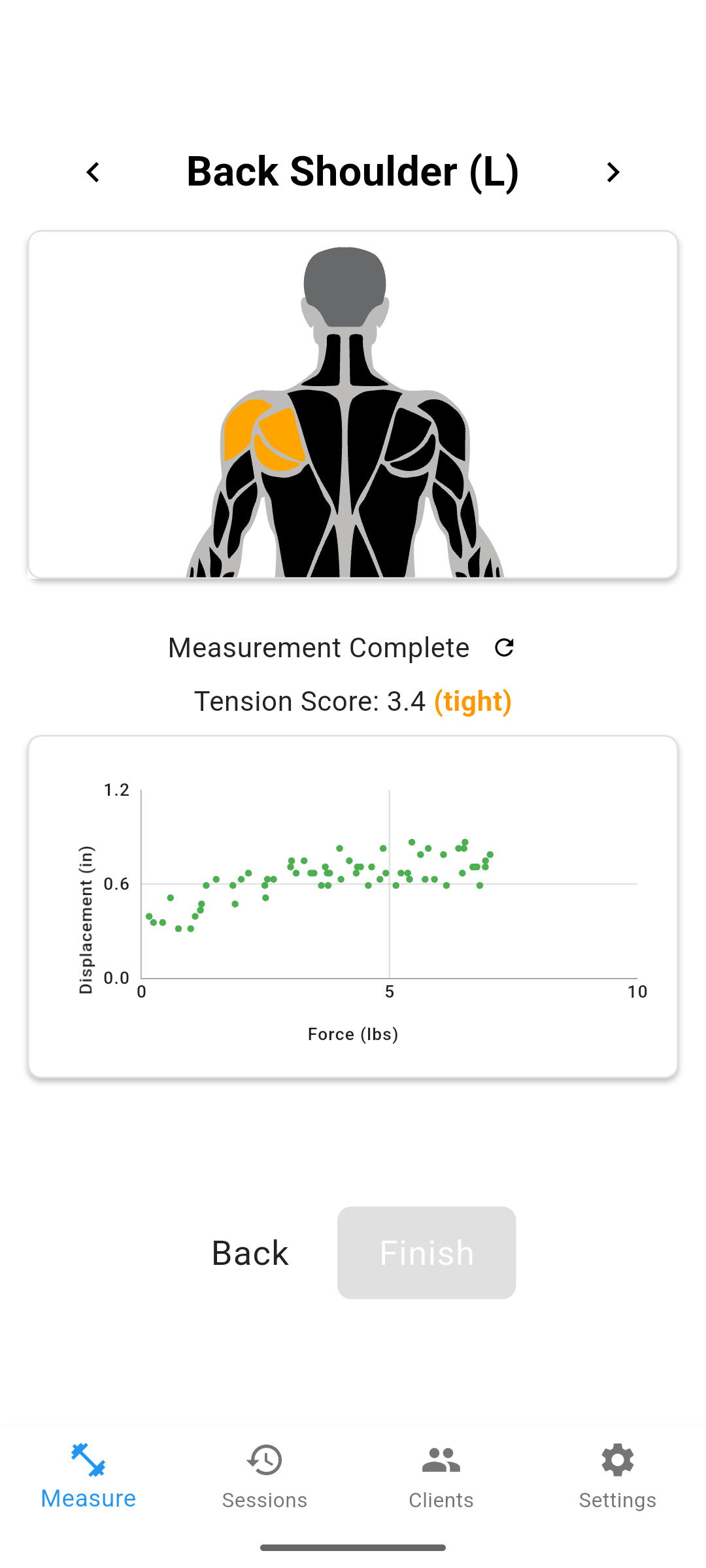
A Shore durometer or a tissue compliance meter is pushed into the skin until a spring-loaded probe meets resistance, and the scale reads how far it got. An indentometer such as the IndentoPRO records force against displacement as it sinks in, so you get a curve rather than a single hardness value. A myotonometer sits on the skin with a light preload, fires a short mechanical impulse, and measures the damped oscillation of the tissue underneath.
Compression tools ask how much this tissue resists being squashed. Oscillation tools ask how this tissue behaves when it is disturbed and allowed to settle. Both are legitimate questions about the same muscle.
What does the evidence say about accuracy?
They are broadly comparable, with layer-specific blind spots. The cleanest comparisons come from phantom models where the true stiffness is known in advance.
A 2023 study in Scientific Reports comparing stiffness assessment tools on a multi-layered phantom tissue model tested a durometer, an indentometer and a myotonometer against layers built to mimic skin, subcutaneous tissue, fascia and muscle. All three detected stiffness differences in most layers. All three struggled with very thin simulants such as deep fascia. The durometer tracked the bulk of the skin and subcutaneous layer more than the muscle beneath it.
A 2025 follow-up in Scientific Reports validating mechanical stiffness tools in layered plantar soft tissue phantoms reinforced the same caution. Device output is anchored to the layer it can reach, so the tissue you are aiming at should drive the choice.
How reliable is each one in clinic?
Both are reliable when the protocol is fixed, and myotonometry has the deeper evidence base. Reliability is what matters if you plan to re-measure the same patient in six weeks.
A 2022 study in the Journal of Clinical Medicine on a new indentometer device reported moderate to good intra-rater and inter-rater reliability for myofascial tissue stiffness. A 2024 systematic review in Medicina evaluating MyotonPro reliability pooled dozens of studies and found consistently high intra-rater and inter-rater reliability across muscle groups. Volume of evidence is not proof of superiority, but it does mean fewer unknowns when you defend a reading in a chart.
| Feature | Tissue hardness meter or indentometer | Myotonometer |
|---|---|---|
| Input | Sustained indentation by the clinician | Standardised brief mechanical tap |
| Typical output | Hardness units, or force against displacement | Stiffness in N/m, plus tone, elasticity, relaxation |
| Main tissue read | Skin and subcutaneous bulk, plus muscle at depth | The full tissue column under the probe |
| Operator force sensitivity | Higher, since the clinician drives compression | Lower, since the impulse is standardised |
| Published reliability base | Growing, smaller | Large, pooled in systematic review |
| Cross-device comparison | Not valid | Not valid |
Which one should you buy?
Decide by what you plan to do with the number. The choice is about workflow, not about which device is objectively best.
If you want a low-cost way to document that a specific area resists pressure differently than the other side, an indentation tool does that. If you want a repeatable series you will show the patient across a course of care, the standardised input and the broader reliability literature favour myotonometry. Whichever you pick, the rule from the phantom work still holds: readings only mean something against other readings from the same device, same site and same protocol.
Survey data: In a 2026 survey of 455 patients who stopped chiropractic care, 58% cited perception-based reasons: 36% felt no progress, and 22% felt better and stopped. Neither group was shown that their soft tissue stiffness was still elevated.
That survey is the practical reason to care about any of this. A device that produces a number you can repeat gives you something to put in front of the patient at week six. A device you use inconsistently gives you a number you will not trust enough to show.
Frequently Asked Questions
What is the difference between a tissue hardness meter and a myotonometer?
A tissue hardness meter presses a probe into tissue and reports the resistance it meets. A myotonometer applies a brief tap and reads the oscillation that returns, which lets it report stiffness alongside tone, elasticity and relaxation time.
Is a durometer the same as an indentometer?
They are close relatives. A Shore durometer reads surface hardness on a fixed scale, while an indentometer records force against displacement as the probe sinks in. Phantom model testing suggests the durometer reflects the skin and subcutaneous bulk more than deeper muscle.
Which one is more accurate?
Neither is a clear winner across all tissue. In layered phantom testing, each tool detected stiffness differences in most layers but struggled with very thin ones. Accuracy depends on the depth and thickness of the tissue you are targeting.
Can I use them interchangeably on the same patient?
No. They report different units and respond to different tissue properties, so a reading from one is not convertible to the other. Pick one tool per patient series and keep it for the whole course of care.
Does either tool depend on how hard the clinician presses?
Indentation devices are more sensitive to applied force and probe angle because the clinician drives the compression. Myotonometers standardise the input tap, which removes part of that variability but not the need for consistent positioning.
Which is better for tracking a patient across visits?
Either works if the protocol is fixed, but myotonometry has the larger published reliability base for repeated measurement. A 2024 systematic review pooled dozens of studies and reported high intra-rater and inter-rater reliability.
Do these tools measure the same thing as palpation?
They quantify part of what your hands sense, not all of it. Palpation blends stiffness, tenderness, temperature and texture into one impression, while these devices isolate a mechanical property and give it a number you can repeat.
One approach is to add a second channel of objective data alongside subjective pain reports. Options include soft tissue stiffness measurement (such as MuscleMap), range-of-motion testing, and posture analysis. Each gives you something concrete to show the patient rather than asking them to take your word for it.