
In chronic non-specific low back pain, thoracolumbar fascia stiffness can track with pain and disability. A 2024 shear wave elastography study of 30 patients and 32 controls found fascia stiffness at the L4-5 level was higher in the pain group and correlated strongly with pain intensity and Oswestry disability scores. That link is not universal, so the practical takeaway is to measure stiffness at the individual level rather than assume it from symptoms. A 2025 review in Frontiers in Pain Research reinforces why the fascia is worth measuring separately from muscle, reporting that fascial densification and fibrosis are associated with tenderness in myofascial pain and that imaging shows increased stiffness in symptomatic regions.
What did the 2024 fascia study actually find?
The thoracolumbar fascia at L4-5 was the standout signal. Its shear modulus was significantly higher in patients with chronic non-specific low back pain than in healthy controls. Left-side correlation with pain reached r = 0.57 and the right side reached r = 0.65, which the authors classed as strong. Correlations with the Oswestry Disability Index were similar in size.
The nearby muscles told a softer version of the same story. The erector spinae and multifidus were also stiffer in the pain group, but their correlations with pain sat in the moderate range around r = 0.42 to r = 0.50. In other words, the connective tissue sheet carried a clearer signal than the muscles it wraps.
This is a single cross-sectional study of young adults. It shows association, not cause. It does not tell you whether stiff fascia drives pain or whether pain and its guarding response drive the stiffness. It does tell you the two often move together in this population.
Why does this seem to contradict "stiffness and pain are independent"?
Because both statements are true in their own context. A 2019 individually controlled study of 40 patients with chronic neck and back pain found the most painful site was not the stiffest site, and the painful side was not stiffer than the pain-free side. There, stiffness and pain were clearly separate signals.
The resolution is that stiffness and pain are independent measures that sometimes correlate and often do not. When they line up, as with the L4-5 fascia above, stiffness confirms what pain reports. When they diverge, stiffness reveals something pain misses. Either way, you learn more from measuring stiffness than from assuming it.
How does fascia stiffness compare to other lower back signals?
| Signal | What it captures | Correlation with pain in chronic LBP | Patient-facing number |
|---|---|---|---|
| Thoracolumbar fascia stiffness (L4-5) | Connective tissue mechanical state | Strong in the 2024 SWE study | Yes |
| Erector spinae / multifidus stiffness | Muscle mechanical state | Moderate | Yes |
| Pain scale (NRS/VAS) | Subjective symptom intensity | By definition | Yes |
| Palpation | Practitioner impression of tissue | Not quantified | No |
Fascia and muscle stiffness both add a mechanical dimension that a pain scale cannot. Palpation senses some of the same information but produces no number the patient can watch change.
Survey data: In a 2026 survey of 455 patients who stopped chiropractic care early, 58% cited perception-based reasons: 36% felt no progress, and 22% felt better and self-discharged. A stiffness reading that is still above baseline gives both groups a concrete reason the pain number alone does not.
How do you use this at re-exam?
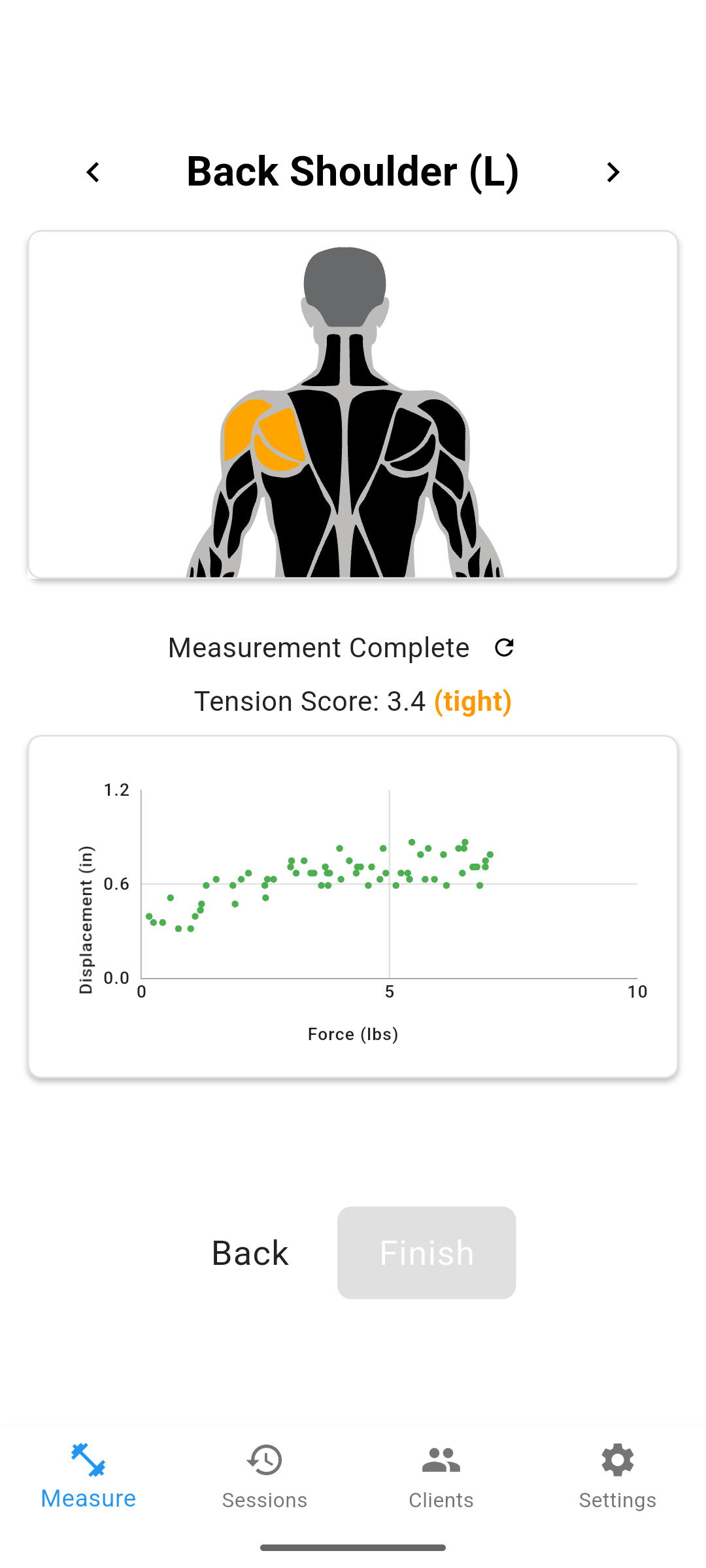
Measure stiffness at a fixed lower back site at the first visit and record the number. At re-exam, measure the same site and place the readings side by side. If the reading has dropped, you can say: "Your lower back stiffness reading went from 61 to 52. That is a measurable change in the tissue, on top of the pain relief you are feeling."
Keep the subject of the sentence the reading, not the fascia. Say "your stiffness reading is still above baseline," not "your fascia is still inflamed." The measurement supports the first sentence and cannot support the second.
Frequently Asked Questions
Does thoracolumbar fascia stiffness correlate with low back pain?
In chronic non-specific low back pain, it can. A 2024 shear wave elastography study found thoracolumbar fascia stiffness at L4-5 was higher in patients than controls and strongly correlated with both pain intensity and disability. This is not a universal rule, so individual measurement still matters more than the group trend.
Is the thoracolumbar fascia the same as muscle?
No. The thoracolumbar fascia is a layered sheet of connective tissue that wraps the lower back muscles and transmits load between the trunk, hips, and arms. It is measured separately from muscles like the erector spinae and multifidus, and it can show elevated stiffness readings independent of them.
If stiffness relates to pain here, why do other studies find no link?
Because the relationship is context dependent. A 2019 study of chronic neck and back pain found the most painful site was not the stiffest site. Stiffness and pain are separate signals that sometimes move together and often do not, which is exactly why measuring stiffness adds information a pain scale cannot.
How do you measure thoracolumbar fascia stiffness in practice?
Research settings use shear wave elastography, an ultrasound method. In a routine chiropractic or physical therapy visit, a handheld device that measures soft tissue stiffness at fixed sites is more practical. Either way, you need a baseline reading and a consistent probe location to make change over time meaningful.
Can fascia stiffness improve while pain stays the same?
Yes, and the reverse also happens. Pain may drop before tissue stiffness normalizes, or a stiffness reading may fall while the patient still reports discomfort. Tracking both gives you two independent lines of evidence rather than relying on one.
Does elevated fascia stiffness mean the fascia is damaged?
Not necessarily. A higher stiffness reading may reflect load, guarding, hydration, or connective tissue changes. It is a measurement, not a diagnosis. Use it to track direction of change over a care plan, not to label the tissue.
Why measure fascia stiffness at all if it varies?
Because a number the patient can see over time is more useful than palpation alone. Even when the group-level link between stiffness and pain is imperfect, an individual patient's baseline-to-re-exam change gives them something concrete to track, which supports staying in care.
Why measure fascia separately from muscle?
Because fascial tissue may change in ways muscle readings do not capture. A 2025 review in Frontiers in Pain Research reported that fascial densification and fibrosis are associated with tenderness in myofascial pain, with imaging showing increased stiffness in symptomatic regions.
Citations
- Shear wave elastography based analysis of changes in thoracolumbar fascia and lumbar muscle stiffness in chronic non-specific low back pain (2024). Frontiers in Bioengineering and Biotechnology.
https://www.frontiersin.org/journals/bioengineering-and-biotechnology/articles/10.3389/fbioe.2024.1476396/full - Tissue Stiffness is Not Related to Pain Experience: An Individually Controlled Study in Patients with Chronic Neck and Back Pain (2019).
https://pmc.ncbi.nlm.nih.gov/articles/PMC6942862/
One approach is to add a second channel of objective data alongside subjective pain reports. Options include soft tissue stiffness measurement (such as MuscleMap), range-of-motion testing, and posture analysis. Each gives you something concrete to show the patient rather than asking them to take your word for it.