
Often yes, and the stiffer muscle depends on the headache type. A 2025 study found measured upper trapezius stiffness rose with headache severity in tension-type headache. In cervicogenic headache, the sternocleidomastoid was the muscle that differed, and the trapezius was not. The association is real. The direction of cause is not settled.
What does the research show in tension-type headache?
Trapezius stiffness tracks with how bad the headache is. A 2025 study in the European Journal of Neurology on trapezius muscle stiffness and headache severity measured stiffness bilaterally and found mean values of 32.5 on the left and 31.3 on the right. HIT-6 scores were positively associated with measured stiffness and with chronic tension-type headache status.
The detail worth sitting with is what was not associated. In the same sample, self-reported shoulder stiffness and neck pain were not significantly associated with headache severity. The measured number carried information the patient's own report of stiffness did not. That is the clearest argument in this literature for measuring rather than asking.
Which muscle is stiffer in cervicogenic headache?
The sternocleidomastoid, not the trapezius. A 2022 study in Biomedical Papers on elasticity of neck muscles in cervicogenic headache found the sternocleidomastoid was significantly stiffer in patients than in healthy volunteers, while the trapezius showed no group difference. Stiffness also varied along the muscle, rising from negligible at the parasternal end to over 20 kPa near the mastoid process.
Two practical consequences. First, measuring one muscle and calling it "the neck" will miss the finding in half your headache patients. Second, a shift of a few centimeters along the sternocleidomastoid changes the number more than most treatment effects would. Mark the site.
| Headache presentation | Muscle where stiffness differed | What the study reported |
|---|---|---|
| Tension-type headache | Upper trapezius | Higher measured stiffness associated with greater HIT-6 severity |
| Cervicogenic headache | Sternocleidomastoid | Significantly stiffer than healthy controls; trapezius no difference |
| Migraine with trigger point therapy | Upper trapezius | Tone and stiffness fell across a seven session course |
| Fibromyalgia with migraine | Cervical muscles | Morphological and mechanical differences in a case-control sample |
Does the stiffness cause the headache?
Nobody has shown that, and you should not tell a patient otherwise. These are cross-sectional associations. Sustained head and neck posture, psychological stress, and central sensitization can plausibly drive both the stiffness and the headache, which would produce exactly the correlation observed. An elevated trapezius reading in a headache patient may reflect a real change in the tissue. It does not identify the tissue as the pain generator.
The one intervention signal comes from a 2023 trial in NeuroRehabilitation on trigger point therapy and myotonometric trapezius properties. Measured tone and stiffness of the upper trapezius fell after the first and fourth sessions and held at one month follow-up, and headache level, frequency, and duration decreased by the seventh session. Encouraging, and still a single study in which the two changes were observed together rather than shown to be linked.
Comorbidity muddies it further. A 2024 case-control study in Musculoskeletal Science and Practice examined cervical muscle morphology and mechanics in patients with fibromyalgia and migraine, a group in which widespread pain sensitivity is already altered. In patients like that, a stiffness reading is one input among several, not an explanation.
Survey data: In a 2026 survey of 455 patients who stopped chiropractic care, 58% cited perception-based reasons: 36% felt no progress, and 22% felt better and stopped. Headache patients are prone to both. Headache frequency swings week to week, which makes a single good week feel like resolution and a single bad week feel like failure.
Frequently Asked Questions
Do tension headache patients have stiffer neck muscles?
Often, yes, in the upper trapezius. A 2025 study in the European Journal of Neurology found that greater measured trapezius stiffness was positively associated with headache severity on the HIT-6 in patients with tension-type headache. The relationship is a correlation, not a demonstrated cause.
Which neck muscle is stiffer in cervicogenic headache?
The sternocleidomastoid. A 2022 study in Biomedical Papers found the sternocleidomastoid was significantly stiffer in cervicogenic headache patients than in healthy volunteers, while the trapezius showed no difference between groups.
Does neck stiffness cause tension headaches?
The research does not establish that. Measured stiffness and headache severity move together in several studies, but correlation in a cross-sectional sample cannot separate cause from consequence. Sustained head posture, stress, and central sensitization all plausibly drive both.
Does treating neck stiffness reduce headaches?
One 2023 trial in NeuroRehabilitation reported that trigger point therapy reduced measured upper trapezius tone and stiffness, and that headache level, frequency, and duration decreased over a seven session course. That is a single study, and it does not prove the stiffness change drove the headache change.
Where do you measure neck muscle stiffness for a headache patient?
Mark a point on the upper trapezius belly midway between the acromion and the C7 spinous process, and a second on the sternocleidomastoid belly. Seat the patient in the same position each visit, since head and neck position shift the reading on their own.
Does the stiffness reading vary along the same muscle?
Substantially. In cervicogenic headache patients, sternocleidomastoid stiffness increased gradually from the parasternal end toward the mastoid process, where it exceeded 20 kPa. Site marking is not optional if you want a comparable number next visit.
Can a stiffness reading diagnose the headache type?
No. Headache classification is a clinical diagnosis based on history and examination. A stiffness reading may support a picture and give you something measurable to track, but it does not separate tension-type from cervicogenic or migraine on its own.
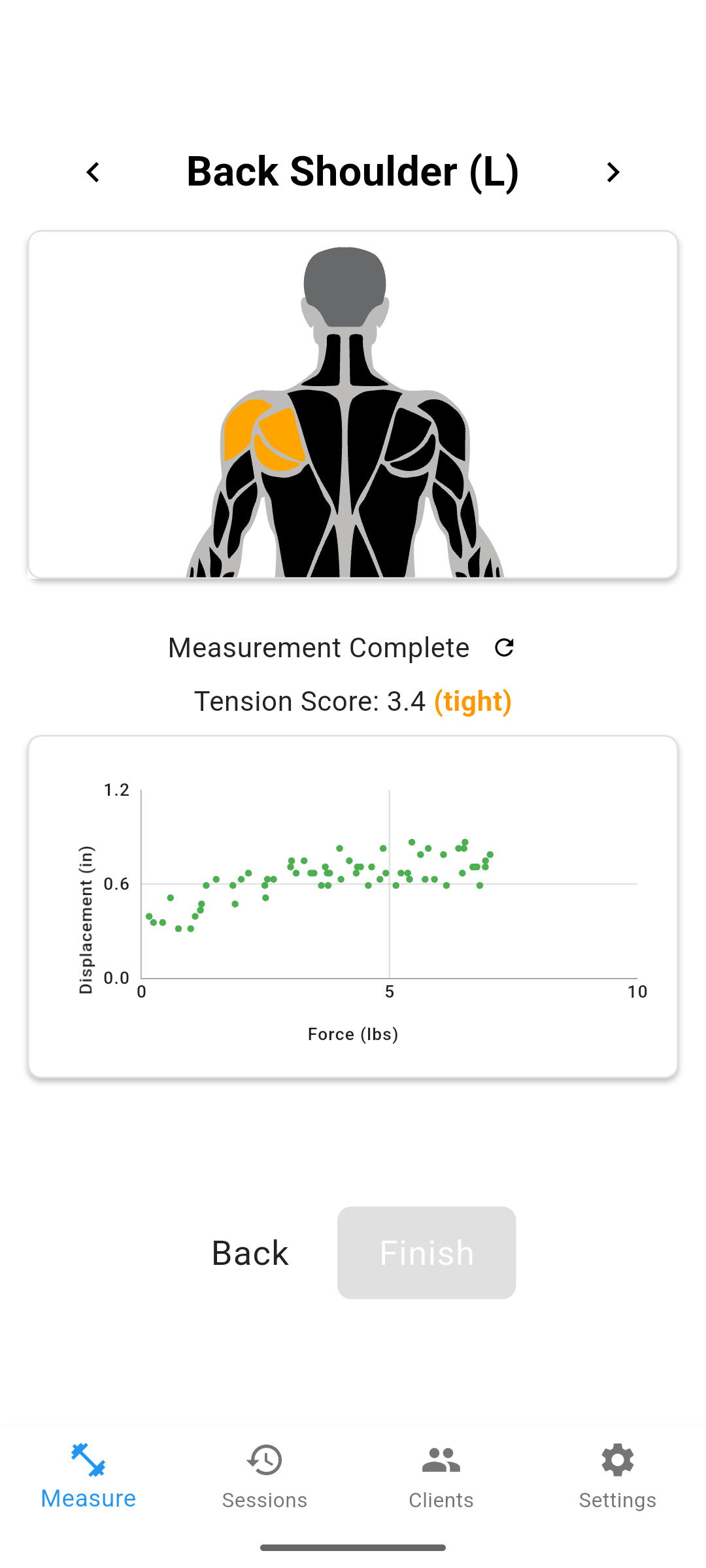
One approach is to add a second channel of objective data alongside subjective pain reports. Options include soft tissue stiffness measurement (such as MuscleMap), range-of-motion testing, and posture analysis. Each gives you something concrete to show the patient rather than asking them to take your word for it.