
Subjective improvement is what the patient feels and reports. Objective improvement is what you measure with an instrument. The two regularly diverge: 2026 research shows pain and function can improve significantly while measured tissue stiffness does not change at all. A 2024 systematic review in Medicina pooling studies across 31 muscles found myotonometry stiffness readings are highly reproducible between raters and sessions, which is what makes an objective channel trustworthy enough to put next to the patient's own report. The divergence is not limited to stiffness: a 2025 study in the Journal of Clinical Medicine examining whether patient-reported outcome measures reflect objective assessment found only moderate correlation between the two, with some subscales showing no significant relationship at all. Most early dropouts happen in the gap between the two.
What is the difference between subjective and objective improvement?
Subjective improvement depends on patient report. Pain scales, disability indexes, quality of life surveys, and the patient saying "I feel 70% better." These are validated tools and they capture something real, but the data is filtered through perception, mood, expectation, and recall.
Objective improvement is what an instrument reads. Range of motion in degrees. Grip strength in pounds. Pressure pain threshold in kg/cm². Soft tissue stiffness in N/m. The number does not change based on whether the patient slept well or whether they liked the front desk that morning.
How often do subjective and objective measures disagree?
Often enough that you should expect it. A 2026 study in Healthcare on Pilates-based training for chronic low back pain measured paraspinal muscle viscoelastic properties before and after a 4-week program. Pain and quality of life improved significantly. Myotonometric stiffness of the paraspinal muscles did not change significantly over the same window.
The reverse happens too. A 2019 individually matched study on 40 chronic neck and back pain patients found no meaningful relationship between the most painful site and the stiffest site. Pain and stiffness are different constructs that move on different timelines.
What does the divergence look like in a real chiropractic case?
| Pattern | Subjective | Objective | What it may indicate |
|---|---|---|---|
| Both improve | Pain down, function up | ROM up, stiffness down | Care is working as expected |
| Subjective only | Pain down, "feels great" | Stiffness unchanged or elevated | Symptom relief without mechanical change; recurrence risk to discuss |
| Objective only | Pain unchanged | ROM up, stiffness down | Tissue is responding; subjective lag is common and can be reassuring |
| Neither | No change | No change | Re-evaluate plan, consider referral or different intervention |
Survey data: In a 2026 survey of 455 patients who stopped chiropractic care, 58% cited perception-based reasons: 36% felt no progress, and 22% felt better and stopped. Neither group was told their stiffness was still elevated.
Why does this matter for patient retention?
When you only have a subjective channel, you only have one signal. If the patient stops feeling pain, you have no way to argue against "I'm done." If the patient stops feeling progress, you have no way to argue against "this isn't working." Both ends of the dropout curve come from running on one channel.
A second, objective channel does not override the patient's report. It sits next to it. When the two agree, the case is clear. When they disagree, you have something concrete to show and a real conversation to have.
How do you add an objective channel without slowing down the visit?
- Pick one objective measure that fits the case. ROM for joint-driven cases. Pressure algometry for tenderness-driven cases. Soft tissue stiffness for muscle-driven cases. Posture analysis for postural cases.
- Record at baseline and at each re-exam. Same points, same protocol, same patient position. Consistency is what makes the numbers comparable.
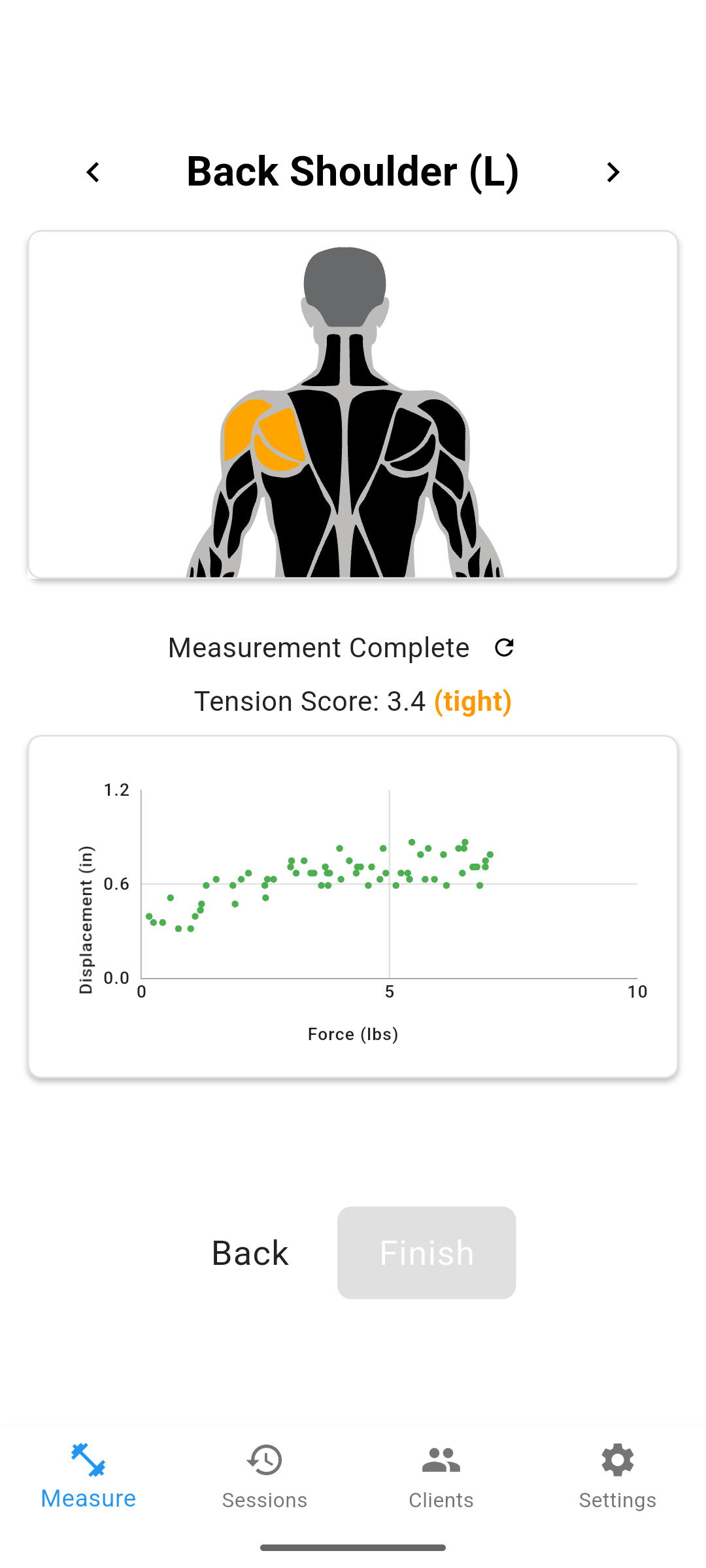
- Show the patient the number, not the chart. "Your right upper trap was 320 N/m at baseline. Today it is 280. That is real movement in the tissue itself, separate from how you feel."
- Document in the SOAP note. Objective findings support medical necessity and protect the re-exam clinically and administratively.
Frequently Asked Questions
What counts as a subjective measure in chiropractic care?
Anything that depends on patient report. Numeric pain rating, Oswestry Disability Index, Neck Disability Index, Patient Specific Functional Scale, and the patient's own statement like "I feel 70% better." These are validated and clinically useful, but they reflect perception, not tissue state.
What counts as an objective measure in chiropractic care?
Anything you measure with an instrument that does not depend on patient report. Range of motion with a goniometer or inclinometer, grip strength with a dynamometer, posture analysis, pressure pain threshold with an algometer, and soft tissue stiffness with a myotonometer. The reading does not change based on how the patient is feeling that day.
Can a patient improve subjectively without improving objectively?
Yes, and 2025-2026 evidence shows this is common. A 2026 study on Pilates-based training for chronic low back pain found that pain and quality of life improved significantly after 4 weeks, but myotonometric stiffness of the paraspinal muscles did not change significantly. Subjective and objective measures track each other loosely at best.
Can a patient improve objectively without feeling better?
Yes. Range of motion can increase, posture can correct, and stiffness can decrease while the patient still reports the same pain level. Pain has central nervous system components that do not always track tissue change in real time. This is why an objective channel matters when the subjective channel stalls.
Which type of measure should I rely on more?
Neither alone. The clinical recommendation is to combine at least one subjective measure with at least one objective measure at baseline and at every re-exam. The two together give you a fuller picture and a backup channel when one of them does not move.
Why does this distinction matter for patient retention?
Most early dropouts happen in the gap between the two. In a 2026 survey of 455 patients who stopped chiropractic care, 58% cited perception-based reasons. When a patient says "I feel better, I'm done" and you have no objective channel to show them, you have nothing to offer except a recommendation they have already declined.
How do you know the objective reading itself is trustworthy?
Use a method with documented reliability and keep the protocol identical each visit. A 2024 systematic review in Medicina pooling studies across 31 muscles found myotonometry stiffness is highly reproducible between raters and sessions. Reproducibility is what lets you say a change in the number reflects the patient, not the tool.
Is this divergence specific to stiffness measurement?
No. A 2025 study in the Journal of Clinical Medicine found that patient-reported outcome measures correlated only moderately with objective assessment, and that some subscales showed no significant relationship at all. The gap between what a patient reports and what an instrument records is a general feature of musculoskeletal care, not an artifact of one device.
One approach is to add a second channel of objective data alongside subjective pain reports. Options include soft tissue stiffness measurement (such as MuscleMap), range-of-motion testing, and posture analysis. Each gives you something concrete to show the patient rather than asking them to take your word for it.