
Three main tool categories let chiropractors objectively assess soft tissue stiffness in the office: myotonometry devices, shear wave elastography units, and tissue hardness meters. Myotonometry is the most practical for routine use: it produces stiffness readings in seconds, requires no imaging equipment, and has good-to-excellent reliability across 31 muscle groups in a 2024 systematic review of 48 studies. A 2025 reliability study in the Journal of Bodywork and Movement Therapies further confirmed reproducible shear wave elastography readings for cervical and lumbar fascia, narrowing the precision gap between in-office handheld tools and the imaging gold standard. A 2025 pilot study in the Journal of Manual and Manipulative Therapy went a step further and published preliminary sex-specific reference intervals for resting muscle stiffness and left-right asymmetry using a handheld myotonometer, which is what makes a single reading interpretable rather than just a number.
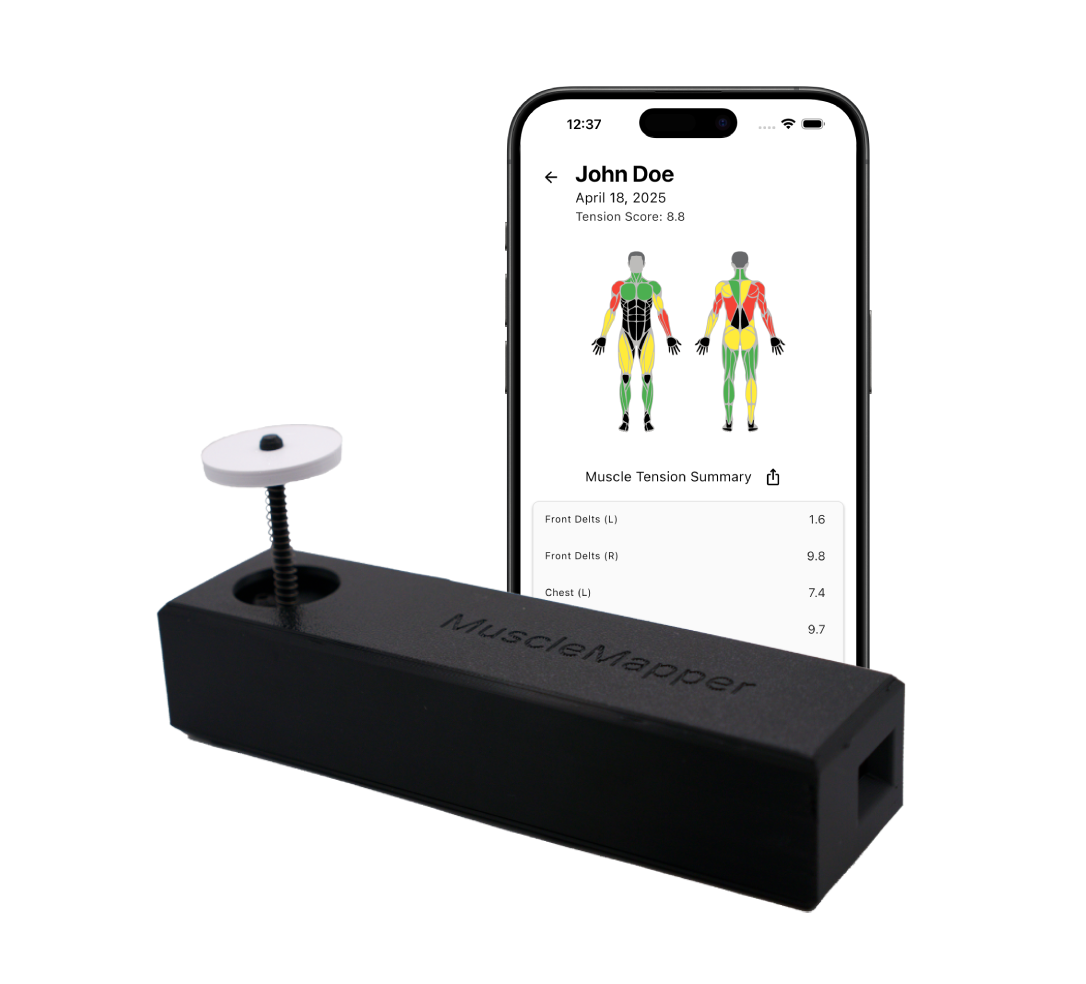
How does myotonometry work in a chiropractic setting?
A myotonometry device delivers a brief, low-force mechanical impulse to the skin surface over a target muscle. It then records the tissue's natural oscillation frequency, damping, and stiffness coefficient. Each measurement takes 5-10 seconds per site. No gel, no imaging, no specialized room setup is required.
The 2024 systematic review in Medicina covering 48 studies across 31 muscle groups found that handheld myotonometry devices show good-to-excellent intra-rater and inter-rater reliability for resting muscle stiffness, with the best results when measurement protocol, patient posture, and muscle activation state are standardized across sessions.
A 2025 pilot study in the Journal of Manual and Manipulative Therapy established preliminary reference values for resting muscle stiffness and bilateral asymmetry using handheld myotonometry in healthy young adults. Males showed significantly higher stiffness than females (approximately 44.6 N/m average), while bilateral asymmetry in healthy subjects was typically 10-14%. Asymmetries larger than 14% may be clinically relevant and worth tracking across sessions.
The main limitations of myotonometry: it measures resting passive stiffness, not contractile force. It does not diagnose specific pathology. It produces a number that can be compared to baseline, compared between sides, or compared against published reference values.
What is shear wave elastography and is it practical for chiropractors?
Shear wave elastography uses ultrasound to measure the speed at which shear waves propagate through tissue. Stiffer tissue propagates shear waves faster. It is currently the research gold standard for muscle stiffness measurement and is used in published studies to validate handheld myotonometry devices.
For most chiropractic offices, shear wave elastography is not practical for routine clinical use. The equipment requires a diagnostic ultrasound unit, imaging training, and per-muscle measurement time is longer than myotonometry. Some chiropractic offices that already have diagnostic ultrasound for other purposes may find it accessible. It is included here because it is the benchmark against which handheld tools are compared in the validation literature.
What are tissue hardness meters and pressure algometers?
Tissue hardness meters measure indentation resistance of soft tissue, typically in Shore hardness units or proprietary hardness scores. They are simpler devices than myotonometry units and generally lower in cost. Recent studies have evaluated their reliability and sensitivity to change in clinical soft tissue assessment contexts, finding good reliability for some muscle sites and moderate reliability for others depending on tissue depth and composition.
Pressure algometers measure pressure pain threshold: how much pressure is required before a point becomes painful. They capture pain sensitivity, not mechanical stiffness. They are most useful for assessing myofascial trigger point sensitivity and tracking changes in pain thresholds across sessions. Pressure pain threshold and soft tissue stiffness are related but independent measures and can change in different directions after the same intervention.
How do these tools compare for chiropractic practice?
| Tool | What it measures | Time per site | Equipment cost | Imaging required? | Reliability evidence |
|---|---|---|---|---|---|
| Myotonometry (handheld) | Stiffness, tone, elasticity | 5-10 sec | Low to moderate | No | Strong (48-study systematic review) |
| Shear wave elastography | Stiffness (shear wave speed) | 1-3 min per site | High (ultrasound unit) | Yes | Strong (research gold standard) |
| Tissue hardness meter | Tissue indentation resistance | 5-10 sec | Low | No | Moderate (site-dependent) |
| Pressure algometer | Pressure pain threshold | 30 sec per site | Low | No | Good (pain sensitivity) |
Survey data: In a 2026 survey of 455 patients who stopped chiropractic care, 58% cited perception-based reasons: 36% felt no progress, and 22% felt better and stopped. Objective tissue assessment tools give practitioners something concrete to show patients in both situations.
Which tool is right for a chiropractic practice?
The answer depends on what you are trying to track. If you want to monitor resting muscle stiffness across sessions and compare bilateral asymmetry, a handheld myotonometry device fits within a typical clinical visit. If pain sensitivity is your primary concern, a pressure algometer is simpler and lower cost. If you already have ultrasound equipment and the training to use it, shear wave elastography provides the highest-resolution stiffness data.
Most chiropractic offices benefit most from a myotonometry device combined with a disability questionnaire: together they capture tissue state and functional impact, which are the two channels most relevant to showing patients objective progress and reducing perception-based dropout.
Frequently Asked Questions
What is the difference between myotonometry and shear wave elastography?
Myotonometry uses a brief mechanical impulse on the skin surface to measure the tissue's natural oscillation, producing readings for stiffness, tone, and elasticity. Shear wave elastography uses ultrasound to measure how fast shear waves travel through tissue, with stiffer tissue propagating waves faster. Elastography is the research gold standard and requires imaging equipment; myotonometry is faster, lower cost, and requires no imaging.
Can a chiropractor use palpation instead of a stiffness measurement device?
Palpation is the most common soft tissue assessment method in chiropractic and requires no equipment. Its limitation is reproducibility: inter-rater agreement for palpatory stiffness findings is low in research settings, making it difficult to track change over time or compare findings between clinicians. Handheld devices produce numerical readings that can be repeated and compared across sessions.
How accurate is myotonometry in a clinical setting?
A 2024 systematic review in Medicina analyzed 48 studies across 31 muscle groups and found good-to-excellent intra-rater and inter-rater reliability for resting muscle stiffness. Accuracy is highest when measurement protocol, patient posture, and muscle activation state are standardized across sessions. Single-measurement reliability is generally good; average-of-three-measurements reliability is excellent.
What does a normal soft tissue stiffness reading look like?
A 2025 pilot study in the Journal of Manual and Manipulative Therapy established preliminary reference values using myotonometry in healthy young adults, with males showing approximately 44.6 N/m average resting stiffness and bilateral asymmetry typically in the 10-14% range. Larger asymmetries or values outside these ranges may be clinically relevant. Full population-specific reference values are still being developed in the literature.
How does a myotonometry device work in a clinical session?
The clinician places the device probe perpendicular to the skin surface over the target muscle. The device delivers a brief, low-force mechanical impulse and records the tissue's oscillation frequency, damping, and stiffness. Each measurement takes 5-10 seconds. Multiple muscles can be assessed in a single session to build a profile, or a single muscle can be measured before and after treatment to detect an acute tissue response.
Can these tools detect changes after a single chiropractic adjustment?
Some studies have found measurable soft tissue changes immediately after manual therapy, but single-session changes may fall within measurement error for some muscles and protocols. These tools are most useful for tracking change across multiple sessions, comparing baseline to re-examination, or identifying bilateral asymmetry as a clinical marker rather than detecting an acute tissue response after a single adjustment.
Are soft tissue stiffness assessment devices covered by insurance?
In most cases, the assessment visit is billed under an established exam or re-examination code rather than for the device itself. The device produces data that supports clinical decision-making, similar to how a goniometer produces ROM data. Check with your billing specialist for the specific CPT codes applicable in your practice and payer contracts.
How reliable is shear wave elastography for spinal soft tissue specifically?
A 2025 reliability study in the Journal of Bodywork and Movement Therapies (ScienceDirect) reported reproducible shear wave elastography readings for cervical and lumbar fascia, including preliminary differentiation between pain patients and controls. This is meaningful for chiropractic because spinal fascia and paraspinal muscle were historically the hardest tissues to assess objectively. Handheld stiffness tools remain more practical for routine in-office use, but the imaging benchmark is becoming more clinically usable.
Are there reference values for what counts as a normal stiffness reading?
Early ones exist, but they are preliminary. A 2025 pilot study using a handheld myotonometer published sex-specific reference intervals for resting muscle stiffness and reported normal bilateral asymmetry averaging roughly 10 to 14 percent. Males read stiffer than females on average, so a single universal cutoff may mislead. For now, the safest reference is the patient's own baseline tracked over time.
One approach is to add a second channel of objective data alongside subjective pain reports. Options include soft tissue stiffness measurement (such as MuscleMap), range-of-motion testing, and posture analysis. Each gives you something concrete to show the patient rather than asking them to take your word for it.