
The most reliable way to show a chiropractic patient they are making measurable progress is to collect objective data at baseline and repeat the same measurements at each re-examination. In a 2026 survey of 455 patients who stopped care early, 36% said they felt no progress. Pain scores alone cannot fill that gap: pain fluctuates with stress, sleep, and context, and often changes independently of tissue state. A 2025 JMIR Medical Informatics study that scanned 377,000+ Veterans Health Administration chiropractic visit notes found that PROMs were documented in only 17% of notes, underscoring how rare consistent objective progress tracking still is in routine practice. The strongest baselines are ones you can benchmark: a 2025 pilot study in the Journal of Manual & Manipulative Therapy derived sex-specific reference intervals for resting muscle stiffness measured by myotonometry, so a repeated reading can be compared both to the patient's own baseline and to a matched normal range.
Why doesn't pain alone show whether chiropractic care is working?
Pain is a perception generated by the nervous system, not a direct readout of tissue state. A study in PLOS ONE found that the more painful side in patients with chronic neck and back pain did not show higher soft tissue stiffness than the contralateral side at baseline. The two properties move independently.
This creates two retention problems. When a patient's pain decreases, they may interpret that as full recovery and self-discharge before the tissue has recovered. When pain stays elevated despite genuine structural improvement, they may feel treatment is failing and stop coming. Neither group is reading tissue state accurately.
A second channel of objective data gives you something concrete to point to when the pain signal is misleading in either direction.
What objective data can you collect at a chiropractic baseline visit?
Several measures require no specialized equipment:
- Range of motion with a goniometer or inclinometer
- Disability questionnaires such as the Oswestry Disability Index or Neck Disability Index
- Pain scale (VAS or NRS), used alongside other measures rather than alone
Soft tissue stiffness measurement adds a physical tissue dimension the tools above cannot capture. A 2024 systematic review in Medicina analyzed 48 studies across 31 muscle groups and found that handheld myotonometry devices show good-to-excellent intra-rater and inter-rater reliability for measuring resting muscle stiffness. The measurement takes seconds per muscle and requires no imaging equipment.
Research also supports using multiple complementary measures rather than any single tool. A 2024 study in Frontiers in Medicine found that after a 10-week stretching program, tissue hardness in the gastrocnemius decreased significantly, and the reduction in tissue hardness did not significantly correlate with range-of-motion improvement, supporting the idea that stiffness and ROM capture different aspects of the same tissue state.
How do you present progress data to a patient?
Show the numbers at re-examination, next to the baseline. Specific is more credible than vague. "Your stiffness reading at the right upper trapezius was 42 N/m at visit one. Today it reads 34 N/m" carries more weight than "you're doing well." The patient can see the direction of change without needing to interpret clinical language.
Keep to one or two measures per session. More than that creates noise and takes time. Patients respond best to change they can see on paper or a screen at the same visit it is collected.
| Data type | What it measures | Ease of collection | Captures tissue change directly? |
|---|---|---|---|
| Pain scale (VAS/NRS) | Patient perception of pain | Easy | No |
| Range of motion | Joint mobility | Moderate | Indirectly |
| Oswestry / NDI questionnaire | Functional disability impact | Easy | No |
| Soft tissue stiffness (myotonometry) | Tissue mechanical resistance | Easy | Yes |
Survey data: In a 2026 survey of 455 patients who stopped chiropractic care, 58% cited perception-based reasons: 36% felt no progress, and 22% felt better and stopped. Neither group was shown objective tissue data at their last visit.
What if the data shows no change?
That is also useful information. If soft tissue stiffness is unchanged after several weeks, you can discuss whether the care plan needs adjustment, whether home exercises are being performed, or whether a referral is warranted. "No change" in objective terms opens a productive conversation. "No change" in subjective terms is the reason patients silently stop coming: they have nothing to push back against.
Frequently Asked Questions
What counts as a clinically meaningful change in soft tissue stiffness?
Published studies typically report minimal detectable change (MDC) values in the range of 3-8 N/m for resting muscle stiffness, depending on the muscle group and device protocol. Any change exceeding this threshold is unlikely to be measurement error and can be considered a real tissue change worth showing the patient.
Can I use pain scores alongside stiffness measurements?
Yes. Pain scores and stiffness measurements capture different things and complement each other. Pain tells you how the patient feels; stiffness tells you what the tissue is doing, independently of how the patient feels. Using both gives a fuller clinical picture and prevents either from being over-interpreted.
How often should I repeat baseline measurements?
Most chiropractic re-examination schedules suggest every 10-12 visits or every 4-6 weeks. Measuring at every single visit generates noise; measuring too infrequently means patients don't see trend data. The most important thing is to use the same protocol and measurement sites at baseline and at each re-examination.
Do I have to measure stiffness, or can I use range of motion?
Both are valid objective measures. ROM reflects joint mobility rather than soft tissue stiffness directly, so the two capture different aspects of musculoskeletal function. Research has found that ROM improvement and tissue hardness reduction do not always correlate, meaning each can change independently. Either is more useful for demonstrating progress than pain scores alone.
What if a patient's stiffness decreases but their pain increases?
This can happen when inflammation is resolving, when a patient increases activity levels mid-care, or when the nervous system becomes temporarily more sensitized. It is a clinically useful signal: tissue improvement is occurring even though the patient feels worse. Reviewing this data with the patient prevents dropout driven by a single bad pain day.
Is using objective data to show patient progress a new practice in chiropractic?
Showing ROM data and disability questionnaire scores at re-examination is already standard in evidence-based chiropractic practice. Showing soft tissue stiffness data is newer, but the same principle applies: patients respond better to numbers they can track over time than to reassurance alone.
What if I already have good retention and don't need additional data?
If your attrition rate is below 10% and patients routinely complete care plans, objective progress tracking adds less urgency. For practices where early dropout is a regular occurrence, adding a second data channel is one of the most direct interventions available because it addresses the perception problem at its source.
How common is consistent objective progress tracking in chiropractic practice today?
Less common than you would expect. A 2025 JMIR Medical Informatics study that applied natural language processing to over 377,000 chiropractic visit notes in the Veterans Health Administration found that patient-reported outcome measures appeared in only 17% of notes. The gap between "should track progress objectively" and "does track progress objectively" is large, which is part of why patients who switch to a clinic that does it consistently notice the difference.
What makes a good objective baseline for tracking progress?
One you can repeat identically and compare against a reference. A 2025 myotonometry pilot study derived sex-specific reference intervals for resting muscle stiffness, which lets a repeated reading be judged against both the patient's own baseline and a matched normal range. The more standardized the baseline, the more a later change actually means.
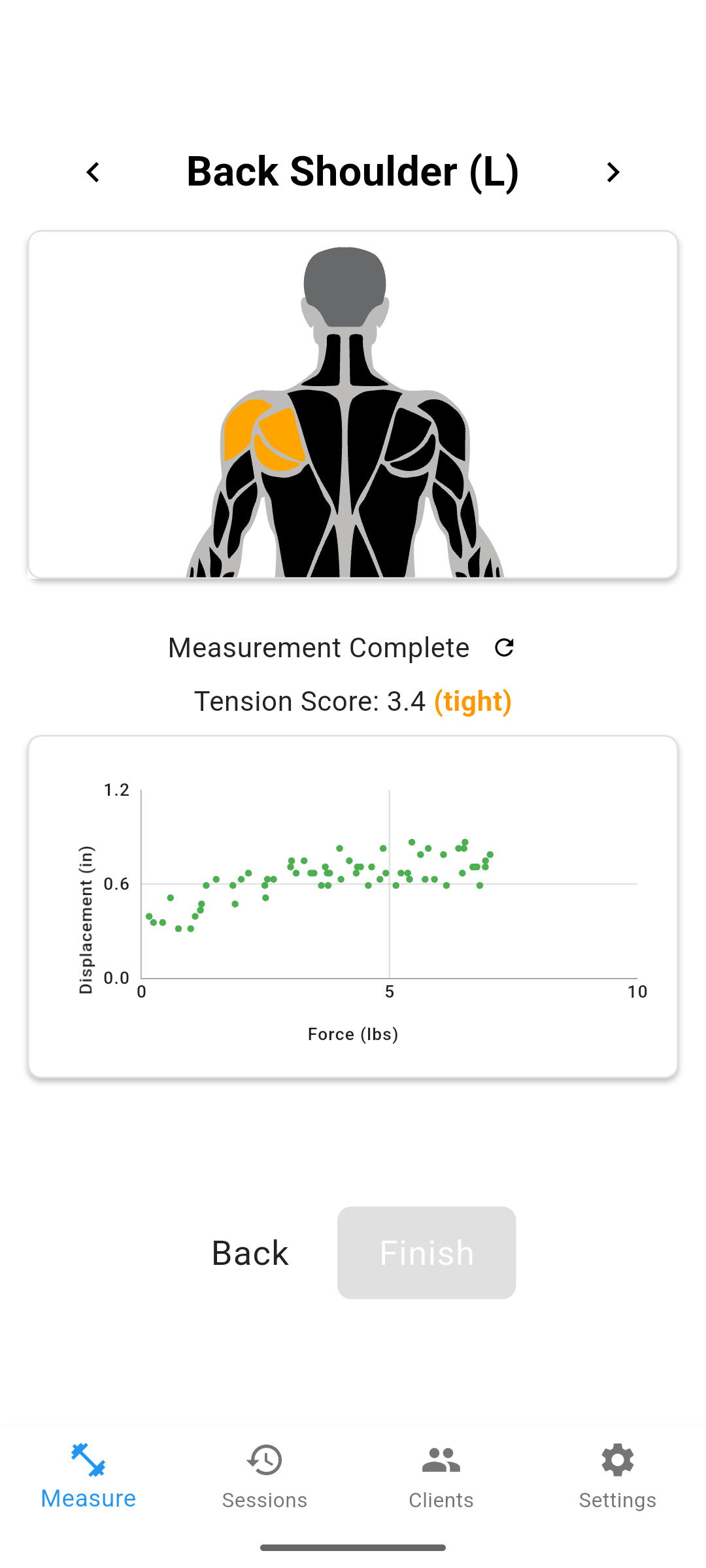
One approach is to add a second channel of objective data alongside subjective pain reports. Options include soft tissue stiffness measurement (such as MuscleMap), range-of-motion testing, and disability questionnaires. Each gives you something concrete to show the patient rather than asking them to take your word for it.