
Probably, but only if the recap carries something the patient did not already know. A recap that restates the next appointment is a reminder. A recap that shows a measured finding next to the baseline is progress feedback, and that is where the retention evidence sits. 36% of patients who quit did so because they felt no progress.
What does the research say about progress feedback?
Routinely feeding measured results back to the patient is associated with better engagement and better outcomes. The mechanism is not motivational. It is informational.
A 2024 narrative review on using progress feedback to enhance treatment outcomes describes the practice of routinely sharing standardised outcome results with both clinician and patient, and links it to earlier course correction and stronger engagement. The value comes from making a change visible while there is still time to act on it.
A 2024 comprehensive review of patient-reported outcome measures used as an intervention makes the same point from the other direction. Collecting a measure and filing it changes nothing. The effect appears when the result is returned to the patient in a form they can act on.
That is the distinction a post-visit recap either respects or ignores. Most recaps ignore it.
Which kind of recap actually moves retention?
The kind that contains a number and a comparison. Everything else is logistics.
| Recap type | What it contains | Addresses perception-based dropout? |
|---|---|---|
| Appointment reminder | Date, time, location | No |
| Thank-you message | Relationship warmth, no clinical content | No |
| Home exercise prompt | Instruction for the week | Partly |
| Progress recap | Today's measured finding next to baseline | Yes |
| Full re-exam report | Multiple measures, interpretation, plan change | Yes, but only at re-exam intervals |
The first two are worth sending for other reasons. Neither one speaks to the patient who is quietly deciding that six visits have produced nothing.
Survey data: In a 2026 survey of 455 patients who stopped chiropractic care, 58% cited perception-based reasons: 36% felt no progress, and 22% felt better and stopped. Neither group was shown that their soft tissue stiffness was still elevated.
Is there evidence from adjacent rehabilitation settings?
Yes, and it is more specific than the chiropractic literature. Physical therapy has run the experiment at scale.
A 2025 retrospective case-control study across 95 outpatient physical therapy clinics compared in-person therapy alone against in-person therapy paired with structured between-visit contact and monitoring. 72% of the paired group reached their targeted functional benchmark, against 63% of controls. Between-visit contact was a significant predictor of reaching that benchmark.
A systematic review of remote patient monitoring across care transitions reports a similar pattern: adherence and functional status show the clearest gains, while broader quality-of-life effects are less consistent. That is a reasonable expectation to carry into a chiropractic practice. Between-visit contact may improve whether the patient keeps coming. It does not by itself change what the treatment does.
What does a recap look like in practice?
Three lines. One measured finding from today, the same finding from the first visit, and one instruction.
The measurement can be range of motion, a validated questionnaire score, or a soft tissue stiffness reading at a marked site. What matters is that it is the same measure taken the same way, so the comparison means something. A finding that has improved gives the patient a reason to continue. A finding that has not improved gives you a reason to change the plan before the patient changes it for you.
Send it when a number changed. A recap that arrives every visit with nothing new in it becomes the message the patient stops opening, and then the useful one arrives in a channel they have already tuned out.
Frequently Asked Questions
Does sending patients a recap after their visit improve chiropractic retention?
It may, but the content decides the effect. Recaps that carry progress feedback have research support in rehabilitation settings, while recaps that only restate the appointment time behave like reminders and do not address the reason most patients quit.
What should a post-visit recap actually contain?
One measured finding from today, the same finding from the baseline visit, and one instruction for the week. Anything longer competes with itself for attention and is less likely to be read.
How often should you send a recap?
Send one when a measurement changed, not after every visit. A recap that arrives with nothing new in it trains the patient to stop opening them.
Is a text recap better than an email recap?
No published comparison settles the channel question in chiropractic care. Open rate favours text, while email carries a chart or a report more comfortably, so the practical answer is to match the format to what you are sending.
Does a recap count as remote therapeutic monitoring for billing?
No. Remote therapeutic monitoring has specific device, data-collection and time requirements attached to its codes. A summary email sent after a visit does not meet them on its own.
What if the recap shows the patient got worse?
Send it anyway, with the interpretation attached. A number that moved the wrong way is still evidence that you are tracking something, and withholding it makes the good readings look selective.
Will a recap keep a patient who feels completely better?
Sometimes. In a 2026 survey of 455 patients who stopped chiropractic care, 22% felt better and self-discharged. A recap showing that a measured finding has not caught up with how they feel gives that patient a reason to reconsider that a pain score cannot give them.
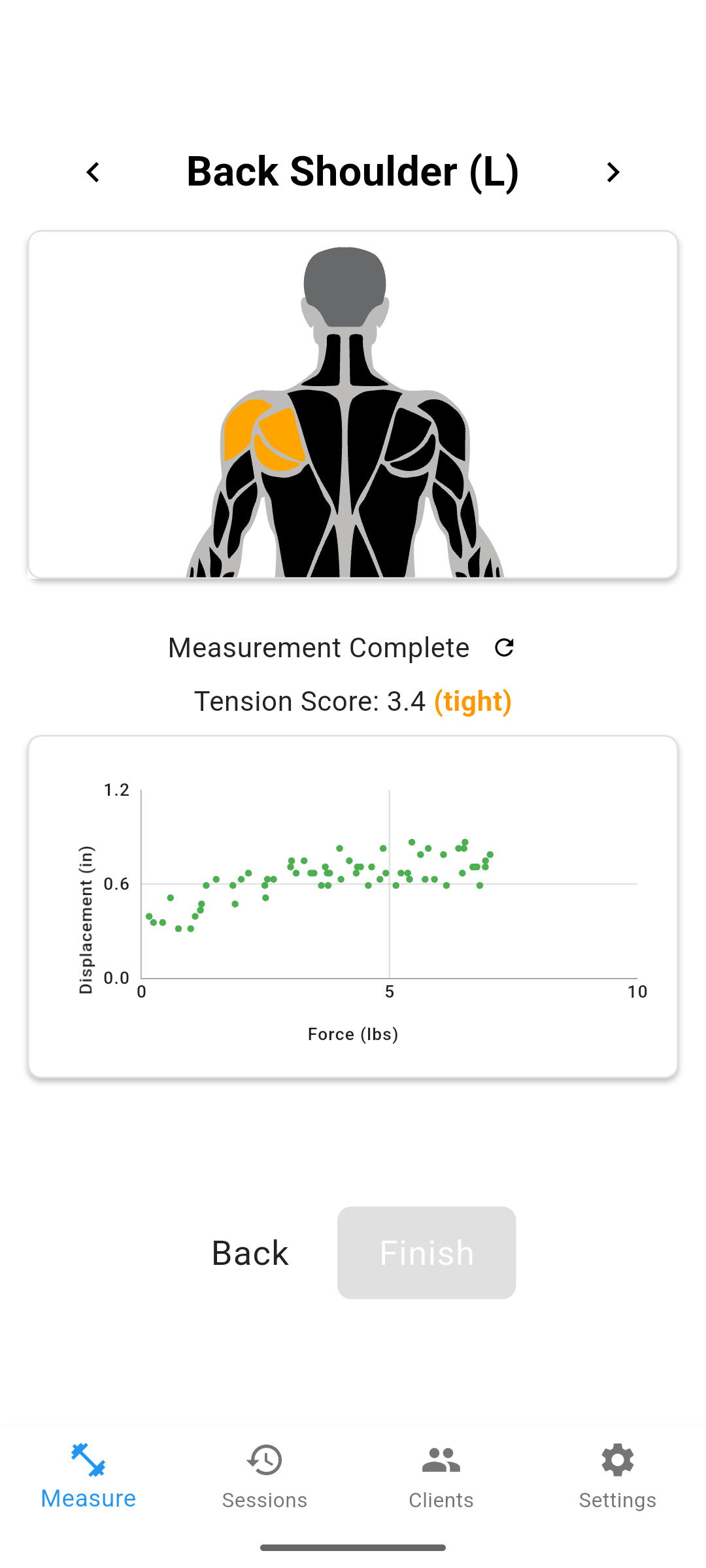
One approach is to add a second channel of objective data alongside subjective pain reports. Options include soft tissue stiffness measurement (such as MuscleMap), range-of-motion testing, and posture analysis. Each gives you something concrete to show the patient rather than asking them to take your word for it.