
The signal from rehabilitation research is yes, with caveats: patients who are regularly shown personalized, easy-to-read data about their own progress tend to adhere longer to care. In a 2026 survey of 455 patients who stopped chiropractic care, 36% said they felt no progress. The data may have existed in the chart. It just was never shown to them in a form they could see for themselves. Newer evidence points the same way: a 2025 retrospective case-control study found patients who added remote therapeutic monitoring to in-person care reached their functional benchmark more often (72% versus 63%) and attended more sessions than those with in-person care alone.
Why does showing objective data move retention?
Because perception of progress, not actual progress, is what drives the decision to return. A patient who has gained 15 degrees of cervical rotation but still feels stiff in the morning will often conclude "this isn't working." If you do not show them the 15 degrees, you are competing with their own subjective summary, which is usually pessimistic in the middle of a care plan.
A 2025 study in Scientific Reports on long-term adherence in stroke rehabilitation found that high-quality personalized feedback significantly improved long-term adherence, while frequent but low-quality feedback could have a negative effect. The principle generalizes: data the patient understands and revisits supports adherence. Data dumped without interpretation does not.
What kinds of objective data actually move the needle?
Not all data is equal for retention. The data that moves retention is data the patient can see change between visits. Imaging and dense lab values usually do not qualify because the patient cannot read them.
| Data type | Patient can see change? | Retention impact |
|---|---|---|
| Range of motion (degrees) | Yes, clearly | High |
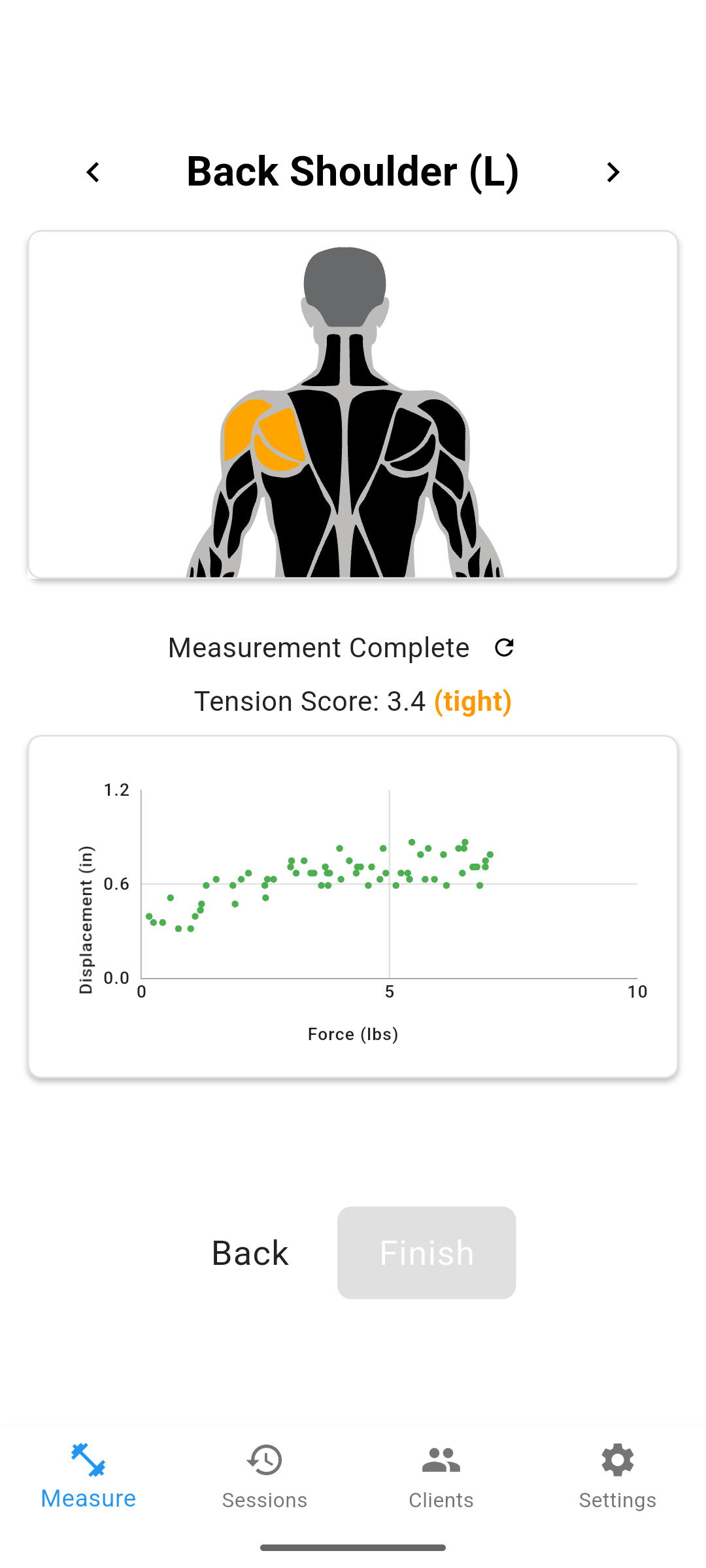
| Soft tissue stiffness reading | Yes, with a chart | High |
| Grip strength (kg) | Yes | High |
| 30-second sit-to-stand reps | Yes | High |
| Oswestry / NDI score | Yes, with explanation | Medium |
| Pain scale (NRS) | Yes, but noisy | Medium |
| X-ray / MRI findings | Hard to interpret | Low |
| SOAP-note checklist | Patient never sees it | Low |
Survey data: In a 2026 survey of 455 patients who stopped chiropractic care, 58% cited perception-based reasons: 36% felt no progress, and 22% felt better and stopped. Neither group was told their stiffness was still elevated.
How often should you show patients their data?
Re-measure at scheduled re-exams, and pull up the existing trend at every visit in between. The patient does not need a new number every visit. They need to revisit the same trend often enough that the arc of progress stays present in their mind. A patient who only sees their numbers at the 30-day re-exam will fade in between; a patient who sees the trend chart for 30 seconds at every visit will stay anchored.
This connects to a broader behavior-change finding: a 2025 JAMA randomized trial of personalized data plus behavioral nudges showed that simply sending personalized data without an in-person interpretive moment did not significantly outperform usual care. The takeaway for chiropractic: the data has to be discussed at the visit, not just generated.
What do you do when the objective data is flat or worse?
Show it anyway and use it as a decision point. A flat trend at week 4 is not a retention problem. It is a clinical signal that the plan needs to change. The honest conversation, "your stiffness has held steady so far, which tells me we should switch approaches," preserves trust because the patient sees you reading the same data they are. The version that destroys retention is staying silent on a flat trend and acting confident anyway. Patients eventually notice the gap and self-discharge.
Which patients benefit most from seeing their data?
- Maintenance patients, who lack the pain-relief feedback loop and need a different visible reason to return.
- Chronic pain patients, whose subjective pain reports often disagree with tissue state and who need a second channel of evidence.
- Patients who self-describe as "data people" (engineers, healthcare workers, athletes), who tend to disengage from care that feels narrative-only.
- Patients in visits 3-6, the highest-risk dropout window, where one objective improvement chart often tips the decision to continue.
How does this compare to other retention tactics?
| Retention tactic | Mechanism | Durability |
|---|---|---|
| Showing the patient their own objective data | Replaces perception with evidence | High, compounds over the care plan |
| Appointment reminders / rebooking flow | Reduces friction | Medium |
| Patient education materials | Builds context | Medium, decays without reinforcement |
| Pre-paid care packages | Sunk-cost commitment | Low, hides dropout but does not prevent it |
| Loyalty discounts | Price-based | Low |
Frequently Asked Questions
Do chiropractic patients who see their own objective data stay in care longer?
The signal in rehabilitation research is yes, with caveats. Personalized, high-quality feedback that the patient can see and interpret is consistently associated with better adherence. Generic data dumps or low-quality feedback can backfire. The mechanism is simple: data replaces guessing about progress with proof.
Which objective measures move retention the most?
The ones the patient can see change between visits: range of motion in degrees, soft tissue stiffness readings, grip strength, sit-to-stand reps, and short validated questionnaires like Oswestry every 30 days. Imaging and SOAP-note checklists typically do not move retention because patients cannot read the change themselves.
How often should you show objective data to a patient?
Re-measure at scheduled re-exams and pull up the trend at every visit in between. The patient does not need a new number every visit. They need a visible trend that they revisit consistently, so the visit feels connected to a longer arc of progress.
What if the objective data does not show improvement?
Show it anyway. A flat or worsening trend is a clinical decision point, not a marketing problem. The conversation becomes "this is not responding the way we hoped, let us change the plan," which preserves trust. Hiding negative data and continuing the same plan is what burns retention long-term.
Is this a substitute for patient-reported outcomes?
No. Patient-reported pain and function are still essential. Objective measures are a second channel that gives the patient something concrete to compare against their own perception, especially when pain and tissue state disagree.
Can showing objective data backfire?
Yes, in two ways. Dumping raw numbers without interpretation can confuse and disengage the patient. Frequent low-quality feedback (a printout with no context) can dilute the signal. Personalized, briefly explained data tied to the patient's own goal is what moves the needle.
Does this apply to maintenance patients too?
Especially to maintenance patients. Maintenance care has no built-in pain feedback loop, so the visit can feel routine. A visible objective trend gives the maintenance patient a reason to return that is independent of whether they are currently in pain.
Does adding digital progress tracking improve attendance?
The recent data suggests it can. A 2025 retrospective case-control study found patients who added remote therapeutic monitoring to in-person care attended more sessions and hit their functional benchmark more often (72% versus 63%) than those with in-person care alone. The tracked, visible feedback appears to be part of why engagement rose.
One approach is to add a second channel of objective data alongside subjective pain reports. Options include soft tissue stiffness measurement (such as MuscleMap), range-of-motion testing, and posture analysis. Each gives you something concrete to show the patient rather than asking them to take your word for it.