
Yes, and the most recent example is a randomized trial, not a case series. A 2025 pragmatic trial randomized 106 adults with subclinical spinal pain to 12 weeks of chiropractic adjustments or sham care and reported measurable shifts in biomarkers linked to neuroplasticity, inflammation, and stress. Pain was never the only variable moving.
What did the 2025 trial actually measure?
Blood, saliva, and hair markers, not symptom scores. Amjad and colleagues, publishing in PLOS ONE in December 2025, tracked brain-derived neurotrophic factor, cortisol, interleukin-6, tumor necrosis factor alpha, C-reactive protein, and several immune cell markers across 12 weeks with follow-up at 16 weeks.
The chiropractic group showed increased brain-derived neurotrophic factor and decreased tumor necrosis factor alpha. Interleukin-6 moved in a pattern the authors read as repair-associated rather than harmful. The honest summary is that something physiological changed and the authors were careful not to call it a cure for anything.
Does biomarker change mean the patient got better?
No, and treating it that way would be overclaiming. A biomarker is not a clinical endpoint. One trial in a subclinical population does not establish that a given patient improved because their inflammatory markers shifted.
What it does undercut is a different assumption, the one your patient walks in with. If a patient believes that a flat pain score means nothing happened, this literature suggests that belief is not well founded. That is a modest claim and it is defensible.
Where else do pain and measured change diverge?
In soft tissue, consistently. A controlled study on tissue stiffness and pain experience found that the regions patients identified as most painful were not necessarily the stiffest when measured objectively, and that reduced stiffness after treatment did not reliably predict pain relief.
A 2023 evidence map using shear wave elastography found the same picture at the field level. Some painful conditions showed higher stiffness, some showed lower, and some showed no difference. The authors attributed much of the spread to inconsistent methods and reporting.
| Signal | What it captures | Moves with pain score? |
|---|---|---|
| Patient-reported pain | Current subjective experience | By definition |
| Soft tissue stiffness | Mechanical tissue property | Not reliably |
| Range of motion | Available joint movement | Partly |
| Inflammatory and neuroplasticity markers | Systemic physiology | Not directly studied against pain in the 2025 trial |
Why does this matter for the patient in front of you?
Because a patient using pain as their only instrument will misread their own case in both directions. One patient feels no change and concludes care is not working. Another feels fine at week three and concludes care is finished. Both are reading a single noisy channel.
The research does not let you tell either patient that they are wrong about how they feel. It does let you put a second reading next to the first one, and let them compare.
Survey data: In a 2026 survey of 455 patients who stopped chiropractic care, 58% cited perception-based reasons: 36% felt no progress, and 22% felt better and stopped. Neither group was told their stiffness was still elevated.
How do you use this without overstating it?
Cite the mechanism, not the miracle. Saying that pain and measured tissue change do not track each other closely is supported. Saying that a patient's inflammatory markers improved because of Tuesday's visit is not, and a skeptical patient will hear the difference.
The practical version is smaller than the research. Measure something repeatable at baseline, measure it again at re-examination, and show the patient both numbers. At an average chiropractic visit fee near $80 per the ChiroEco 28th Annual Survey, losing five patients a month to early dropout costs roughly $105,000 a year in potential revenue. Most of those patients left over a judgment they made with one incomplete signal.
Frequently Asked Questions
Is there research showing chiropractic care changes anything besides pain?
Yes. A 2025 pragmatic randomized controlled trial in PLOS ONE randomized 106 adults with subclinical spinal pain to 12 weeks of chiropractic adjustments or sham care and reported changes in biomarkers linked to neuroplasticity, inflammation, and stress.
What biomarkers changed in the 2025 trial?
The chiropractic group showed increased brain-derived neurotrophic factor and decreased tumor necrosis factor alpha, along with shifts in interleukin-6, cortisol, and immune cell markers. The authors frame these as physiological modulation, not clinical endpoints.
Does that mean chiropractic care works even when pain does not change?
It means pain is not the only variable moving. Biomarker change is not the same as clinical benefit, and no single trial establishes that. It does undercut the assumption that a flat pain score means nothing happened.
Do stiffness measurements track pain?
Not reliably. A controlled study found that the areas patients identified as most painful were not necessarily stiffer when measured objectively. Stiffness and pain appear to move independently.
Why does the stiffness and pain literature look inconsistent?
A 2023 evidence map using shear wave elastography found some painful conditions showed higher stiffness, some showed lower, and some showed no difference. The authors attributed much of the inconsistency to varied methods and reporting standards.
How does this apply to a patient who wants to stop care?
It gives you a reason to show a second measurement instead of arguing about how they feel. If pain is the only channel you track, a patient with a flat pain score has no evidence to weigh.
Should biomarker findings be used in patient conversations?
Use them carefully and without overclaiming. Biomarker research from a single trial does not describe what happened in one patient's tissue, and presenting it that way is not defensible.
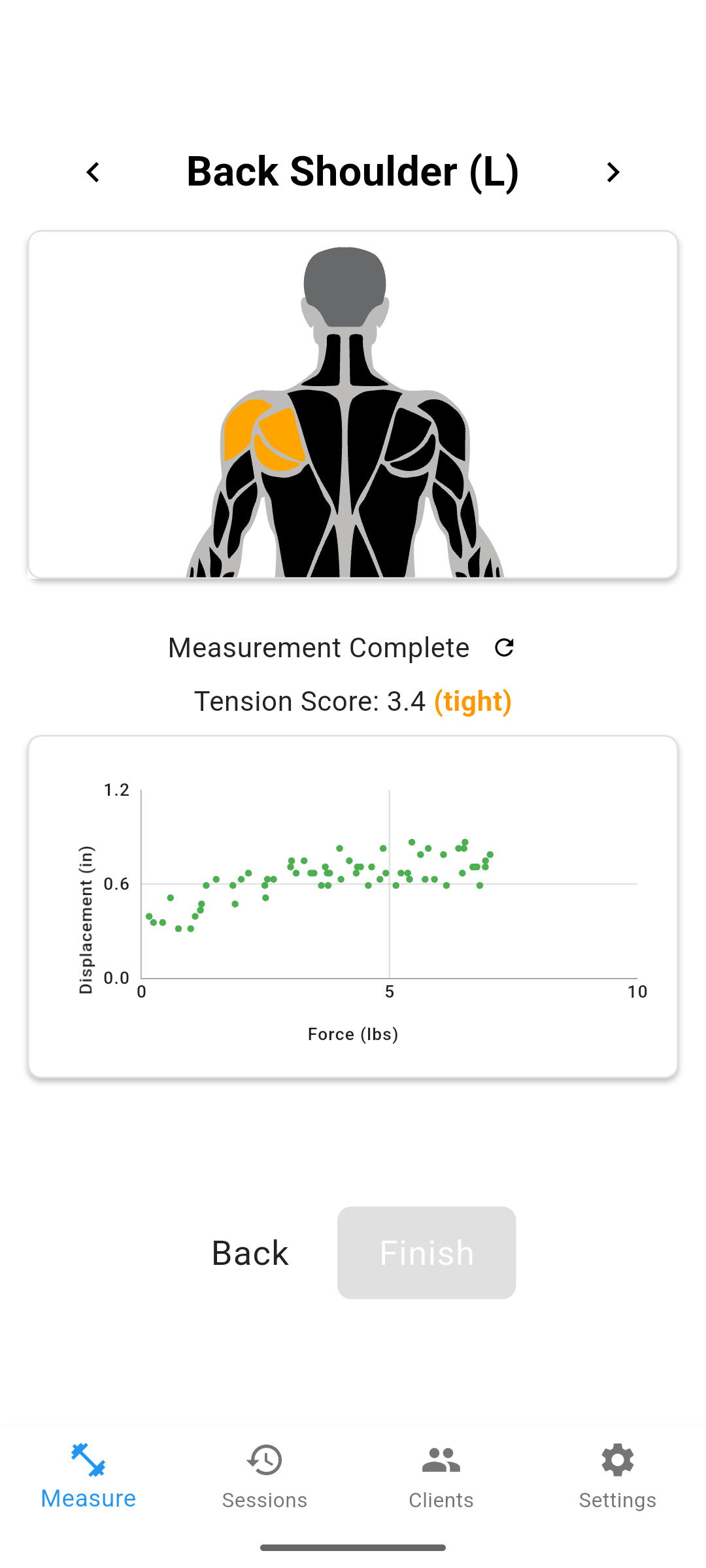
One approach is to add a second channel of objective data alongside subjective pain reports. Options include soft tissue stiffness measurement (such as MuscleMap), range-of-motion testing, and posture analysis. Each gives you something concrete to show the patient rather than asking them to take your word for it.