
Yes, and it shows up as falling completion rates rather than complaints. A 2025 analysis found that as questionnaire length rose, the share of patients who finished them fell, with roughly 50 items acting as a practical ceiling. Patients rarely say they are tired of the forms. They just stop filling them in.
What Does the Evidence Say About Questionnaire Burden?
Length is the variable that moves response rates. A 2025 analysis in the Journal of Clinical Medicine looked at how question burden related to completion in musculoskeletal patient cohorts. More items meant fewer completed responses, and the authors put the practical ceiling at around 50 items per administration to hold completion above 60%. Notably, younger adults responded at lower rates than older patients, which cuts against the assumption that a digital form solves the problem on its own.
Why Does This Matter for Retention Rather Than Just Data Quality?
Because an unanswered questionnaire leaves you with nothing to show the patient. The point of re-measuring is to have a second channel of evidence when the patient's own sense of progress stalls. If the instrument quietly stops producing data by visit six, you are back to asking the patient how they feel, at exactly the point in a course of care where that question is least useful. The burden problem and the retention problem are the same problem seen from different ends.
Survey data: In a 2026 survey of 455 patients who stopped chiropractic care, 58% cited perception-based reasons: 36% felt no progress, and 22% felt better and stopped. Neither group was told their stiffness was still elevated.
Which Measurement Types Cost the Patient the Most?
The ones that ask the patient to do the work. Burden is not evenly distributed across measurement methods. A questionnaire spends patient attention. A physical measurement spends clinician time. Mixing the two keeps your total evidence up without pushing any single channel past the point where patients disengage.
| Measurement type | Who carries the burden | Risk of drop-off with repetition |
|---|---|---|
| Long disability index (30+ items) | Patient | High. Completion falls as items rise |
| Short region-specific index | Patient | Moderate. Manageable if it is the only form |
| Single pain rating | Patient | Low. But low information on its own |
| Range-of-motion measurement | Clinician | Low. Patient effort is minimal |
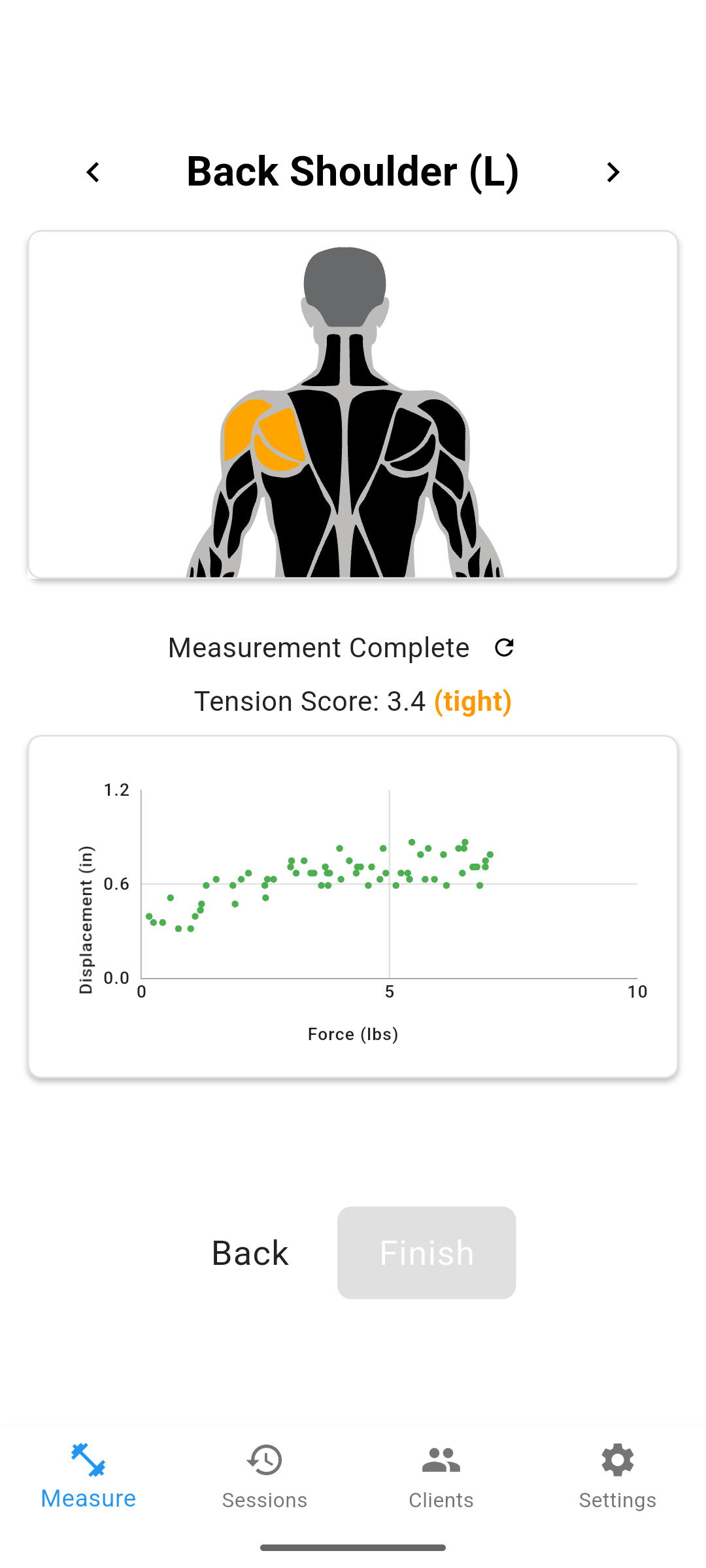
| Soft tissue stiffness reading | Clinician | Low. Passive for the patient |
What Actually Reduces the Fatigue?
Showing the patient the output of the last one. A form that vanishes into a chart teaches the patient that answering it accomplishes nothing, and a rational person deprioritises it. When the re-exam ends with a side-by-side against their baseline, the next round of questions has an obvious reason to exist. The Keele Musculoskeletal Patient-Reported Outcome Measure was developed with patients and clinicians specifically to cover the domains that matter in musculoskeletal care without redundant items, and it held up on reliability and responsiveness. Brevity and relevance are both doing work there.
What Is the Cost of Letting Measurement Lapse?
Roughly $105,000 a year in potential revenue for five lost patients a month. That figure uses the approximately $80 average visit fee from the 2024 ChiroEco annual survey. The limitation is worth stating plainly: measurement does not retain anyone by itself, and a patient who genuinely no longer needs care is not a loss. What measurement does is give the patient something other than their own week-to-week impression to decide on.
Frequently Asked Questions
Do patients get tired of filling out the same forms every few visits?
Yes, and it shows up in the data as falling response rates. A 2025 analysis in the Journal of Clinical Medicine found that as the number of questionnaire items rose, the share of patients who completed them fell, with roughly 50 items acting as a practical ceiling for keeping completion above 60%.
How many outcome measures should a patient complete at a re-exam?
Enough to cover the complaint and no more. In practice that is usually one region-specific index plus a pain rating. Adding a second overlapping questionnaire mostly adds items without adding information you will act on.
Does survey fatigue affect younger or older patients more?
The 2025 Journal of Clinical Medicine analysis found younger adults had lower response rates than older patients. That runs against the common assumption that digital forms solve the problem for younger patients. Length appears to matter more than format.
Is a physical measurement less burdensome than a questionnaire?
Usually, because the burden shifts from the patient to the clinician. A range-of-motion check or a soft tissue stiffness reading takes staff time but asks the patient for almost nothing. That is a reason to mix measurement types rather than stacking more forms.
How do you keep re-testing from feeling pointless to the patient?
Show them the result. A questionnaire that disappears into a chart teaches the patient that answering it changes nothing. Comparing this visit against their baseline in front of them gives the next round of questions an obvious purpose.
Should you drop outcome measures if patients resist them?
No. Dropping measurement removes the only evidence of progress that is independent of how the patient feels that day. The better response is to shorten what you collect and make the results visible, rather than collecting nothing.
Are shorter musculoskeletal questionnaires as useful as long ones?
They can be when built for it. The Keele Musculoskeletal Patient-Reported Outcome Measure was developed with patients and clinicians to cover the domains that matter in musculoskeletal care while staying brief, and it demonstrated acceptable reliability and responsiveness.
One approach is to add a second channel of objective data alongside subjective pain reports. Options include soft tissue stiffness measurement (such as MuscleMap), range-of-motion testing, and posture analysis. Each gives you something concrete to show the patient rather than asking them to take your word for it.