
They measure different things and both have a clinical role. Pressure algometry quantifies pain threshold (how sensitive a point is to applied pressure). Myotonometry quantifies tissue stiffness (how mechanically resistant the muscle is). Recent reliability evidence supports both: a 2025 test-retest study reported good to excellent reliability for digital pressure pain threshold measurement (ICC 0.76 to 0.91), mirroring the strong reliability myotonometry shows for stiffness. The right choice depends on whether your case turns on sensitivity or on tissue mechanics. A 2025 review in Frontiers in Pain Research reported that patients with myofascial pain syndrome often show stiffer, less elastic fascia, which is a case where both readings may change together.
What does each tool actually measure?
This is where most practitioners get confused.
- Pressure algometry presses a probe into a defined point at a controlled rate. The patient signals when the pressure becomes painful. The reading (pressure pain threshold, or PPT) is reported in kg/cm² or newtons. It is a perception-based measure of how the nervous system interprets local pressure.
- Myotonometry applies a brief mechanical tap to a relaxed muscle and reads the tissue's mechanical response. Output includes stiffness in N/m, oscillation decrement (damping), and relaxation time. It is a mechanical measure of the muscle itself, independent of patient report.
When does each tool answer the clinical question?
| Clinical question | Better tool | Why |
|---|---|---|
| Has this tender point become less sensitive? | Algometry | PPT directly measures the construct of tenderness |
| Has the muscle itself become less stiff? | Myotonometry | Stiffness in N/m is a direct mechanical reading |
| Left vs right asymmetry in a muscle group | Myotonometry | Reliable side-to-side comparison without pain confound |
| Mapping fibromyalgia tender point pattern | Algometry | Standard FM literature uses PPT |
| Tracking soft-tissue response to spinal manipulation | Myotonometry | Captures mechanical change even when patient reports no symptom change |
| Pre/post a trigger-point intervention | Either, often both | Algometry catches sensitivity change; myotonometry catches local mechanical change |
What does the 2024-2025 reliability evidence say?
Both are reliable with standard protocols. A 2025 study in Muscles on intra-rater reliability of digital pressure pain threshold reported good-to-excellent ICCs across upper trapezius, lumbar spine, extensor carpi ulnaris, and tibialis anterior, with reliability highest among experienced raters. A 2024 systematic review of MyotonPRO across 48 studies reported ICC values above 0.75 in most measurements, and a 2025 reliability study on the masseter showed moderate-to-excellent inter- and intra-rater reliability for myotonometry.
The takeaway: reliability is not the deciding factor anymore. Both tools clear the bar. The deciding factor is which construct your case actually depends on.
Are stiffness and tenderness the same thing?
No. A 2019 individually matched study on chronic neck and back pain found no meaningful relationship between the most painful site and the stiffest site across 40 patients. A 2025 study in the Journal of Bodywork and Movement Therapies on DOMS found stiffness in gastrocnemii remained elevated even as soreness reports dropped. These two variables track each other loosely at best. That is exactly why pairing the two measures gives you more clinical information than either alone, and why "the muscle feels tense" cannot replace either.
Survey data: In a 2026 survey of 455 patients who stopped chiropractic care, 58% cited perception-based reasons: 36% felt no progress, and 22% felt better and stopped. Neither group was told their stiffness was still elevated.
How do you fit either tool into a chiropractic re-exam?
Three practical patterns:
- Single-tool re-exam. Pick one (algometry or myotonometry), measure 2 to 4 points at baseline, re-measure the same points at each re-exam. Report change in absolute and percent terms.
- Two-channel re-exam. Use both. Algometry on the most tender point, myotonometry on the suspected involved muscle. This captures sensitivity and mechanical change separately, which is useful when the two diverge (a common pattern).
- Triaged use. Default to range of motion and patient-reported function for routine re-exams. Add algometry or myotonometry on cases where pain is the headline complaint (algometry) or where soft-tissue stiffness drives the case (myotonometry).
Frequently Asked Questions
What does pressure algometry actually measure?
Pressure algometry measures the pressure pain threshold (PPT): the minimum pressure applied to a tissue point that the patient reports as painful, usually in kg/cm² or newtons. It is a measure of tissue sensitivity, not tissue mechanics. Lower values mean the area is more sensitive to pressure.
What does myotonometry actually measure?
Myotonometry applies a brief mechanical impulse to a relaxed muscle and measures how the tissue responds. The device reports stiffness in N/m, decrement (a damping measure), and relaxation time. It quantifies mechanical properties of the muscle, not the patient's perception.
Can a patient have high stiffness without high tenderness?
Yes, and the inverse is also true. A 2019 study on chronic neck and back pain found no meaningful relationship between the most painful site and the stiffest site across 40 patients. Stiffness and pain sensitivity are independent variables, which is exactly why combining the two measures gives you more clinical information than either alone.
Which is more reliable in clinical use?
Both are reliable when used with standard protocols. A 2025 Muscles journal study on digital algometers reported good-to-excellent intra-rater ICC values. A 2024 systematic review of MyotonPRO across 48 studies reported ICC values above 0.75 in most measurements. Reliability is similar; the deciding factor is which construct your case actually needs.
Are these tools accepted by insurance for chiropractic re-exam documentation?
Insurance acceptance varies by carrier and region. Both can be documented as objective findings in a SOAP note. Neither has a dedicated reimbursement code in most chiropractic schedules. The clinical value is showing the patient measurable change; the reimbursement value is supporting medical necessity in re-exam notes.
How much do these tools cost?
Digital pressure algometers typically run from a few hundred to roughly two thousand dollars. Myotonometers vary more widely: research-grade devices like the MyotonPRO cost several thousand, while newer chairside myotonometric devices come in at lower price points. Both have meaningful ongoing utility per visit when used consistently.
How reliable is pressure algometry?
Reliable when the protocol is standardized. A 2025 test-retest study of digital pressure pain threshold measurement reported good to excellent intra- and inter-session reliability, with ICC values from 0.76 to 0.91. As with myotonometry, consistent probe placement and rate of pressure are what keep the readings comparable across visits.
Do stiffness and pain threshold ever change together?
In some conditions they may. A 2025 review in Frontiers in Pain Research reported that patients with myofascial pain syndrome often show stiffer, less elastic fascia alongside their symptoms. That is an association in a specific population, not a general rule, so keep tracking the two readings separately.
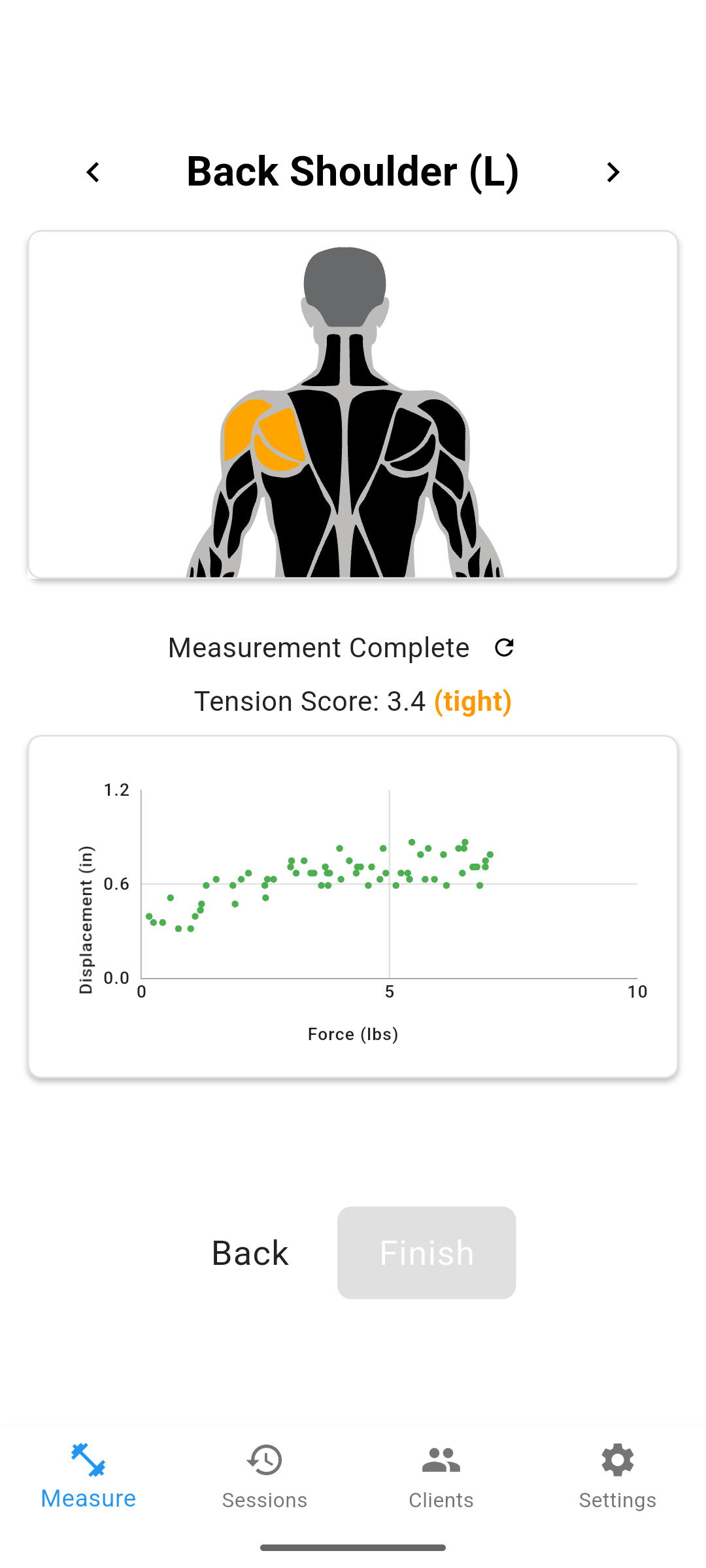
One approach is to add a second channel of objective data alongside subjective pain reports. Options include soft tissue stiffness measurement (such as MuscleMap), range-of-motion testing, and posture analysis. Each gives you something concrete to show the patient rather than asking them to take your word for it.