
Posture meaningfully changes muscle stiffness readings. A 2026 study on the lumbar erector spinae in healthy young adults reported that posture, spinal level, gender, and muscle activation state all significantly affect myotonometry readings. A 2025 study in PubMed on forward head posture and upper trapezius stiffness using shear wave elastography reported a measurable association between craniovertebral angle and trapezius elastic modulus, with greater forward head posture linked to higher trapezius stiffness. Two readings at the same probe site can differ by a clinically meaningful amount if posture is not held constant. The effect is not limited to the trunk. A 2025 study on the biceps brachii and brachioradialis reported that forearm rotation and elbow flexion angle each changed measured stiffness during isometric contraction, so limb angle matters as much as trunk posture. The practical implication is simple: standardize posture, then track change within the patient. A 2026 shear wave elastography study in Frontiers in Bioengineering and Biotechnology reinforced the point, reporting that body position and contraction state both significantly changed measured stiffness in the rectus femoris, with the largest shifts seen in sitting.
Why does posture change the reading?
A muscle at rest is mechanically different from the same muscle under stretch or active contraction. Joint angle determines whether the muscle is shortened, lengthened, or near its resting length. Body position determines how much gravity is loading the muscle. Both feed into the stiffness reading.
A standing erector spinae is actively maintaining trunk posture against gravity. A prone erector spinae, with the patient fully relaxed, is closer to passive baseline. The stiffness reading reflects what the muscle is mechanically doing in that moment, not a fixed property of the tissue.
What does the evidence say about posture and stiffness?
A 2026 study on the lumbar erector spinae using myotonometry in healthy young adults reported that posture, spinal level, gender, and muscle activation state all significantly influenced biomechanical readings of stiffness, tone, and damping. The authors recommended that protocols be posture- and gender-specific.
A 2025 pilot study establishing reference values for muscle stiffness using MyotonPRO reported that males had significantly higher stiffness than females across multiple muscle groups, with a male-female coefficient near 44.6 N/m. Age, BMI, and weekly exercise were not significant predictors in that sample.
A 2024 systematic review of 48 MyotonPRO studies reported intraclass correlation coefficients above 0.75 across most muscle groups when protocol was standardized. The reliability number assumes the protocol, including posture, is held constant.
What changes a stiffness reading the most?
The largest sources of within-patient variability in stiffness readings, ranked roughly by impact:
| Variable | Direction of effect | How to control it |
|---|---|---|
| Muscle activation state | Active muscle reads stiffer than relaxed | Cue full relaxation; allow 30 seconds settle time |
| Joint angle | Stretched muscle reads stiffer than shortened | Fix joint angle with positioning props |
| Body position | Loaded position reads higher than unloaded | Use the same posture every visit |
| Probe site | Stiffness varies across millimeters | Mark site; reference photos for re-exams |
| Time of day | Possible diurnal variation | Schedule re-exams at a similar time |
| Recent activity | Recent exercise raises readings | Standardize a rest window before measuring |
| Probe pressure or angle | Off-axis pressure distorts impulse | Hold device perpendicular; use light contact |
Survey data: In a 2026 survey of 455 patients who stopped chiropractic care, 58% cited perception-based reasons: 36% felt no progress, and 22% felt better and stopped. The clinical value of objective measurement is only realized when readings are reproducible enough to track change.
What is a defensible measurement protocol?
A defensible protocol does three things. First, it fixes posture per muscle group. Second, it fixes probe site, often with a skin pencil mark and a reference photo on the first visit. Third, it gives the patient a consistent relaxation cue so muscle activation state is similar across visits.
Most published paraspinal protocols use the patient prone, arms at the sides, head in neutral, fully relaxed, sometimes with a small pillow under the abdomen to reduce lumbar lordosis. Limb muscles are usually measured at a documented joint angle, supported on a bolster.
The specific posture matters less than holding it constant. A protocol that compares a prone measurement at baseline to a sitting measurement at re-exam has lost the comparison entirely.
What does this mean for clinical interpretation?
The implication is that population reference values are useful for orientation but not for clinical decisions in individual patients. Within-patient change, measured under the same conditions across visits, is the clinically meaningful number. A patient whose left lumbar erector spinae drops from 320 N/m to 280 N/m across six visits, with posture and protocol held constant, has shown a measurable change. The same patient compared to a male population mean does not give you the same clinical signal.
Frequently Asked Questions
Does posture really change a muscle stiffness reading?
Yes, meaningfully. A 2026 study on the lumbar erector spinae in healthy young adults reported that posture, spinal level, gender, and muscle activation state all significantly affect myotonometry readings of stiffness, tone, and damping. Two readings at the same anatomical site can differ by a clinically relevant amount if posture is not held constant.
What posture should I use to measure paraspinal stiffness?
Most published protocols measure paraspinal stiffness with the patient prone, arms at the sides, head in neutral, and the patient instructed to relax fully. Some protocols use a small pillow under the abdomen to flatten lumbar lordosis. The specific posture matters less than holding it constant across visits.
Does muscle activation change the reading?
Yes. An actively contracted muscle reads stiffer than the same muscle at rest. A patient who is bracing in anticipation of the probe gives a higher stiffness reading than the same patient fully relaxed. Standardizing position and giving a clear instruction to relax matter as much as the device itself.
Why do men show higher stiffness than women in reference data?
Sex-based differences in muscle composition, cross-sectional area, and resting tone appear to drive a real difference. A 2025 pilot reference-values study found males had significantly higher stiffness than females across multiple muscle groups. This means normative values should be sex-specific, and within-patient change over time is more clinically useful than comparison to a population mean.
Can I compare a patient lying down to a patient sitting up?
No. Postural change alone shifts stiffness readings, so prone, supine, sitting, and standing measurements are not directly interchangeable. If you change posture between visits, you have lost the within-patient comparison and the chart entry is no longer trackable change.
What is the simplest way to standardize protocol?
Pick one posture per muscle group, document it once on a card or in the EHR template, and use it every time. Mark probe sites with a skin pencil during the first measurement and reference photographs at re-exams. Brief the patient on relaxation each time. Consistency at the protocol level beats device precision in real-world clinical use.
Does forward head posture affect upper trapezius stiffness readings?
Yes. A 2025 study using shear wave elastography reported a measurable association between craniovertebral angle and upper trapezius elastic modulus: greater forward head posture corresponded to higher trapezius stiffness. Subjective stiffness complaints did not always match the objective readings, which is another argument for measuring rather than guessing.
Does sitting versus other positions change stiffness readings?
Yes. A 2026 shear wave elastography study found that body position and muscle contraction state both significantly affected measured stiffness, with the most pronounced changes in the sitting position. This is why the same patient should be measured in the same position every visit.
Does limb position matter as much as trunk posture?
Yes, at least in the upper limb. A 2025 study found that forearm rotation and elbow flexion angle each changed measured biceps brachii and brachioradialis stiffness. Record the joint angle you used and reproduce it at every re-examination.
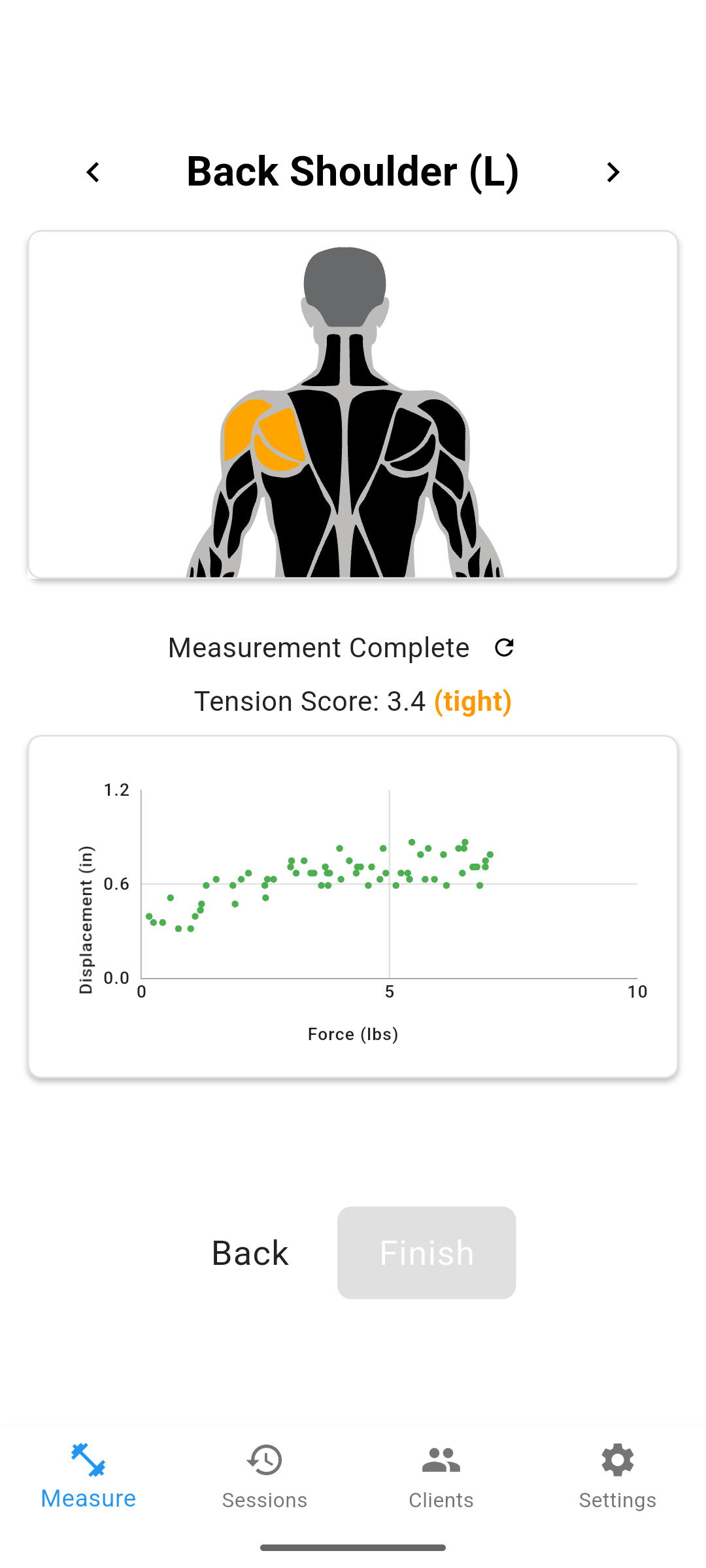
One approach is to add a second channel of objective data alongside subjective pain reports. Options include soft tissue stiffness measurement (such as MuscleMap), range-of-motion testing, and posture analysis. Each gives you something concrete to track over time, provided the protocol stays the same across visits.