
Because felt stiffness is built in the brain, not read directly off the tissue. A patient can feel tight while an objective reading comes back normal. A 2017 study in Scientific Reports described back stiffness as a protective perceptual inference: in that work, people with chronic back pain felt stiffer, yet their objectively measured spinal stiffness was not reliably different from pain-free controls. The sensation is real. It just does not always match the mechanics. A 2025 study in Healthcare pushes this further, finding that a person's attitude toward pain modulated the perceived effect of foam rolling even where tissue properties were measured directly.
Where does the feeling of stiffness come from?
The nervous system assembles it. A 2025 study in Imaging Neuroscience mapped the neural substrates of stiffness perception and found it integrates somatosensory, motor, and visual feedback. The feeling is a construct built from several inputs, not a gauge wired straight to the muscle. When those inputs signal threat or vulnerability, the brain can raise the sense of stiffness as a protective response, even with normal tissue underneath.
That is why a normal reading does not mean the patient is imagining things. Their felt stiffness is genuine. The reading simply tells you the driver is more likely perceptual than mechanical, which is useful information rather than a contradiction.
What does a normal reading actually rule in or out?
A normal stiffness reading tells you the tissue mechanics at that site are within a typical range. It does not tell you the patient feels fine, and it does not tell you nothing is wrong. It narrows the field.
| Patient feels | Stiffness reading | What it may suggest |
|---|---|---|
| Stiff | Elevated | Felt stiffness and tissue mechanics may be aligned |
| Stiff | Normal | May suggest a perception-led driver rather than tissue |
| Fine | Elevated | Tissue may still be changing while symptoms have settled |
| Fine | Normal | Felt state and measured state both unremarkable |
Can the gap run the other way?
Yes, and it commonly does. A 2025 study in the Journal of Bodywork and Movement Therapies found that stiffness readings stayed elevated even as subjects reported less soreness after exercise-induced muscle damage. Felt state improved while the tissue was still mechanically changed. Perception and measurement can disagree in either direction, which is exactly why relying on only one of them can mislead you.
Survey data: In a 2026 survey of 455 patients who stopped chiropractic care, 58% cited perception-based reasons: 36% felt no progress, and 22% felt better and stopped. Perception drives decisions, so a second objective channel gives you something to compare it against.
How should you handle it in the room?
Validate the sensation before you explain it. Telling a patient their reading is normal can sound like a dismissal if it comes first. A better order is to acknowledge that the stiffness they feel is real, then explain that the feeling is produced by the nervous system and does not always track the tissue. Because perceived stiffness is shaped by expectation and perceived threat, reassurance and graded movement can shift it. Showing the patient the normal reading itself can become part of that reassurance rather than a point of friction.
Frequently Asked Questions
Why does a patient feel stiff when the measurement is normal?
Felt stiffness is a perception the brain builds from many signals, not a direct readout of tissue mechanics. A 2017 study in Scientific Reports described back stiffness as a protective perceptual inference, meaning a patient can feel stiff even when the tissue measures normal.
Does a normal stiffness reading mean nothing is wrong?
No. A normal reading means the tissue mechanics at that site are within a typical range, not that the patient is fine. Their felt stiffness is real and worth addressing, but it may be driven by perception rather than tissue, which points care in a different direction.
Is the patient imagining the stiffness?
No. The sensation is genuine. Research on stiffness perception shows the brain integrates somatosensory, motor, and visual feedback to produce the feeling, so it can be very real to the patient while the tissue reading stays normal.
Can perceived stiffness be changed?
Often, yes. Because felt stiffness is influenced by expectation and perceived threat, reassurance, graded movement, and showing the patient an objective reading can shift the sensation even when the tissue was already within a normal range.
Why measure stiffness if perception and tissue can disagree?
Because the disagreement itself is useful. A normal reading against a strong felt-stiffness complaint suggests a perception-led driver, while an elevated reading points toward the tissue. One value helps you separate the two.
Can the reverse happen, where tissue is stiff but the patient feels fine?
Yes. A 2025 study in the Journal of Bodywork and Movement Therapies found stiffness readings stayed elevated even as subjects reported less soreness after muscle damage. Felt state and measured state can diverge in either direction.
How do you explain a normal reading to a patient who feels stiff?
Validate the sensation first, then explain that the feeling of stiffness is produced by the nervous system and does not always match tissue mechanics. Framing a normal reading as reassuring news, rather than a dismissal, tends to land better.
Do a patient's beliefs about pain change what they feel?
They appear to. A 2025 study in Healthcare found that attitude toward pain modulated the perceived effect of foam rolling, even in participants whose tissue properties were measured directly. Expectation sits between the tissue and the reported sensation.
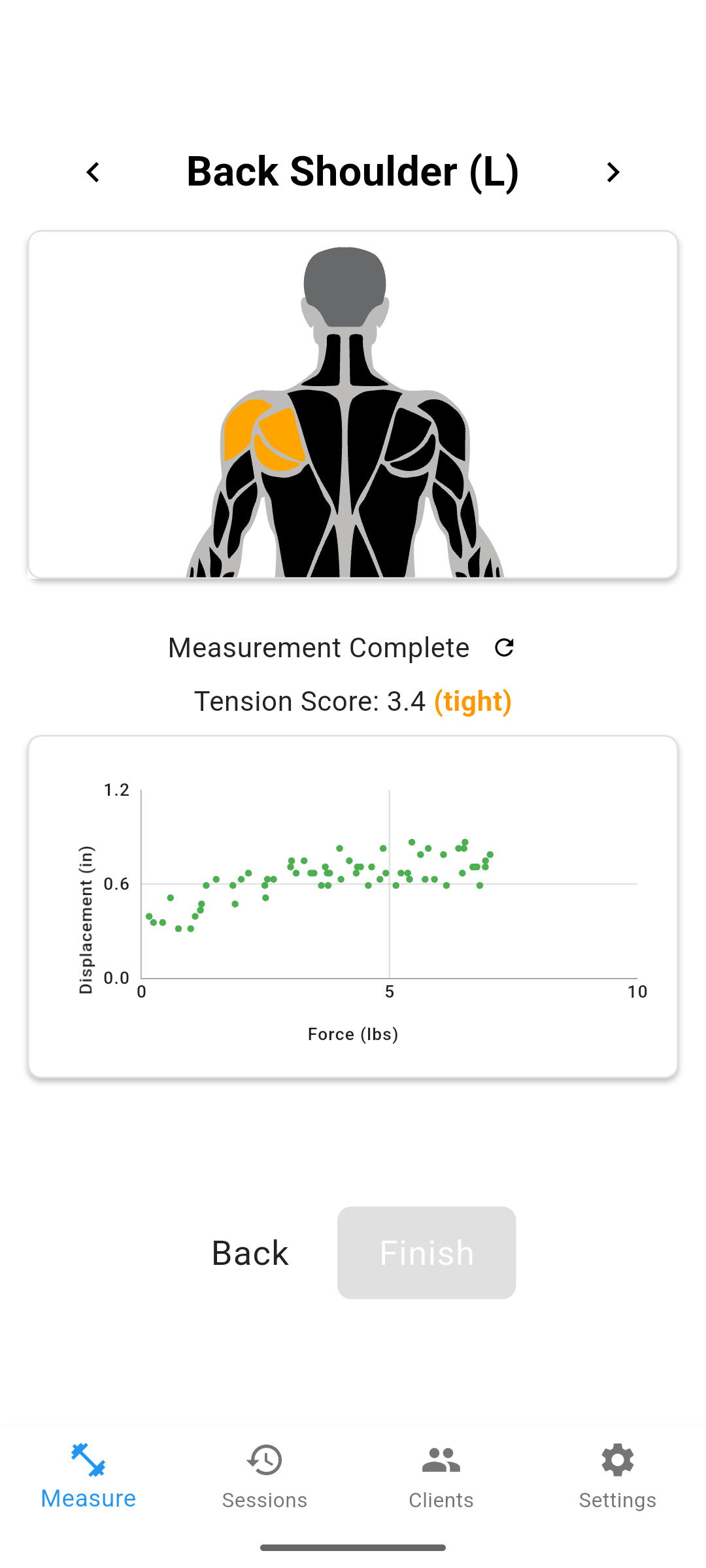
One approach is to add a second channel of objective data alongside subjective pain reports. Options include soft tissue stiffness measurement (such as MuscleMap), range-of-motion testing, and posture analysis. Each gives you something concrete to show the patient rather than asking them to take your word for it.