
Palpation is manual. Myotonometry is instrumented. Neither gives you a body-composition-independent number. A 2025 study in the Scandinavian Journal of Medicine and Science in Sports found that thicker subcutaneous adipose tissue lowers handheld stiffness readings, which is why instrumented values are best read as change within one patient rather than as an absolute property. Palpation gives you a tactile read of tissue texture, tenderness, and trigger points within the flow of an exam, but two clinicians often disagree on which side is stiffer. A 2025 clinical commentary in the Journal of Parker University summarized the inter-rater reliability of motion palpation as poor (Kappa typically at or below 0.40), even between trained examiners. Myotonometry produces a stiffness number that two clinicians can compare directly, and a 2024 review of 48 MyotonPRO studies reported intraclass correlation coefficients above 0.75 in most muscle groups. A 2026 systematic review and meta-analysis on dry needling and muscle mechanical properties found that myotonometry and shear-wave elastography produced similar patterns of measurable short-term change after intervention on myofascial trigger points (SMD -0.37, 95% CI -0.64 to -0.11), giving instrumented measurement a track record where palpation has only impressions.
What does each method actually measure?
Palpation is the clinician using their hands to assess tissue resistance, texture, temperature, swelling, tenderness, and the patient's reaction to pressure. It is integrated, qualitative, and dependent on the experience of the hand doing the work.
Myotonometry is a handheld device that delivers a brief mechanical impulse to the tissue surface and records the response. The instrument computes properties like stiffness (resistance to deformation), tone (resting muscle tension), and elasticity. The output is a number rather than a clinical impression.
How do they compare on reliability?
Reliability in measurement is reported as an intraclass correlation coefficient (ICC). Values above 0.75 are considered good and above 0.90 excellent.
A 2024 systematic review in Medicina aggregated 48 studies on the MyotonPRO across 31 muscle groups. It reported ICC values above 0.75 in most measurements. A 2024 study in adults with low back pain reported ICC values at or above 0.94 for the lumbar multifidus. A separate 2024 reliability study on lower lumbar myofascial tissue showed good intra-rater and inter-rater reliability for a handheld myotonometer. A 2025 study in Cranio extended the same finding to cervico-mandibular muscles across raters and sessions.
Palpation does not produce a number, so it is harder to report formal ICC values, but the qualitative finding is consistent: inter-rater agreement is moderate at best, particularly for subtle differences in tissue tone. The same patient can be described as "tight on the right" by one clinician and "tight on the left" by another.
Side-by-side comparison
| Dimension | Palpation | Myotonometry |
|---|---|---|
| Output | Clinical impression, qualitative | Numerical stiffness reading |
| Cost | Free | Device investment plus per-use time |
| Speed in exam | Seconds, integrated with exam | Seconds per site, requires positioning |
| Reproducibility | Depends on clinician experience | High when protocol is fixed |
| Detects tenderness | Yes | No |
| Detects trigger points | Yes | Indirectly, via local stiffness |
| Comparable across clinicians | Limited | Yes |
| Comparable across visits | Limited | Yes, with consistent protocol |
| Showable to patient | Verbal description | Number, chart, or visual report |
When should you use each one?
Use palpation when you are screening within an exam, looking for tenderness, identifying trigger points, or feeling for swelling and temperature changes. Nothing replaces hands for that kind of multi-dimensional read.
Use myotonometry when you need a number you can compare. Baseline versus re-examination at six weeks. Treated side versus contralateral side. One clinician's reading versus another's. A myotonometer answers questions like "is this objectively better than three visits ago?" in a way palpation cannot.
In practice, most clinicians who adopt myotonometry layer it on top of palpation rather than replacing it. Palpation drives the exam flow. Myotonometry produces the trackable data point that goes in the chart and gets shown to the patient.
What are the limits of myotonometry?
Reliability tends to drop in deep muscles or under thick subcutaneous tissue, since the probe impulse reaches the surface tissue most cleanly. Probe placement, joint angle, and muscle activation state all shift readings, so a fixed protocol matters more than for many other measures. And a stiffness reading does not tell you about pain.
A controlled study in patients with chronic neck and back pain found the more painful side did not always show higher myofascial tissue stiffness than the opposite side. Stiffness and pain are independent measures. Use myotonometry to track tissue mechanics, and use a separate pain scale to track the patient's experience.
Survey data: In a 2026 survey of 455 patients who stopped chiropractic care, 58% cited perception-based reasons: 36% felt no progress, and 22% felt better and stopped. A measurement the patient can see, rather than just feel, gives them something to weigh against their own pain report.
Frequently Asked Questions
What is the main difference between palpation and myotonometry?
Palpation is a manual assessment of tissue resistance using the clinician's hands. Myotonometry uses a handheld probe that delivers a brief mechanical impulse and records the tissue response as a number. Palpation is fast and free but varies between clinicians. Myotonometry produces a measurement two clinicians can compare directly.
Is myotonometry more accurate than palpation?
Myotonometry is more reproducible. A 2024 systematic review of 48 studies on the MyotonPRO reported intraclass correlation coefficients above 0.75 in most muscle groups. Palpation has well-documented inter-rater variability, meaning two experienced clinicians can disagree on which side is stiffer.
Should myotonometry replace palpation?
No. They serve different purposes. Palpation gives the clinician a tactile read of tissue texture, temperature, tenderness, and trigger points within the flow of an exam. Myotonometry produces a number for tracking. Most clinicians who use both treat them as complementary.
What can palpation detect that myotonometry cannot?
Palpation lets you feel skin temperature, tissue swelling, fascial restrictions, trigger points, tenderness, and the patient's reaction to pressure. A myotonometer reads stiffness, tone, and elasticity at a single probe site. Palpation covers more dimensions but with less reproducibility.
Where does myotonometry work best?
Reliability is highest in larger, accessible muscles. A 2024 study in adults with low back pain reported intraclass correlation coefficients at or above 0.94 for the lumbar multifidus. Reliability tends to drop in deep muscles or under thick subcutaneous tissue.
Does a stiffness reading tell me what the patient is feeling?
No. Stiffness and pain are independent measures. A controlled study in patients with chronic neck and back pain found the more painful side did not always show higher tissue stiffness than the other side. A myotonometry reading describes mechanical tissue properties, not the patient's pain.
What is the inter-rater reliability of motion palpation in chiropractic?
Poor. A 2025 clinical commentary in the Journal of Parker University summarized the evidence as Kappa typically at or below 0.40 for motion palpation, even between trained examiners. The recommendation is to combine palpation with patient history, validated physical tests, and where available instrument-based or imaging findings, rather than relying on palpation alone.
Can myotonometry detect changes that palpation misses after a manual therapy intervention?
Yes, in the short term. A 2026 systematic review and meta-analysis of dry needling for myofascial trigger points reported a standardized mean difference of -0.37 in muscle stiffness after intervention, as measured by myotonometry and shear-wave elastography. Palpation cannot quantify a change that small, but an instrumented reading can, which makes objective devices useful for documenting short-term treatment effects that the hands would otherwise miss.
Does body composition affect a myotonometry reading?
Yes. A 2025 study in the Scandinavian Journal of Medicine and Science in Sports reported that thicker subcutaneous adipose tissue produces lower handheld stiffness values independent of the muscle underneath. That makes both methods safer for tracking one patient over time than for comparing two patients to each other.
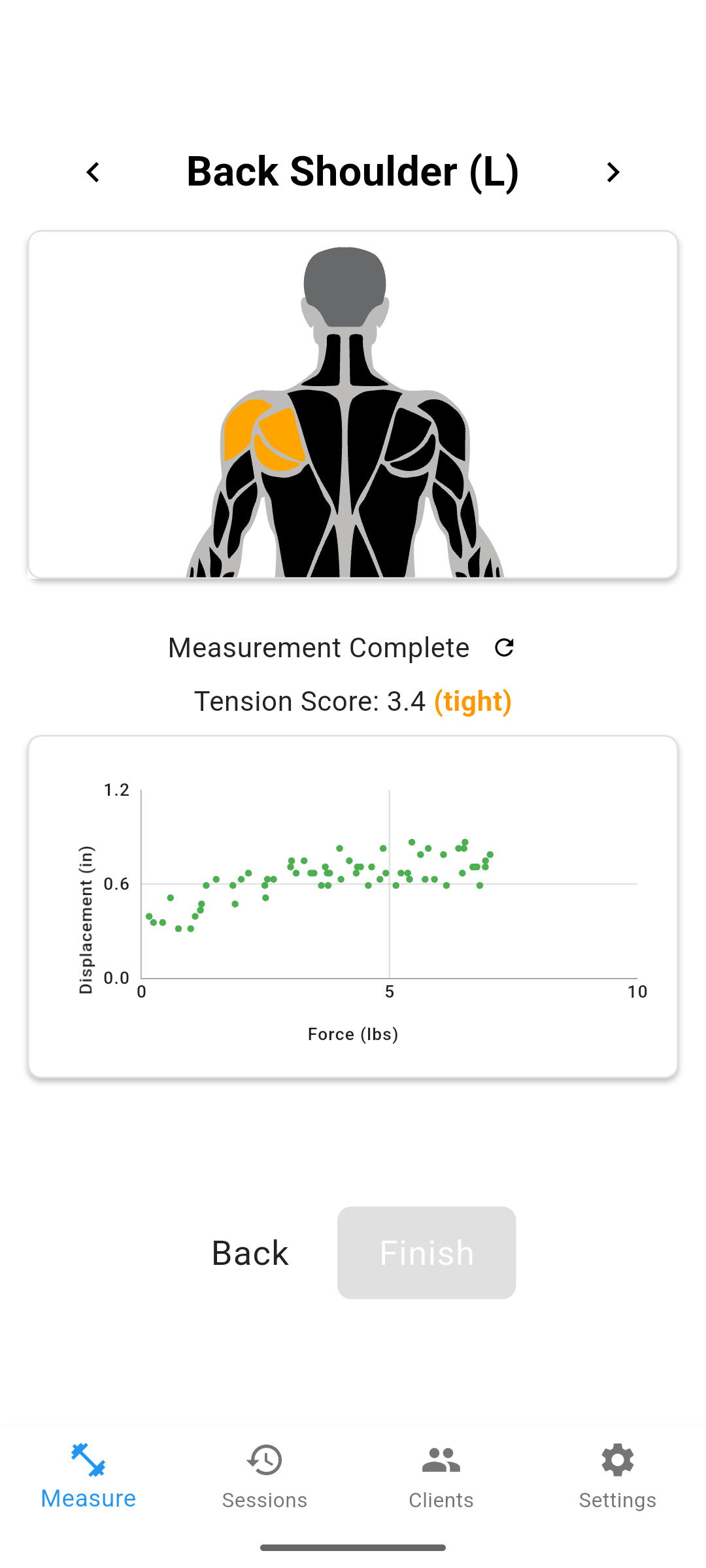
One approach is to keep palpation for what it does best and add an instrumented channel for what it does not. Options include handheld soft tissue stiffness measurement (such as MuscleMap), shear wave elastography when an ultrasound system is available, and instrumented range-of-motion testing. Each gives you a number to track over time alongside what your hands tell you.