
Capture a small set of repeatable measures before you treat anything. A baseline is the reference point every future re-exam is judged against. Take it on the first visit: range of motion, a validated questionnaire, and at least one objective tissue measure such as soft tissue stiffness. Skip it, and you can assert progress later but never show it. Intake is also where you learn how long this patient is likely to need you: in a 2026 cross-sectional study at two US chiropractic teaching clinics, 39.6% of new spinal pain patients screened as potential maintenance care candidates on the MAINTAIN instrument.
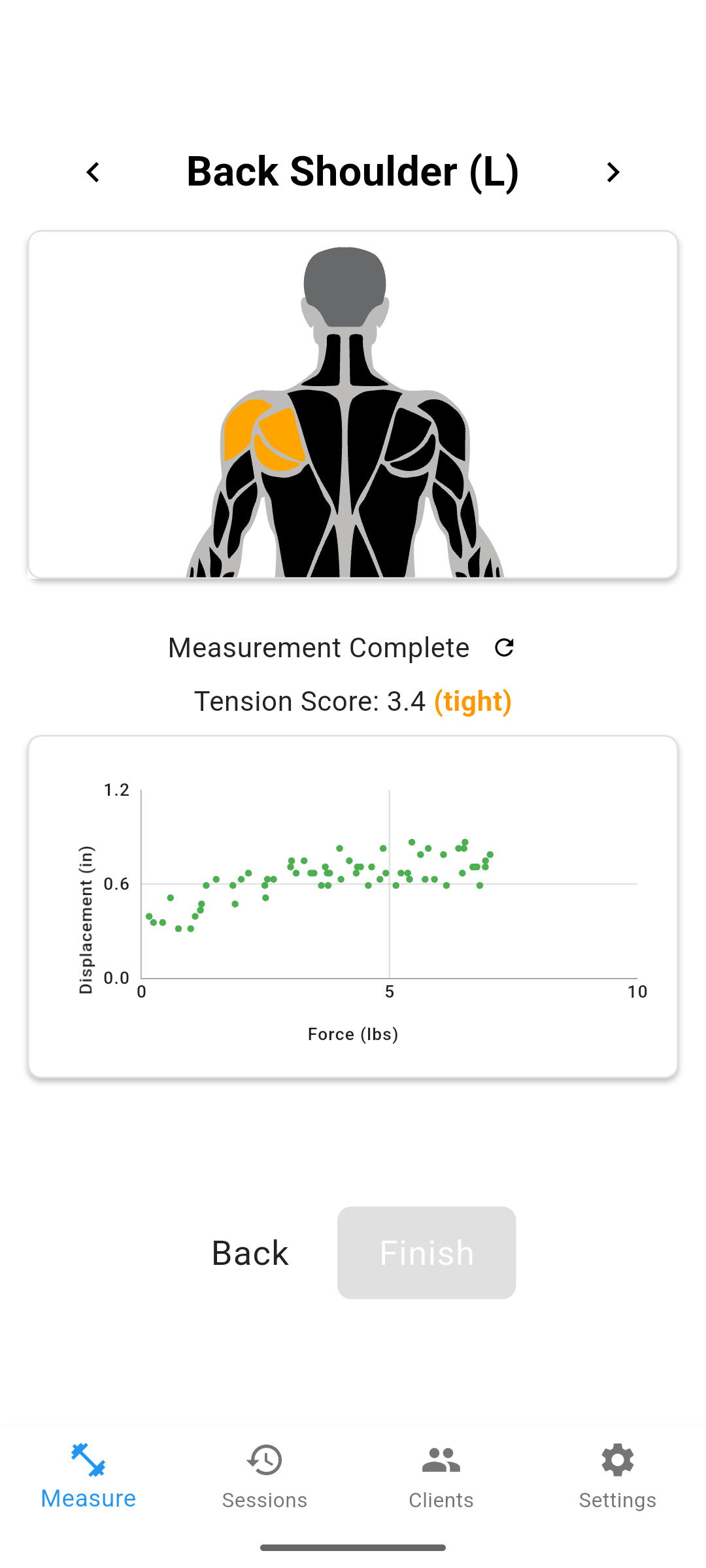
Why does the first-visit baseline matter so much?
Because change is meaningless without a starting point. If you do not measure before treatment, the only evidence of progress later is the patient's memory of how they used to feel. Memory is a poor instrument. A patient who feels better will often underestimate how limited they once were, and a patient who feels stuck will forget any gains. A recorded baseline replaces memory with a number you can compare against.
Should the baseline be built on pain scores?
Not on pain alone. Pain is easy to record but unreliable as a measure of tissue status. A 2025 study in the Journal of Bodywork and Movement Therapies found that objective stiffness readings stayed elevated even as subjects reported less soreness after exercise-induced muscle damage. If your baseline is only a pain score, you lose the signal that shows recovery is incomplete once the pain fades.
The independence runs deeper than soreness. Hidalgo-Garcia and colleagues (2019) found no meaningful relationship between the most painful site and the stiffest site in 40 patients with chronic neck and back pain. Stiffness and pain are independent measures, which is exactly why a baseline should capture both.
What should the baseline actually include?
One functional measure, one patient-reported measure, and one objective tissue measure. That combination captures the problem from three angles without becoming too slow to repeat. The functional measure tracks what the patient can do, the questionnaire tracks how they experience daily life, and the tissue measure tracks something neither the patient nor your hands can quantify on their own.
| Baseline component | Example | What it captures |
|---|---|---|
| Functional measure | Range of motion via inclinometer | What the patient can physically do |
| Patient-reported measure | Oswestry or Neck Disability Index | Impact on daily life |
| Objective tissue measure | Soft tissue stiffness reading | A signal independent of pain and palpation |
| Pain score | Numeric rating scale | Symptom intensity, recorded but not relied on alone |
What makes a measure reliable enough to trust?
It has to repeat across visits and examiners. A baseline is only useful if you can reproduce it later under the same conditions. Standardize patient position, the exact site, and the timing, then use a tool with demonstrated test-retest reliability. A 2024 systematic review in Medicina of 48 studies found that handheld myotonometry had good to excellent reliability, with intraclass correlation coefficients above 0.75 across most measurements and muscles. A measure that drifts with technique is worse than none, because it manufactures false change.
Survey data: In a 2026 survey of 455 patients who stopped chiropractic care, 58% cited perception-based reasons: 36% felt no progress, and 22% felt better and stopped. A first-visit baseline is what lets you show both groups, at a re-exam, what their own bodies actually did.
How do you use the baseline at a re-examination?
Repeat the same measures under the same conditions, then show the patient the before and after side by side. The comparison turns progress from a claim into something the patient can see. This matters most for the patient whose pain has already eased, because the baseline is the only way to show that stiffness or range of motion is still catching up. Without it, you are asking them to take your word for it.
Frequently Asked Questions
How do you build an objective baseline for a new chiropractic patient?
Capture a small set of repeatable measures on the first visit before any treatment: range of motion, a validated disability questionnaire, and at least one objective tissue measure such as soft tissue stiffness. Record the exact conditions so you can reproduce the measurement at re-exams.
Why does the first-visit baseline matter so much?
Without a baseline you cannot show change later, only assert it. A measure taken before treatment is the reference point every future re-exam is compared against. Skip it, and the only evidence of progress is the patient's unreliable memory of how they used to feel.
Should the baseline rely on pain scores alone?
No. Pain and tissue status move independently, so a pain-only baseline can mislead you. Pairing a pain score with an objective measure like stiffness or range of motion gives you two signals that can diverge, which is what reveals incomplete recovery.
What makes an objective measure reliable enough for a baseline?
It needs to be repeatable across visits and examiners. Standardize patient position, site, and timing, and use a tool with demonstrated test-retest reliability. A measure that drifts with technique is worse than no measure, because it creates false change.
How many measures should a baseline include?
Enough to capture the problem, few enough to repeat every time. A practical baseline is one functional measure, one patient-reported measure, and one objective tissue measure. More than that and the baseline becomes too slow to reproduce at re-exams.
How do you use the baseline at a re-examination?
Repeat the same measures under the same conditions and show the patient the difference side by side. The comparison turns progress from a claim into something visible, which keeps patients engaged when their pain has already improved.
Should the first visit include a screening tool as well as measurements?
They serve different purposes and pair well. A 2026 study found 39.6% of new spinal pain patients screened as maintenance care candidates at intake, which shapes the care horizon. Repeatable measurements are what later show the patient whether that horizon is earning its keep.
One approach is to add a second channel of objective data alongside subjective pain reports. Options include soft tissue stiffness measurement (such as MuscleMap), range-of-motion testing, and posture analysis. Each gives you something concrete to show the patient rather than asking them to take your word for it.