
Neither one wins, because they measure different properties. Range-of-motion testing tells you how far a joint moves. Myotonometry tells you how stiff the soft tissue is. A 2025 validation study found inclinometer range-of-motion readings correlated moderately to highly with optoelectronic motion capture only when a standardized protocol was followed, which is the same condition that governs a useful stiffness reading.
What does each tool actually measure?
They sit on different sides of the same problem. Range of motion is an output: how many degrees a joint travels before it stops. Soft tissue stiffness is an input to that output: how much the tissue resists deformation. A change in one does not guarantee a change in the other, which is exactly why tracking only one can mislead you.
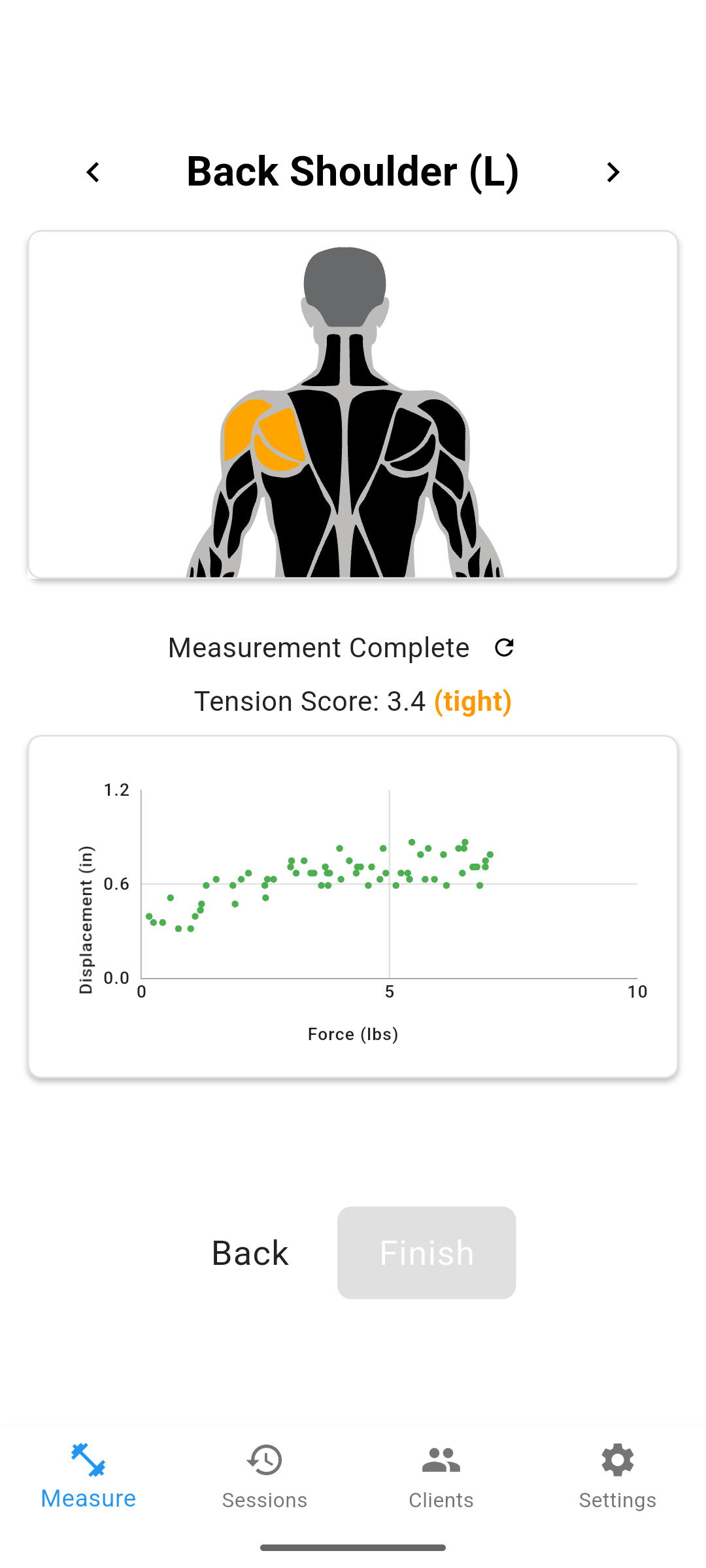
Range of motion is often the more familiar number because goniometers and inclinometers have been in clinics for decades. Stiffness is the newer chairside measurement, made practical by handheld myotonometry devices that press on the tissue and read how it responds.
How reliable is range-of-motion testing?
Good, when the protocol is consistent. Inclinometers generally outperform goniometers for the spine, with intraclass correlation coefficients commonly reported from 0.75 to 0.98 for intra-rater reliability. The catch is standardization: reliability depends on the same landmarks, the same patient position, and the same examiner. Rotation and lateral flexion tend to be less reliable than flexion and extension.
How reliable is myotonometry?
High, and often more consistent than palpation. A 2024 systematic review of 48 studies covering 31 muscle groups found the MyotonPRO device produced intra-rater reliability frequently above 0.90 and inter-rater reliability in the 0.75 to 0.97 range, with stiffness the most reliable parameter measured. A review in the Journal of Athletic Training reached a similar conclusion: myotonometric stiffness exceeds the repeatability of manual palpation and can support rehabilitation and return-to-activity decisions.
| Property | Range-of-motion testing | Myotonometry |
|---|---|---|
| What it measures | Joint travel in degrees | Soft tissue stiffness |
| Typical reliability (ICC) | 0.75 to 0.98 (standardized) | 0.75 to 0.97 |
| Influenced by nervous system tolerance | Strongly | Less so |
| Equipment | Inclinometer or goniometer | Handheld device |
Why can the two numbers disagree?
Because range of motion is heavily shaped by the nervous system. After treatment, a patient often moves further mainly because the brain feels safer at the end of the range, not because the tissue got less stiff. That means a range gain can look like progress while a stiffness reading shows the tissue has barely changed. Reading both lets you tell a genuine tissue change apart from a change in movement tolerance.
Survey data: In a 2026 survey of 455 patients who stopped chiropractic care early, 58% cited perception-based reasons: 36% felt no progress, and 22% felt better and self-discharged. A second objective number gives these patients something to watch besides how they feel, which is the signal most likely to send them out the door early.
So which should you use to show progress?
Use range of motion to show what the patient can now do, and use stiffness to show the tissue state behind it. When both move in the same direction, your progress story is strong and hard to argue with. When they diverge, you learn something a single number would have hidden, and you can set the patient's expectations honestly instead of overselling a range gain that may not last.
Frequently Asked Questions
Is myotonometry or range-of-motion testing better for tracking chiropractic progress?
Neither replaces the other. Range of motion captures how far a joint moves, myotonometry captures how stiff the tissue is. A patient can gain range while stiffness stays elevated, so together they give a fuller picture.
How reliable is myotonometry?
A 2024 systematic review of 48 studies and 31 muscle groups found intra-rater reliability frequently above 0.90 and inter-rater reliability from 0.75 to 0.97, with stiffness the most reliable parameter.
How reliable is range-of-motion testing?
Inclinometers and goniometers show good to excellent reliability for spinal range of motion when protocols are standardized, with ICCs commonly from 0.75 to 0.98. Reliability drops without consistent landmarks and positioning.
Can range of motion improve while stiffness stays high?
Yes. Range often improves because the nervous system tolerates more movement, not because tissue stiffness dropped. A range gain alone can overstate how much the tissue has actually changed.
Which is faster to perform in a busy clinic?
Both are quick. A myotonometry reading takes seconds per site with a handheld device. Range-of-motion testing takes slightly longer to position and record. Neither requires imaging or a separate appointment.
Do I need both tools?
You do not need both, but they answer different questions. Range of motion tells you what a patient can do, stiffness tells you about the tissue behind it. Using both separates a real tissue change from a change in movement tolerance.
How much does protocol affect a range-of-motion reading?
More than most clinics assume. A 2025 validation study of the baseline bubble inclinometer for sagittal thoracic range of motion found reliability was highest when standardized procedures such as fixation were followed. The same rule applies to stiffness readings, so both tools are only comparable across visits when collected the same way.
Citations
- Evaluating the Reliability of MyotonPro in Assessing Muscle Properties: A Systematic Review of Diagnostic Test Accuracy (2024). PubMed PMID 38929468.
https://pubmed.ncbi.nlm.nih.gov/38929468/ - The Utility of Myotonometry in Musculoskeletal Rehabilitation and Human Performance Programming (2023). Journal of Athletic Training. PubMed PMID 37418563.
https://pubmed.ncbi.nlm.nih.gov/37418563/
One approach is to add a second channel of objective data alongside subjective pain reports. Options include soft tissue stiffness measurement (such as MuscleMap), range-of-motion testing, and posture analysis. Each gives you something concrete to show the patient rather than asking them to take your word for it.