
Barely, if you require the word chiropractic on the paper. The instrument evidence is substantial. A 2024 systematic review pooled 48 studies of handheld myotonometry reliability. Almost none of them were run in chiropractic settings, and that gap is worth understanding before you cite anything.
What does the existing evidence actually cover?
It covers the instrument, not the profession. Published myotonometry research is concentrated in physical therapy, sports medicine, and neurorehabilitation. Those fields adopted the device for research reasons, so that is where the studies accumulated.
The 2024 review in Medicina reported high intra-rater and inter-rater reliability for frequency and stiffness across a wide range of muscles. That is a statement about whether two people pressing the same probe on the same spot get the same number. It does not become less true when the person holding the probe is a chiropractor.
Have the muscles chiropractors care about been studied?
Yes, and this is the closest the literature gets to your use case. Koterba and Saulicz published a systematic review in the Journal of Bodywork and Movement Therapies in 2025 focused specifically on the reliability of MyotonPRO measurement for neck and back muscle mechanical properties.
Neck and back is most of chiropractic measurement. So while the study population was not recruited from chiropractic offices, the anatomy under the probe is the same anatomy you assess.
| Research area | Coverage | Transfers to chiropractic? |
|---|---|---|
| Instrument reliability, general | 48-study systematic review, 2024 | Yes |
| Neck and back reliability | Systematic review, 2025 | Yes |
| Stiffness in chronic low back pain | Individual studies | Mostly, population matches |
| Normative reference values | Pilot study, healthy adults, 2025 | Partly, sample is small |
| Change after spinal manipulation | Sparse | Not established |
| Stiffness as a chiropractic outcome measure | Absent | No |
What has been found in patients with spinal pain?
Stiffness and pain move independently, which is the finding to carry into the treatment room. A 2022 study in PLOS ONE measured lumbar erector spinae stiffness in people with chronic low back pain and reported excellent intra-rater and inter-rater reliability, with higher stiffness on the painful side during sitting.
Pain intensity was not linearly associated with stiffness in that sample. A patient may report less pain while a stiffness reading stays elevated, and the reverse also happens. Treat them as two separate variables you record, not one variable with two names.
Survey data: In a 2026 survey of 455 patients who stopped chiropractic care, 58% cited perception-based reasons: 36% felt no progress, and 22% felt better and stopped. Neither group was shown that their soft tissue stiffness was still elevated.
Does the missing chiropractic label matter?
For reliability, no. For treatment effects, yes. These are different claims and they deserve different levels of confidence.
Reliability is a property of the instrument, the operator technique, and the tissue being measured. None of those change based on who is licensed to touch the patient. If a probe produces repeatable readings on a lumbar multifidus in a physical therapy lab, it produces repeatable readings on a lumbar multifidus in your office, assuming the same protocol.
Treatment-effect data is where the gap bites. There is no body of work showing what a stiffness reading does across a course of chiropractic care, or what magnitude of change should be considered clinically meaningful in that context. Anyone telling you otherwise is extrapolating.
What can you responsibly claim from this evidence?
That the measurement is repeatable, and that you are tracking it. That is a defensible position and it is enough to be useful at a re-exam.
What you should not claim is that a drop in a stiffness reading proves the treatment worked, or that an elevated reading predicts a future flare. Neither of those has been established. A reading may reflect a change in tissue mechanical properties. What that change means for the patient's trajectory is still an open question.
What research would close the gap?
Prospective cohorts in real chiropractic offices. Follow patients across a course of care. Record stiffness alongside a validated patient-reported outcome at every re-exam. Report both, including the cases where they disagree.
That study does not exist yet. Until it does, the honest framing is that myotonometry gives you a repeatable number, and a repeatable number is more than palpation gives you, and less than a validated outcome measure gives you.
Frequently Asked Questions
Is there myotonometry research on chiropractic patients?
Very little that is labelled chiropractic. Most of the relevant work studies the same spinal muscles in the same painful populations, but it is published in physical therapy, sports medicine, and rehabilitation journals rather than chiropractic ones.
Have the paraspinal muscles been studied with myotonometry?
Yes. A 2025 systematic review in the Journal of Bodywork and Movement Therapies looked specifically at reliability of MyotonPRO measurement for neck and back muscles. The neck and back are where most chiropractic measurement happens.
Does the absence of chiropractic-labelled studies matter clinically?
Less than it sounds. Reliability is a property of the instrument, the operator, and the tissue, not of the practitioner's license. What does not transfer automatically is treatment-effect data, since the intervention differs.
What has been shown about stiffness in low back pain patients?
A 2022 study in PLOS ONE measured lumbar erector spinae stiffness in people with chronic low back pain and found higher stiffness on the painful side in sitting. Pain intensity was not linearly related to stiffness, so the two should be tracked separately.
How large is the overall myotonometry evidence base?
A 2024 systematic review in Medicina pooled 48 studies of MyotonPRO reliability across a range of muscles and reported high intra-rater and inter-rater reliability for frequency and stiffness.
Can I cite this research to justify measurement in my documentation?
You can cite reliability evidence to support that the measure is repeatable. Do not cite it as evidence that a stiffness change proves a treatment worked, because that link has not been established.
What research is still missing?
Prospective work following chiropractic patients across a course of care, with stiffness and patient-reported outcomes recorded together. Until that exists, stiffness readings are best treated as a tracked variable rather than a proven outcome measure.
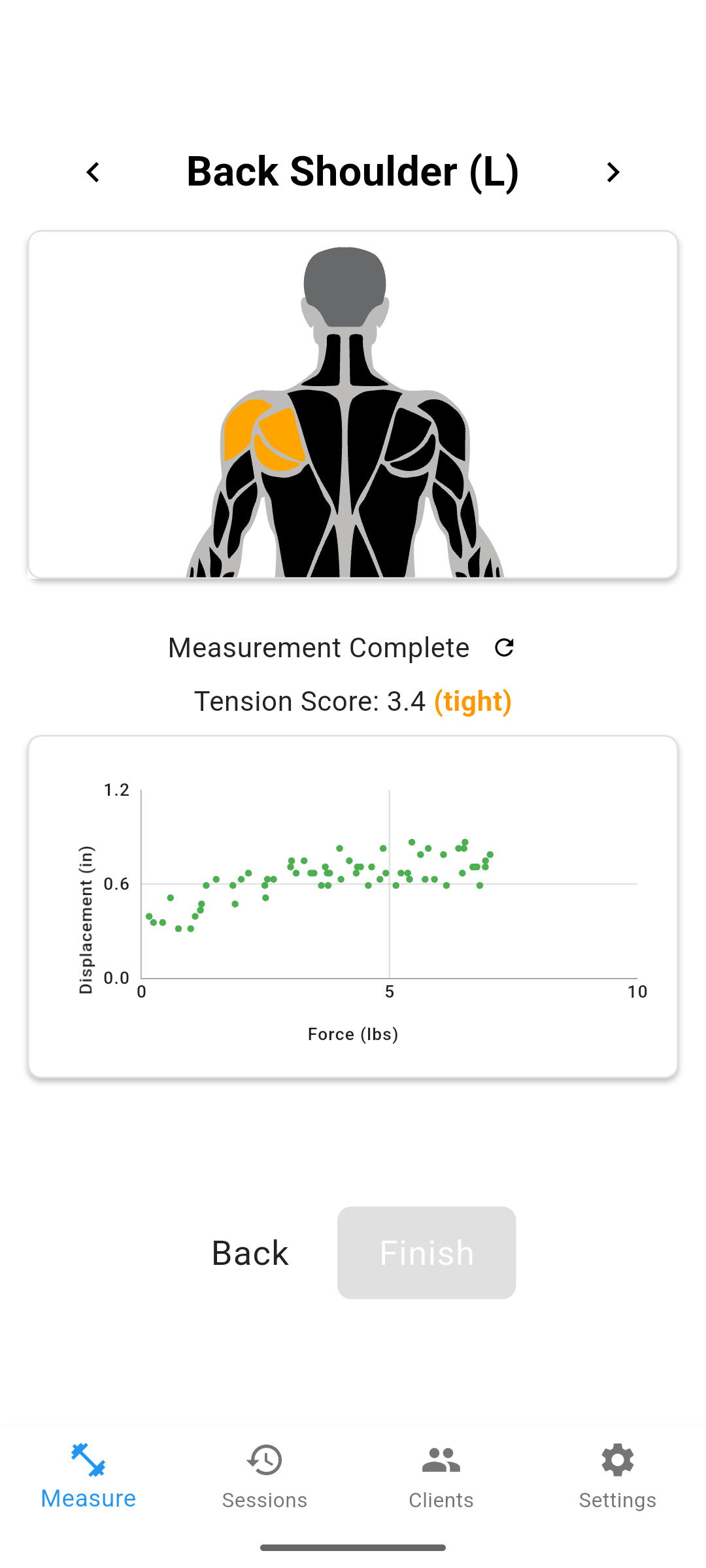
One approach is to add a second channel of objective data alongside subjective pain reports. Options include soft tissue stiffness measurement (such as MuscleMap), range-of-motion testing, and posture analysis. Each gives you something concrete to show the patient rather than asking them to take your word for it.