
It is both, and nothing you do with your hands can separate them. Skin, fascia, and muscle sit in series under every palpating thumb. Any surface reading, manual or instrumented, records their combined mechanical response. That limitation is worth understanding before you name a layer out loud to a patient.
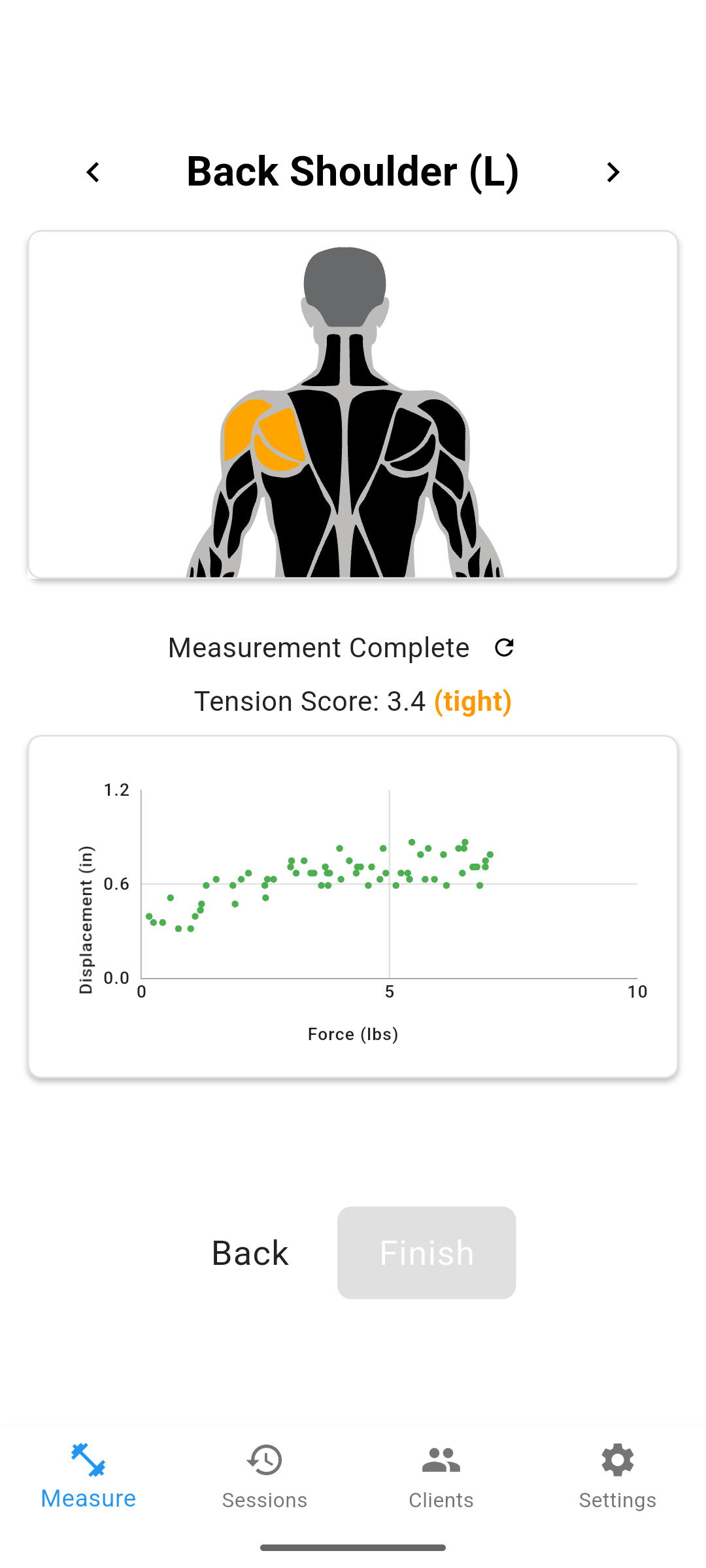
Why can't palpation tell muscle from fascia?
Because you are compressing a stack, not a single tissue. Pressing into the upper trapezius loads epidermis, subcutaneous fat, superficial fascia, deep fascia, and muscle before anything pushes back. What returns to your hand is the sum. Trained clinicians are consistent with themselves about where tissue feels different, and much less consistent with each other about what that difference is.
This is not a criticism of palpation as a skill. It is a statement about what a surface measurement can resolve. Instrumented tools have the same constraint, which is why an honest stiffness reading is a value at a site rather than a claim about a layer.
What does the fascia research actually propose?
That fascia may contribute to pain through mechanisms that stiffness alone does not capture. A 2025 review in Frontiers in Pain Research outlines a model in which changes in fascia such as densification and fibrosis may generate nociceptive signalling, interact with central sensitisation, and persist independently of muscle behaviour.
Read carefully, that is a proposed model, not a settled mechanism. It widens the list of candidate tissues. It does not hand you a way to identify which one you are touching, and it does not establish that a stiffer reading means a more painful site.
Does stiffer tissue mean more painful tissue?
The evidence says no, repeatedly. A controlled study in chronic neck and back pain measured tissue stiffness objectively and found it did not correspond to the sites of maximum reported pain. Stiffness fell after treatment and pain fell after treatment, but the two did not track each other.
The imaging literature is no tidier. A systematic review of shear wave elastography in musculoskeletal pain found highly inconsistent results across studies, with painful muscles measuring stiffer in some, no different in others, and less stiff in a few. Whatever relationship exists appears to be condition-specific and is not yet established.
| Question | What the evidence supports | What it does not support |
|---|---|---|
| Which layer is stiff? | A combined reading at a site | Naming muscle or fascia specifically |
| Does stiffness equal pain? | The two vary independently | Treating a stiff site as the pain source |
| Is stiffness worth measuring? | Tracking change at a fixed site over time | Diagnosing a condition from one reading |
| Do patients mean what you mean? | Patients separate stiffness from pain | Using the two words interchangeably |
Do patients mean what you mean by "stiff"?
Often not, and the gap is documented. Qualitative research in BMC Musculoskeletal Disorders asked patients what discomfort, pain, and stiffness meant to them. Patients consistently separated the terms. Stiffness described restriction and tightness. Pain described something sharper and more likely to stop an activity outright.
So when a patient says they feel loose, they may be reporting restored range, not resolved tissue change. And when they say they feel stiff, they may be describing something a measurement at that site does not reflect. Both directions are common enough to plan around.
Survey data: In a 2026 survey of 455 patients who stopped chiropractic care, 58% cited perception-based reasons: 36% felt no progress, and 22% felt better and stopped. Neither group was told their stiffness was still elevated.
What can you defensibly claim from a stiffness reading?
That this site, on this patient, measures differently than it did before. That is a narrow claim and it survives every limitation above. It does not require you to identify a layer, and it does not require stiffness to correlate with pain.
It is also the claim that does the most work in a re-examination. A patient deciding whether to keep coming is reasoning from how they felt this week. Giving them a comparison against their own baseline replaces a memory with a number. Elevated stiffness at a site may reflect ongoing tissue change worth continued attention, and a reading that has moved toward the unaffected side may suggest the plan is doing something. Neither statement needs you to know whether you are looking at muscle or fascia.
Frequently Asked Questions
Is the stiffness you feel under your hands muscle or fascia?
Under a hand it is both, and palpation cannot separate them. Any surface measurement, manual or instrumented, records the combined mechanical response of skin, fascia, and muscle at that site rather than one isolated layer.
Does fascia contribute to myofascial pain?
A 2025 review in Frontiers in Pain Research argues that changes in fascia such as densification and fibrosis may contribute to myofascial pain independently of muscle stiffness. It is a proposed model rather than a settled mechanism, and it does not establish that measured stiffness predicts pain.
Is stiffer tissue more painful tissue?
The evidence does not support that assumption. A controlled study of chronic neck and back pain found that objectively measured tissue stiffness did not correspond to the sites of maximum reported pain intensity.
Do shear wave elastography studies agree on muscle stiffness in pain?
No. A systematic review of shear wave elastography studies in musculoskeletal pain found highly inconsistent results, with some muscles measuring stiffer, some no different, and some less stiff than in asymptomatic controls.
Do patients mean the same thing by stiffness that clinicians do?
Not reliably. Qualitative research published in BMC Musculoskeletal Disorders found that patients distinguish stiffness from pain, describing stiffness as restriction or tightness while pain is sharper and more likely to stop an activity.
If the layer is ambiguous, is measuring stiffness still useful?
Yes, provided you use it as a tracked value rather than a diagnosis. Measuring the same site on the same patient at the same conditions gives you a comparison over time, which is a different and more defensible claim than naming which tissue is responsible.
Should I tell a patient their fascia is tight?
It is more accurate to say the tissue at that site is measuring stiffer than the surrounding area or than their own baseline. Naming a specific layer claims a precision that surface measurement and palpation do not provide.
One approach is to add a second channel of objective data alongside subjective pain reports. Options include soft tissue stiffness measurement (such as MuscleMap), range-of-motion testing, and posture analysis. Each gives you something concrete to show the patient rather than asking them to take your word for it.