
They are three separate findings measured three different ways. Stiffness is a mechanical property of the tissue. Tenderness is the pressure needed to provoke discomfort. Pain is what the patient reports before you touch them. Research repeatedly finds they do not move together, and treating them as one number hides most of the clinical picture.
How is each one actually measured?
Different instruments, different units, different sources of error. Stiffness is a tissue property expressed in newtons per metre, captured by myotonometry or shear wave elastography. Tenderness is a sensitivity threshold expressed in kilograms of force, captured by pressure algometry. Pain is a self-report on a 0 to 10 scale.
| Finding | What it describes | Typical measure | Subjective or objective |
|---|---|---|---|
| Stiffness | Resistance of the tissue to deformation | Myotonometry (N/m), elastography | Objective |
| Tenderness | Pressure at which discomfort begins | Algometry (kg/cm²) | Mixed |
| Pain | What the patient experiences unprovoked | Numeric rating scale, 0 to 10 | Subjective |
Only one of the three requires nothing from the patient. That matters when the patient is guarded, stoic, or highly sensitised.
Does a stiffer muscle mean a more painful muscle?
The evidence says not reliably. A systematic review in Clinical Physiology and Functional Imaging asked whether musculoskeletal pain is associated with increased muscle stiffness on shear wave elastography and found inconsistent results. Some studies reported higher stiffness in painful muscles. Some found no difference. Some found lower stiffness on the painful side. The authors explicitly called for stiffness, pain, and tenderness to be treated as distinct constructs.
A controlled study in patients with chronic neck and back pain compared tissue stiffness at the most painful point against the opposite side and found no significant difference before treatment.
If pain drops after treatment, did the tissue change?
Not necessarily, and this is the finding clinicians find hardest to accept. In that same controlled study, pain and disability scores fell after treatment while measured stiffness returned to baseline inside 24 hours. A 2025 systematic review of instrument-assisted soft tissue mobilisation reported a similar pattern, with patient-reported pain improving while objectively measured tissue properties did not consistently follow.
The reverse also happens. A 2025 study in the Journal of Bodywork and Movement Therapies found stiffness readings in the calf remained elevated after delayed onset soreness had faded. The patient felt recovered. The tissue reading did not agree.
Survey data: In a 2026 survey of 455 patients who stopped chiropractic care, 58% cited perception-based reasons: 36% felt no progress, and 22% felt better and stopped. Neither group was told their stiffness was still elevated.
Why does palpation blur all three together?
Because pressing on tissue tests all three at once. Your fingers register resistance while the patient reacts to discomfort. Both signals arrive in the same second and get compressed into one impression, which then goes into the chart as "tight." The note cannot later be separated back into its parts, so the next clinician inherits a blend rather than a measurement.
That blend is also why interrater agreement on palpation is weaker than clinicians expect. Two examiners can feel the same tissue and weight the resistance and the wince differently.
Could fascia explain some of the mismatch?
It may account for part of it. A 2025 review in Frontiers in Pain Research describes fascial densification, fibrosis, and inflammation in myofascial pain syndrome, and reports imaging changes in fascial stiffness in those patients. If the layer driving symptoms is fascial and the reading is taken over muscle belly, a mismatch between what the patient feels and what the device reports may reflect anatomy rather than error.
None of this makes stiffness readings less useful. It makes them a second channel rather than a proxy for pain. A patient whose pain has cleared but whose stiffness reading is still elevated has something worth discussing. A patient whose pain persists with a normal stiffness reading has a different conversation ahead, and both of those conversations start with data the patient can see.
Frequently Asked Questions
What is the difference between muscle stiffness, tenderness, and pain?
Stiffness is a mechanical property of the tissue, measured in newtons per metre. Tenderness is the pressure required to provoke discomfort, measured with an algometer. Pain is what the patient reports without you touching them. They are three different findings and they often do not move together.
Does a stiffer muscle mean a more painful muscle?
Not reliably. A 2023 systematic review in Clinical Physiology and Functional Imaging found inconsistent results across studies, with some reporting higher stiffness in painful muscles, some reporting no difference, and some reporting lower stiffness.
Can a muscle be tender without being stiff?
Yes. Tenderness reflects sensitivity to pressure, which is influenced by nociceptor sensitisation and central processing, not only by tissue mechanics. A tender area may measure within a normal stiffness range.
Why does palpation blur these three together?
Because pressing on tissue tests all three at once. Your hand feels resistance while the patient reacts to discomfort, and the two signals arrive as one impression that gets recorded as tight.
If pain drops after treatment, did the tissue change?
Not necessarily. A 2019 controlled study found that pain and disability scores fell after soft tissue treatment while measured tissue stiffness returned to baseline within 24 hours.
Which of the three should I document?
Document all three separately and label them. Payers and reviewers read a pain score as subjective, and a stiffness or pressure threshold reading as objective, so collapsing them into one line loses the part that carries weight.
Does fascia explain the mismatch?
It may explain part of it. A 2025 review in Frontiers in Pain Research describes fascial densification and inflammation in myofascial pain syndrome, suggesting the layer generating symptoms is not always the layer you are measuring.
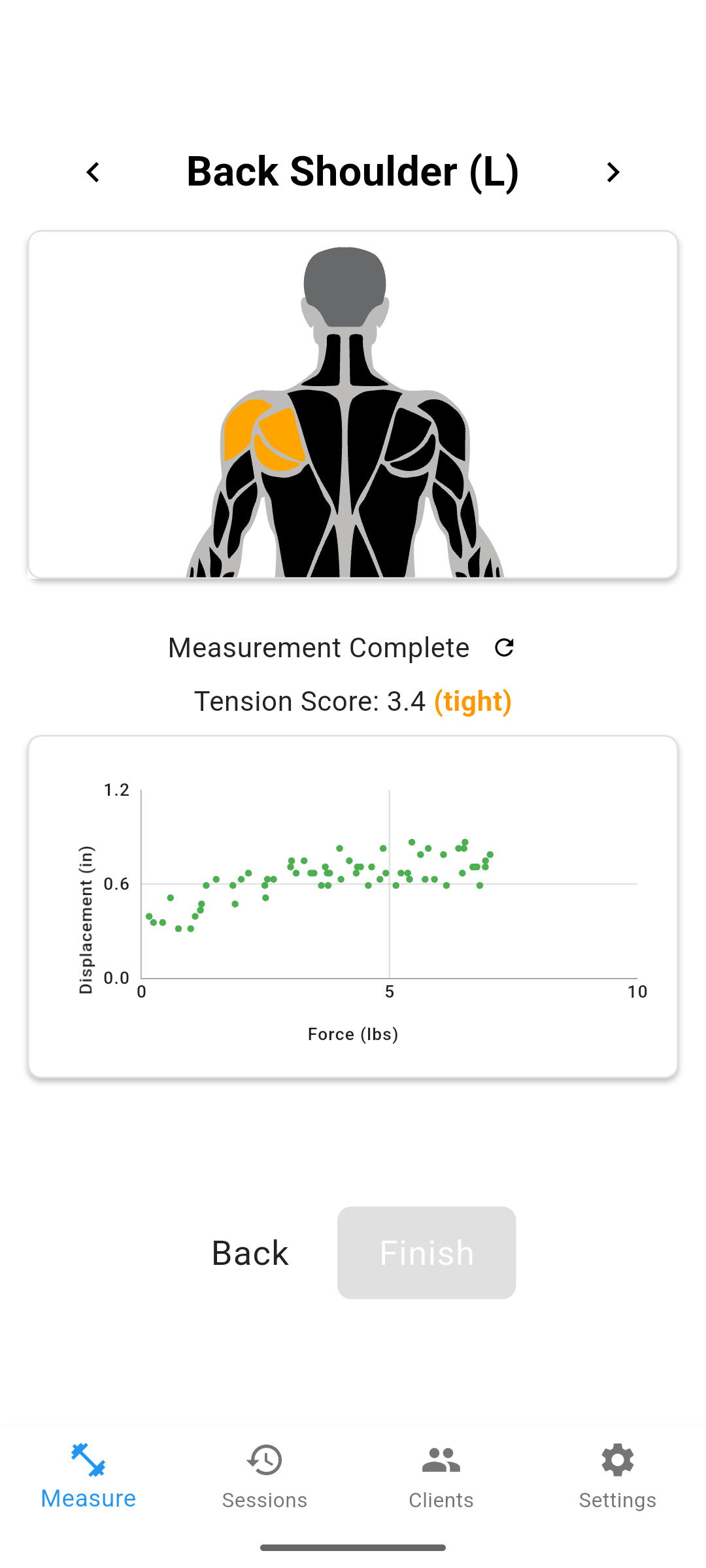
One approach is to add a second channel of objective data alongside subjective pain reports. Options include soft tissue stiffness measurement (such as MuscleMap), range-of-motion testing, and posture analysis. Each gives you something concrete to show the patient rather than asking them to take your word for it.