
No. Handheld stiffness measurement requires direct skin contact. Every published protocol specifies it, and no study has validated readings taken through fabric. A reading through a shirt is not a slightly worse reading. It is a number you cannot compare to anything, including the same patient last month.
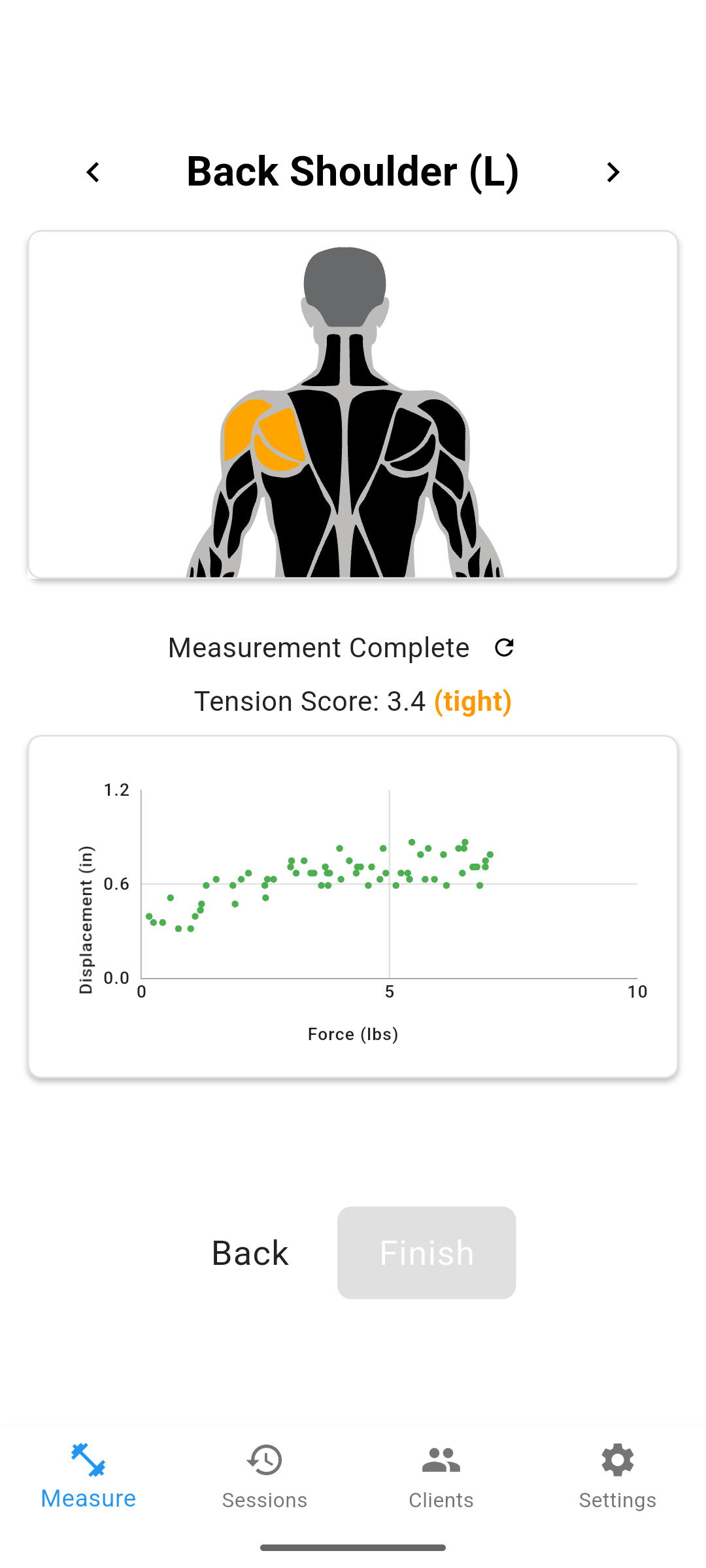
Why does clothing break the measurement?
The device is not reading pressure. It is reading how the tissue answers back. A brief mechanical impulse goes into the tissue, and the probe records the oscillation that comes out. Stiffness is derived from that oscillation.
Fabric sits directly in that path. It absorbs part of the impulse on the way in and damps part of the response on the way out. The number you get reflects the shirt as much as the muscle, and there is no way to subtract the shirt afterward.
What do the protocols actually require?
Skin contact, at a marked site, with the probe perpendicular. The MyotonPRO quick guide instructs the operator to mark the measurement point on the skin with a medical marker before taking readings. That step only makes sense on bare skin.
The reliability literature inherits that assumption. Koterba and Saulicz, in a 2025 systematic review in the Journal of Bodywork and Movement Therapies, pooled reliability data for neck and back muscle measurement. Every included study used direct skin application. The reported reliability figures do not describe measurement through a layer, because no included study did that.
| Barrier between probe and skin | Validated? | What to do |
|---|---|---|
| Bare skin, marked site | Yes, this is the protocol | Standard measurement |
| Thin shirt or athletic top | No | Expose the site or skip it |
| Thick sweater or layered clothing | No | Expose the site or skip it |
| Kinesiology tape or bandage | No | Remove, or measure a different site |
| Heavy lotion or liniment | No | Wipe the site before measuring |
| Hair over the site | Not studied, avoid | Shift slightly to a clear point and note it |
Is a thin layer good enough?
There is no evidence for a safe thickness, because nobody has published a threshold. The honest answer is that we do not know how much error a t-shirt adds, and neither does anyone else.
The temptation is to assume a thin layer adds a small constant error that cancels out across visits. It does not work that way. Fabric tension varies with the patient's posture, how the garment was pulled on that morning, and whether they shifted between readings. A varying uncontrolled input produces a varying uncontrolled error.
What if the patient does not want to undress?
Change the site, not the protocol. Several useful measurement points are reachable without asking anyone to remove clothing.
The upper trapezius, cervical paraspinals, forearm extensors, and calf are all accessible with a normal collar or rolled sleeve. A smaller panel of sites you can measure properly is worth more than a larger panel you measured through fabric. Record which sites you used and keep that list stable across visits, because a panel that changes between sessions is its own comparison problem.
Survey data: In a 2026 survey of 455 patients who stopped chiropractic care, 58% cited perception-based reasons: 36% felt no progress, and 22% felt better and stopped. Neither group was shown that their soft tissue stiffness was still elevated.
Why does this matter more at the second visit than the first?
Because the whole point is comparison. A single reading in isolation tells you almost nothing. The value shows up when you put a baseline next to a re-exam number and the patient can see whether it moved.
That comparison only holds if the conditions were the same both times. Protocol papers reporting minimal detectable change values assume controlled placement, direct skin contact, and consistent patient positioning. Introduce a fabric layer at one of the two visits and any difference you observe may reflect the clothing rather than the tissue. Showing a patient a change that came from their sweater is worse than showing them nothing.
What should your standard operating procedure look like?
Write it down once and follow it every time. The instrument is repeatable. Operators drift.
A workable baseline: expose the site fully, wipe off any lotion or residue, mark the point against a bony landmark, position the patient the same way each visit, and note the position in the chart. If a site cannot meet those conditions on a given day, skip it and record that you skipped it. A gap in the record is honest. A contaminated reading in the record is not.
Frequently Asked Questions
Can you measure soft tissue stiffness through clothing?
No. Every published myotonometry protocol specifies direct skin contact, and manufacturer guidance instructs marking the skin at the measurement site. No study has validated readings taken through fabric.
Why does clothing break the measurement?
The device reads the oscillation the tissue produces after a brief mechanical impulse. Fabric sits between the probe and the tissue and absorbs part of that response, so the number reflects the shirt as well as the muscle.
Would a thin layer be acceptable?
There is no evidence for a safe thickness threshold, because nobody has tested one. Treat any layer as invalidating until a study establishes otherwise.
Does it matter if I use the same shirt every visit?
It does not fix the problem. Fabric tension changes with posture, body position, and how the garment sits that day. A consistent-looking error is still an uncontrolled variable across sessions.
What should I do if a patient will not undress?
Move to sites you can reach with dignity, such as the upper trapezius, cervical paraspinals, forearm, or calf. Record which sites you used and stay consistent. A smaller reliable panel beats a larger unreliable one.
Does skin lotion or tape cause the same problem?
Anything between the probe and the skin is an uncontrolled layer. Kinesiology tape, bandages, and heavy lotion should all be removed or the site skipped. Published reliability figures assume clean, direct contact.
How do I keep site placement consistent between visits?
Use a skin marker at a landmark-referenced point and note the reference in your chart. Protocol papers report minimal detectable change values that assume this level of placement control.
One approach is to add a second channel of objective data alongside subjective pain reports. Options include soft tissue stiffness measurement (such as MuscleMap), range-of-motion testing, and posture analysis. Each gives you something concrete to show the patient rather than asking them to take your word for it.