
Measure quadriceps stiffness with a handheld myotonometer at the vastus lateralis or rectus femoris muscle belly, relaxed and non-weight-bearing, taking 3 to 5 readings per site and averaging the result. This chairside protocol has shown good to excellent reliability across most lower-extremity muscles in recent research. A 2025 pilot study in the Journal of Manual and Manipulative Therapy adds the context that was missing: in healthy young adults, bilateral asymmetry averaged 10% to 14%, so a modest side-to-side difference is not automatically a finding.
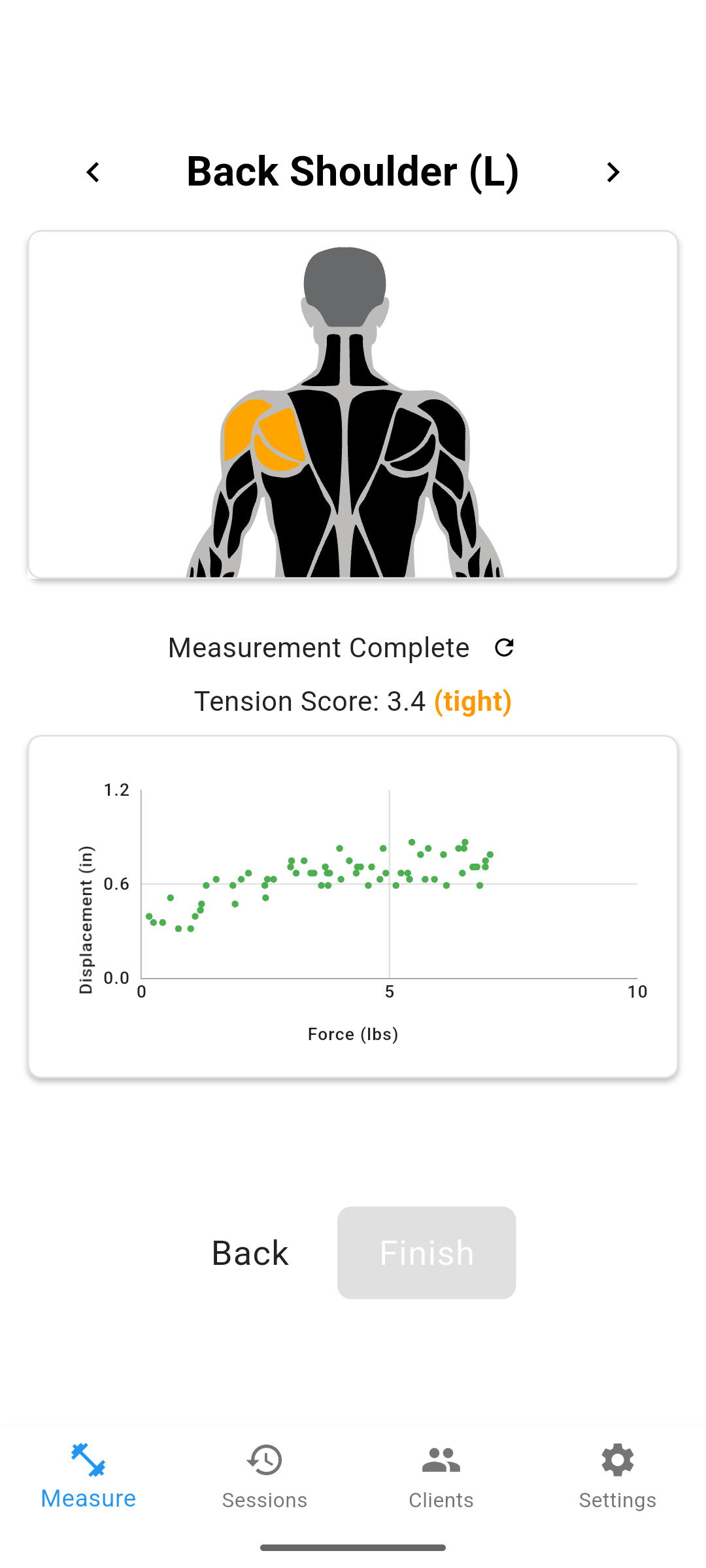
What Device Measures Quadriceps Stiffness Objectively?
A handheld myotonometer is the standard chairside tool. The device applies a brief mechanical tap to the muscle belly and records the tissue's oscillation frequency and decay, converting that response into a stiffness value. Unlike palpation, the number doesn't depend on the clinician's hands or experience level, which makes it usable for tracking a specific patient's change over multiple visits.
How Reliable Is Myotonometry for the Quadriceps?
A 2024 study in Frontiers in Sports and Active Living tested handheld myotonometry across lower-extremity muscles in athletes and found ICC values between 0.74 and 0.99 for most muscles, indicating good to excellent reliability. Vastus medialis was the notable exception, showing lower consistency than the other muscles tested. In practice, this means readings from the vastus lateralis or rectus femoris can generally be trusted to reflect real change rather than measurement noise, while vastus medialis readings should be interpreted more cautiously.
Where Should You Take the Measurement?
The muscle belly, not the tendon or the joint line. For the quadriceps, that typically means the vastus lateralis or rectus femoris, at a point midway between two bony landmarks identified at the first visit. Mark this location, or record the exact distance from a landmark, so the same site is used at every follow-up. A measurement taken two centimeters off from the original site is not a comparable data point, even if the device itself is reliable.
Positioning: Standing or Lying Down?
Lying down, non-weight-bearing, with the muscle fully relaxed. Any active contraction, weight-bearing, or guarding changes what the device is actually measuring. A stiffness reading taken with the patient tensing the muscle reflects contractile activity, not the resting mechanical properties you're trying to track. Ask the patient to relax the leg fully and confirm visually before taking the reading.
| Assessment tool | What it measures | Chairside feasible? |
|---|---|---|
| Manual palpation | Subjective impression of tone | Yes, but not reproducible between examiners |
| Handheld myotonometer | Objective mechanical stiffness at the muscle belly | Yes |
| Shear wave elastography | Tissue elasticity via ultrasound | Rarely, requires specialized equipment |
| Dynamometry / strength testing | Force output, not stiffness | Yes, but measures a different property |
Survey data: In a 2026 survey of 455 patients who stopped chiropractic care, 58% cited perception-based reasons: 36% felt no progress, and 22% felt better and stopped. Objective readings, whether for the low back or a specific muscle like the quadriceps, give clinicians something concrete to show instead of relying on how a patient says they feel.
Frequently Asked Questions
What device measures quadriceps muscle stiffness objectively?
A handheld myotonometer is the most common chairside option. It applies a brief mechanical tap to the muscle belly and measures the tissue's oscillation response, giving a repeatable stiffness value without imaging equipment.
How reliable is myotonometry for the quadriceps?
A 2024 study in Frontiers in Sports and Active Living found handheld myotonometry produced ICC values between 0.74 and 0.99 across most lower-extremity muscles in athletes, indicating good to excellent reliability. Vastus medialis was a noted exception with lower consistency.
Where on the quadriceps should you take the measurement?
The muscle belly of the vastus lateralis or rectus femoris, midway between identified landmarks, is the most commonly used site. Marking the exact location at baseline makes repeat measurements at follow-up comparable.
Should the patient be standing or lying down for the measurement?
Lying down, non-weight-bearing, with the muscle fully relaxed. Weight-bearing or active contraction changes the mechanical properties being measured and makes the reading unusable for tracking change over time.
Can quadriceps stiffness readings replace strength testing?
No. Stiffness and strength are different properties measured with different tools. A stiffness reading may reflect how the tissue responds to mechanical load, while strength testing measures force output. Using both gives a fuller picture than either alone.
How many readings should you take per session?
Most reliability studies use 3 to 5 consecutive taps per site and average the result. Taking a single reading increases the chance that measurement noise, not a real change, drives the number you record.
How much left-to-right difference is normal in the quadriceps?
A 2025 pilot study establishing reference values in healthy young adults reported bilateral asymmetry averaging 10% to 14% across the muscle groups measured. That range suggests a small side-to-side gap may reflect normal physiology rather than a problem, so asymmetry is more useful tracked over time than judged at a single visit.
One approach is to add a second channel of objective data alongside subjective pain reports. Options include soft tissue stiffness measurement (such as MuscleMap), range-of-motion testing, and posture analysis. Each gives you something concrete to show the patient rather than asking them to take your word for it.