
You can measure muscle stiffness in physical therapy with four main methods: manual palpation, handheld myotonometry, shear wave elastography, and surface indentometry. Palpation is fast but varies between clinicians. The instrumented methods give a number two therapists can compare. A 2024 review of 48 studies reported good to excellent reliability, with ICC values above 0.75, for handheld myotonometry across most muscles. New work is extending the evidence into longitudinal tracking: a 2025 study in Applied Sciences used MyotonPRO to track cervical muscle tone, stiffness, and elasticity across a 6-week stabilization exercise program in neck pain patients, and detected significant stiffness decreases alongside pain improvements, supporting use of the device for serial measurement during a plan of care. A 2024 review in BMC Musculoskeletal Disorders found that myotonometry can detect trunk muscle stiffness differences between people with and without low back pain, which is why the method is useful for tracking a symptomatic muscle over a course of care. A 2025 study in the Journal of Oral and Facial Pain and Headache separately reported moderate-to-excellent inter- and intra-rater reliability for myotonometry of the masseter muscle, with significant differences detected between normal and hypertrophic muscle states. The remaining gap has been interpretation rather than reliability, and that is starting to close: a 2025 paper in the Journal of Manual and Manipulative Therapy published reference values for muscle stiffness and side-to-side asymmetry using myotonometry, giving therapists a benchmark for judging whether a reading is unusual rather than just recording it.
Why measure muscle stiffness instead of just palpating?
Palpation is the default in most clinics because it is fast, free, and folds into the rest of your hands-on exam. Its weakness is reproducibility. Two experienced clinicians palpating the same muscle can disagree about which side is stiffer, particularly when the difference is small. That makes palpation hard to track over time, because the reading depends on the hand doing the assessing.
An instrument removes that dependency. It produces a number that does not change with hand pressure or experience level, which is what you need when the goal is to document a change between the first visit and a re-assessment six weeks later.
What are the main ways to measure muscle stiffness?
Each method trades cost and depth against portability and speed. A study comparing stiffness tools on a layered phantom tissue model evaluated several instrument categories, including durometers, tissue compliance meters, and handheld myotonometers, against reference measurements.
| Method | How it works | Best for | Limitation |
|---|---|---|---|
| Palpation | Manual feel of tissue resistance | Fast screening within an exam | High variability between clinicians |
| Handheld myotonometry | Brief probe impulse, records tissue response as a number | Portable chairside tracking over time | Depth limited; sensitive to protocol |
| Shear wave elastography | Ultrasound measures shear wave speed in tissue | Detailed, deeper-tissue assessment | Expensive; equipment and operator heavy |
| Surface indentometry (durometer) | Measures resistance to a surface indentation | Low-cost surface readings | Surface only; less validated for muscle |
How reliable is handheld myotonometry?
Reliability in measurement research is reported as an intraclass correlation coefficient (ICC). Values above 0.75 are considered good and values above 0.90 are considered excellent. A 2024 systematic review in Medicina aggregated 48 studies on the MyotonPRO across 31 muscle groups and reported ICC values above 0.75 in most measurements.
The evidence holds up in the low back, which matters for physical therapy. A 2024 study in adults with low back pain reported ICC values at or above 0.94 for the lumbar multifidus across standing and loaded positions. A separate 2024 reliability study on lower lumbar myofascial tissue in healthy adults found good intra-rater and inter-rater reliability for a handheld myotonometer. Reliability tends to be highest in larger, accessible muscles and lower under thick subcutaneous tissue.
How does shear wave elastography compare?
Shear wave elastography (SWE) is usually treated as the more detailed reference because it images stiffness deeper in the tissue. A quantitative analysis comparing SWE and Myoton across major muscles found the two methods produce correlated stiffness readings. That correlation is what supports handheld myotonometry as a portable, lower-cost option for surface and intermediate muscle, while SWE remains the better choice when you need depth and imaging. Research using SWE in women with chronic neck pain shows it can quantify stiffness differences clinically, but it requires an ultrasound system and a trained operator.
Does a stiffness number tell me about the patient's pain?
No. Stiffness and pain are independent measures. A controlled study in patients with chronic neck and back pain found that the more painful side did not always show higher myofascial tissue stiffness than the contralateral side. A stiffness reading may reflect a mechanical change in the tissue, but it does not tell you how much the patient hurts.
That independence is useful, not a flaw. A 2025 study in the Journal of Bodywork and Movement Therapies found that stiffness readings stayed elevated even as subjects reported less soreness after delayed-onset muscle soreness. A therapist tracking both pain and stiffness sees the residual change that a pain score alone would miss.
Survey data: In a 2026 survey of 455 patients who stopped care, 58% cited perception-based reasons: 36% felt no progress, and 22% felt better and stopped. A second, objective channel of data gives the clinician something to show that does not move with how the patient feels on a given day.
How do you use stiffness measurement in a plan of care?
Measure at baseline, at the same site and joint position each time, then re-measure at re-assessment. The value of the number comes from consistency: probe placement, joint angle, and muscle activation state all shift a reading, so a fixed protocol is what makes two visits comparable. Used this way, a stiffness measurement becomes a tracking tool that documents change in the tissue alongside your pain and function measures.
Frequently Asked Questions
What are the main ways to measure muscle stiffness?
The four most common methods are manual palpation, handheld myotonometry, shear wave elastography, and surface indentometry such as a durometer. Palpation is fast and free but varies between clinicians. The instrumented methods produce a number that two clinicians can compare directly.
How reliable is handheld myotonometry?
A 2024 systematic review of 48 studies on the MyotonPRO reported intraclass correlation coefficients above 0.75 in most muscle groups, which is considered good to excellent. A 2024 study in adults with low back pain reported ICC values at or above 0.94 for the lumbar multifidus. Reliability is highest in larger, accessible muscles.
Is myotonometry as accurate as shear wave elastography?
Shear wave elastography is generally treated as the more detailed reference method because it images deeper tissue. A quantitative comparison found that myotonometry and shear wave elastography produce correlated stiffness readings across major muscles, which supports myotonometry as a portable, lower-cost alternative for surface and intermediate muscle.
Why not just use palpation to assess muscle stiffness?
Palpation is fast, free, and integrates the rest of your exam, but it has well-documented inter-rater variability. Two experienced clinicians can disagree about which muscle is stiffer, especially when the difference is subtle. An instrument gives a number that does not depend on hand pressure or experience level.
Does a muscle stiffness reading tell me whether the patient is in pain?
No. Stiffness and pain are independent measures. A controlled study in patients with chronic neck and back pain found that the more painful side did not always show higher tissue stiffness than the other side. A stiffness reading describes a mechanical property of the tissue, not the patient's pain.
What affects the accuracy of a muscle stiffness measurement?
Probe placement, joint angle, muscle activation state, and the depth of overlying tissue all affect a stiffness reading. Keeping the patient position and probe site consistent between sessions is the single most important step for getting comparable numbers over time.
Can myotonometry be used outside the limbs and spine?
Yes. A 2025 study in the Journal of Oral and Facial Pain and Headache reported moderate-to-excellent inter-rater and intra-rater reliability for myotonometry of the masseter muscle, and detected significant stiffness differences between normal and hypertrophic muscle states. Cranial and facial muscles fall within the working envelope of a handheld device.
Can a handheld myotonometer track real changes across a plan of care?
Yes. A 2025 study in Applied Sciences tracked cervical muscle tone, stiffness, and elasticity using MyotonPRO across a 6-week stabilization exercise program in neck pain patients, and detected significant stiffness decreases alongside pain improvements. This supports using the device for serial measurement during a plan of care rather than only as a one-time assessment.
Can myotonometry tell apart patients with and without low back pain?
It can detect group differences. A 2024 review in BMC Musculoskeletal Disorders found myotonometry quantifies trunk muscle stiffness differences between people with and without low back pain. A single reading is not a diagnosis, but tracking a symptomatic muscle over time gives you an objective trend.
Are there published reference values for muscle stiffness?
Some, and they are new. A 2025 paper in the Journal of Manual and Manipulative Therapy reported reference values for stiffness and side-to-side asymmetry measured by myotonometry. Reference data helps you judge whether a reading is unusual, though within-patient change over time remains the more practical comparison in a clinic.
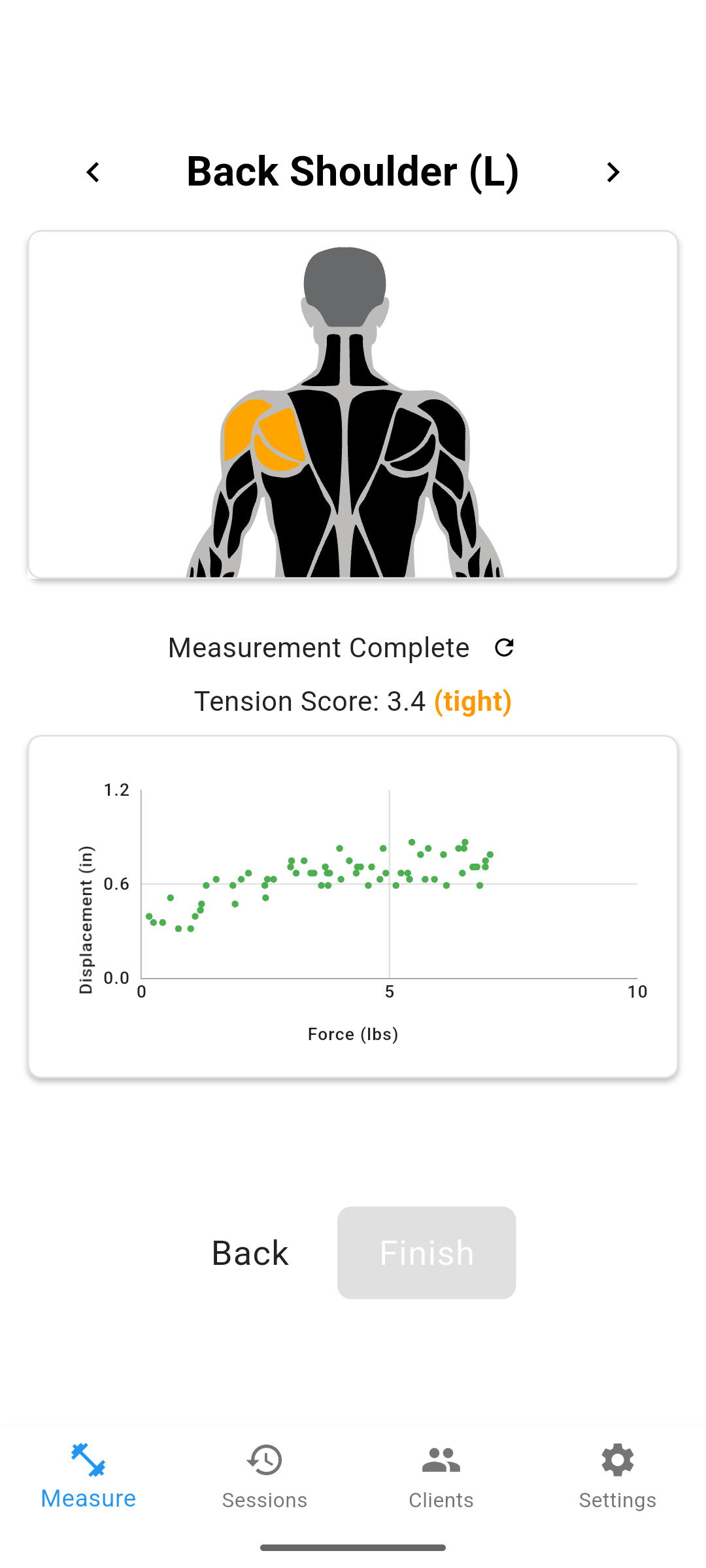
One approach is to add an objective tissue-level channel alongside your pain and function measures. Options include handheld soft tissue stiffness measurement (such as MuscleMap), shear wave elastography where an ultrasound system is available, and instrumented range-of-motion testing. Each gives you something concrete to track rather than relying on feel alone.