
Measure each side with a myotonometer at the same landmark and position, then compare the two readings as a percentage difference. A 2025 pilot study found that a side-to-side difference of about 10 to 14 percent is normal in healthy muscle. A 2026 methodological paper on reference values for muscle stiffness and asymmetry argues those thresholds are only usable when landmark, posture, and time of measurement are standardised first. Larger or growing gaps are what may matter. The discipline is in matched placement, not the device.
How do you actually take the two readings?
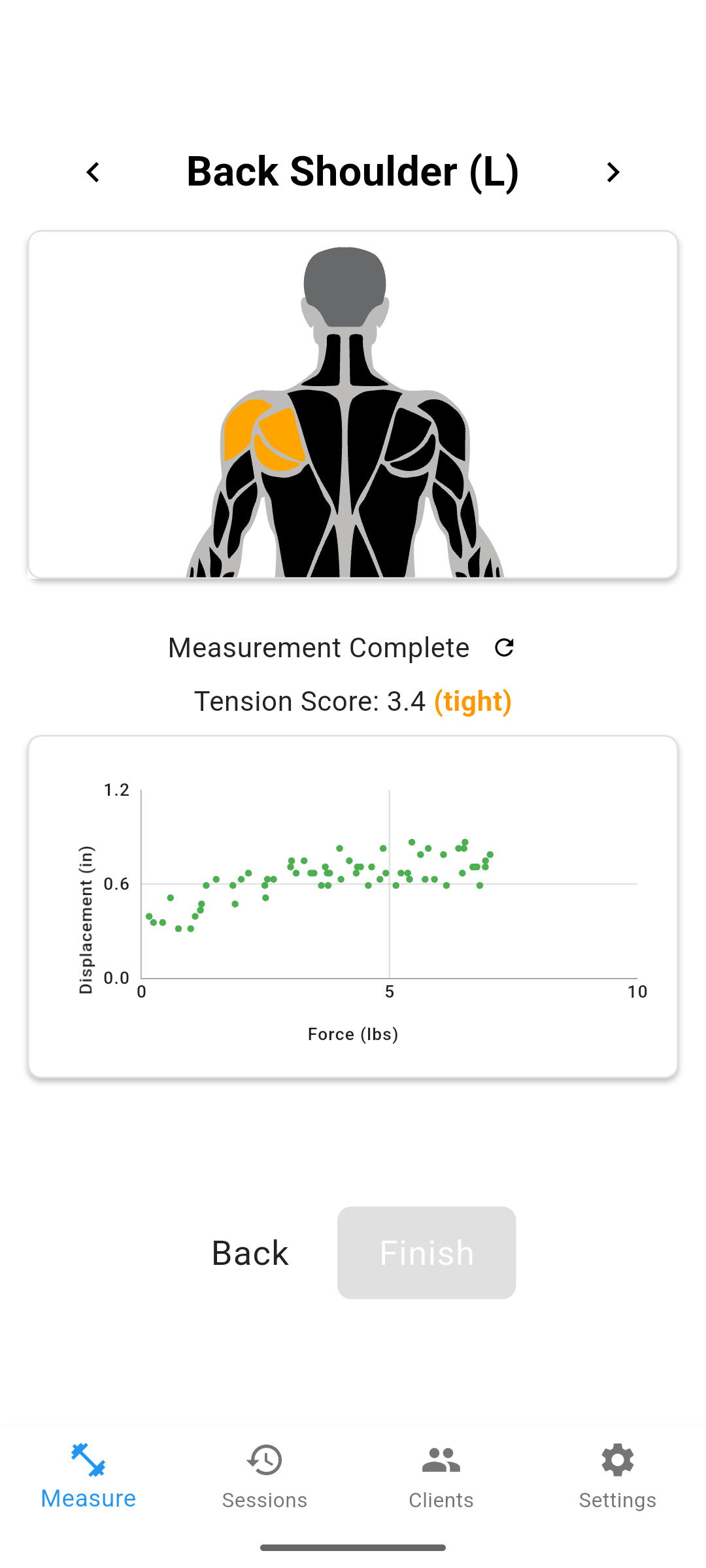
You measure one side, then mirror everything on the other side. Place a handheld myotonometer over the muscle belly, deliver the same brief impulse, and record the stiffness value. Then repeat on the contralateral muscle at the matched landmark, with the patient in the identical position. The difference between the two numbers is your asymmetry.
What makes or breaks the comparison is consistency. A study quantifying paraspinal muscle tone and stiffness reported good between-day reliability for these measurements when the protocol was standardized. Measure both sides at rest, at the same level, with the patient set up the same way. A relaxed muscle on one side and a guarded one on the other will read as asymmetry that is not really there.
How much asymmetry is normal?
Small side-to-side differences are expected. A 2025 pilot study in the Journal of Manual and Manipulative Therapy measured 26 healthy young adults across seven muscle groups with the MyotonPRO and found average bilateral asymmetry of roughly 10 to 14 percent, consistent with physiologic variation. Sex was the only significant predictor of overall stiffness in that sample. Age, BMI, and weekly exercise were not.
The practical takeaway is to treat a modest left-right gap as background noise. A reading that sits well outside the normal band, or one that tracks with the patient's symptomatic side, is the kind of finding worth a second look.
| Side-to-side difference | How to read it |
|---|---|
| Roughly 10 to 14 percent | Within the normal physiologic range |
| Notably larger than baseline | May warrant a closer look alongside symptoms |
| Tracks the patient's painful side | One data point to interpret with pain and function |
| Shrinking over a course of care | A measurable trend you can show the patient |
Is the stiffer side always the painful side?
No. Stiffness and pain are independent signals. A study in PLOS ONE on lumbar erector spinae stiffness found higher stiffness on the painful side during sitting, but the difference was not significant in prone, and pain intensity did not reliably mirror stiffness. A patient can have a stiffer side with no pain there, or pain on the side that reads softer.
That is why asymmetry is a measurement, not a verdict. It may reflect handedness, habitual posture, or load history. It becomes more useful when it is large, when it lines up with symptoms, or when it moves across visits.
Survey data: In a 2026 survey of 455 patients who stopped chiropractic care, 58% cited perception-based reasons: 36% felt no progress, and 22% felt better and stopped. A side-to-side number that narrows over several visits gives the first group something concrete to see, even before their pain shifts.
What is the most common way to get a false reading?
Position drift between sides is the usual culprit. If the patient rotates slightly, holds tension on one side, or you measure a centimeter off the matched landmark, the two numbers stop being comparable. The asymmetry you record is then an artifact of method, not tissue.
Build a small ritual. Mark the landmarks, set the position once, measure at rest, and take both sides back to back. Repeating that ritual at every re-exam is what lets you trust a change in the gap over time.
Why measure asymmetry instead of just palpating it?
Palpation can tell you one side feels tighter, but it cannot put a number on it or chart whether the gap closes over six visits. A myotonometer returns a repeatable value you can record, compare, and show the patient on a report. It does not replace your hands. It adds a number to what they already tell you.
Frequently Asked Questions
How do you measure left-right muscle stiffness asymmetry?
Take a stiffness reading on each side at the same landmark, in the same position, with the same number of taps. Compare the two values as a percentage difference. A handheld myotonometer gives the numbers; matched placement makes the comparison valid.
How much left-right stiffness difference is normal?
A 2025 pilot study using the MyotonPRO found average bilateral asymmetry of about 10 to 14 percent across seven muscle groups in healthy young adults. Small side-to-side differences are physiologic. Larger or growing gaps are what may warrant attention.
Does stiffness asymmetry mean the patient has a problem?
Not on its own. Asymmetry may reflect handedness, posture, or normal variation. It is more informative when it is large, tracks the symptomatic side, or changes over care. Interpret it alongside pain and function, never in isolation.
Is the stiffer side always the painful side?
No. Stiffness and pain are independent. One study found higher paraspinal stiffness on the painful side in sitting but not prone, and pain intensity did not reliably track stiffness. Position and the individual both matter.
What ruins an asymmetry comparison?
Inconsistent placement, a different patient position between sides, an active muscle on one side, or measuring at different times. Any of these can produce a side difference that is an artifact of method rather than a real finding.
Why measure asymmetry instead of just palpating?
Palpation cannot put a number on a 12 percent side difference or chart whether it shrinks over six visits. A myotonometer returns a repeatable value you can record and show the patient. It supplements palpation rather than replacing it.
Are published asymmetry thresholds ready to use as clinical cutoffs?
Not yet as hard cutoffs. A 2026 methodological paper on reference values notes that published asymmetry ranges only transfer between clinics when landmark, posture, and timing are standardised. Treat them as orientation and rely on each patient's own baseline for decisions.
One approach is to add a second channel of objective data alongside subjective pain reports. Options include soft tissue stiffness measurement (such as MuscleMap), range-of-motion testing, and posture analysis. Each gives you something concrete to show the patient rather than asking them to take your word for it.