
Place a handheld myotonometer over the infraspinatus belly in the infraspinous fossa, about two to three centimeters below the scapular spine, with the patient prone and the arm relaxed. Mark the site, take several readings, and average them. The harder point is interpretation: a stiffness number does not identify a trigger point or explain shoulder pain.
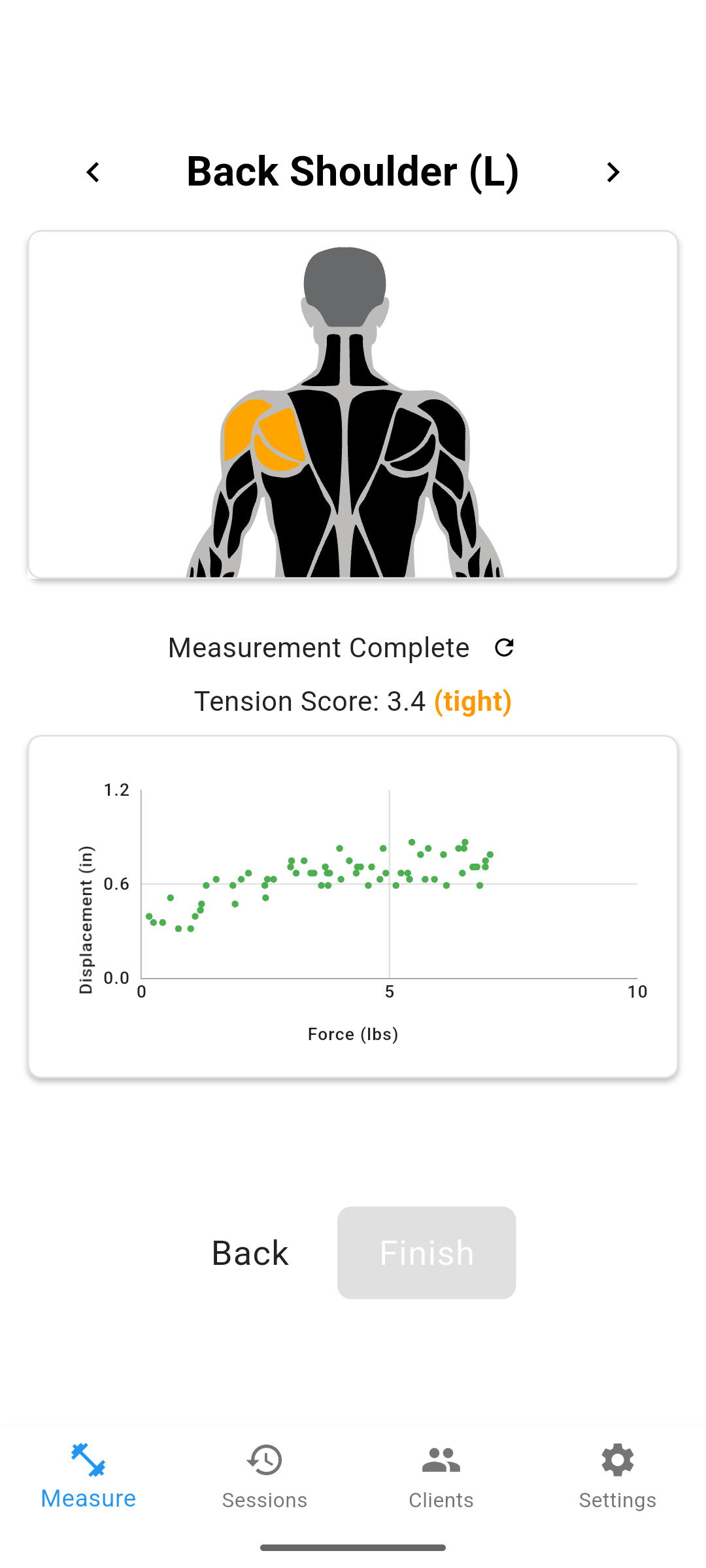
Where do you place the probe on the infraspinatus?
Find the scapular spine, drop two to three centimeters into the infraspinous fossa, and stay between the medial scapular border and the posterior deltoid. That window keeps you over the muscle belly and off bone. The posterior deltoid overlaps the lateral portion, so drifting laterally measures a different muscle. Mark the site with a skin pencil so every re-test lands in the same place.
Arm position is the variable most people underestimate here. The infraspinatus is an external rotator, so rotating or abducting the arm changes muscle length and moves the reading on its own. Standardize on prone with the arm relaxed at the side, and use the same position at every visit. Site drift and position drift are the two fastest ways to lose a usable trend.
Can a stiffness reading find a trigger point?
No, and this is worth knowing before you build a workflow around it. A 2025 study that determined pain pressure thresholds and muscle stiffness cut-offs in the infraspinatus reported excellent intra-examiner reliability for shear wave elastography, with good inter-examiner agreement. Pressure pain thresholds were significantly lower at latent trigger points than at nearby control sites. Measured stiffness was not significantly different between those same sites.
The practical reading of that: pressure algometry is the more sensitive tool for locating a latent trigger point, and stiffness measurement is better suited to tracking a region over time. They answer different questions, and substituting one for the other produces a confident wrong answer.
| Question you are asking | Better tool | Limitation |
|---|---|---|
| Is this specific spot tender? | Pressure algometry | Requires patient report, not a passive measure |
| How stiff is this region, and is it changing? | Handheld myotonometry | Superficial depth; site marking is critical |
| What is the deeper tissue doing? | Shear wave elastography | Costlier, less portable, operator-dependent |
| Is the infraspinatus the pain source? | Full clinical exam | No single measurement answers this |
What is a stiffness reading actually good for here?
Tracking the direction of change in a marked region across an episode of care. Myotonometry has been used to capture immediate changes in infraspinatus viscoelastic properties after intervention, including in a study on the immediate effect of dry needling on trigger point viscoelastic properties. That is a change-detection use, not a diagnostic one.
Reliability supports that use when the protocol holds. A 2024 systematic review in Medicina evaluating MyotonPRO reliability pooled 48 studies across 31 muscles and found consistently high intra-rater and inter-rater reliability for stiffness, conditional on standardized positioning. Compare the patient to their own baseline rather than to a population norm: a 2025 pilot study in the Journal of Manual & Manipulative Therapy found sex significantly predicted stiffness and that small bilateral asymmetry was normal in healthy adults.
Survey data: In a 2026 survey of 455 patients who stopped chiropractic care, 58% cited perception-based reasons: 36% felt no progress, and 22% felt better and stopped. A shoulder patient who can see a measured trend has something to judge besides how the shoulder felt this morning.
Frequently Asked Questions
How do you measure infraspinatus stiffness?
Place a handheld myotonometer over the infraspinatus belly in the infraspinous fossa, roughly two to three centimeters below the scapular spine and midway between the medial border and the posterior deltoid. Keep the patient prone with the arm relaxed, mark the site, take several readings, and average them.
Where is the best probe placement for the infraspinatus?
Find the scapular spine, drop two to three centimeters into the infraspinous fossa, and stay between the medial scapular border and the posterior deltoid. This keeps you over the muscle belly and away from bone and the overlying deltoid.
Can a stiffness reading identify a trigger point in the infraspinatus?
Not on its own. A 2025 study using shear wave elastography found excellent reliability but no significant stiffness difference between latent trigger points and nearby control sites, even though pressure pain thresholds were clearly lower at the trigger points.
Should the patient's arm be positioned or supported?
Keep the arm relaxed at the side in prone, in the same position at every visit. The infraspinatus is an external rotator, so any arm rotation or abduction changes muscle length and shifts the reading independently of tissue change.
Can you compare left and right infraspinatus readings?
Yes, but interpret asymmetry cautiously. Some bilateral difference is normal in healthy adults, and unilateral loading from work or sport can shift a side without any pathology. Use asymmetry as a prompt to look further, not as a finding by itself.
Does infraspinatus stiffness explain a patient's shoulder pain?
No. Stiffness and pain are independent, and the research linking measured stiffness to shoulder symptoms is inconsistent. An elevated reading may reflect a change in the tissue, but it does not diagnose the infraspinatus as the pain source.
Can you use stiffness readings to track treatment of the infraspinatus?
Yes, and this is the stronger use. Myotonometry has been used to capture immediate changes in infraspinatus viscoelastic properties after intervention. Take a baseline at the marked site and trend the direction of change rather than reading a single value.
One approach is to add a second channel of objective data alongside subjective pain reports. Options include soft tissue stiffness measurement (such as MuscleMap), range-of-motion testing, and posture analysis. Each gives you something concrete to show the patient rather than asking them to take your word for it.