
Patient-reported stiffness is a useful outcome, but not a reliable stand-in for measured tissue stiffness. What a patient calls stiff reflects sensation and nervous-system guarding as much as tissue mechanics, so it can improve or worsen on its own. Track it, but pair it with an objective channel. Relying on the felt report alone leaves you judging care by a number that may not track the tissue at all.
Does felt stiffness match measured stiffness?
Frequently, no. The sensation of stiffness and mechanically measured stiffness are related but independent, and in some populations they move in opposite directions. A 2019 study, "Tissue Stiffness Is Not Related to Pain Experience", found that in chronic neck and back pain the more painful side did not reliably show higher measured myofascial stiffness than the less painful side. Felt state and measured state simply did not line up.
Patients themselves treat these as different things. A 2022 study in BMC Musculoskeletal Disorders on what discomfort, pain, and stiffness mean to patients found that people describe stiffness as restricted movement or tightness, separate from the sharp, interrupting quality they call pain. Stiffness is a real and trackable experience, but it is a perception, and perceptions are shaped by fatigue, stress, and expectation, not only by tissue.
So why measure stiffness objectively at all?
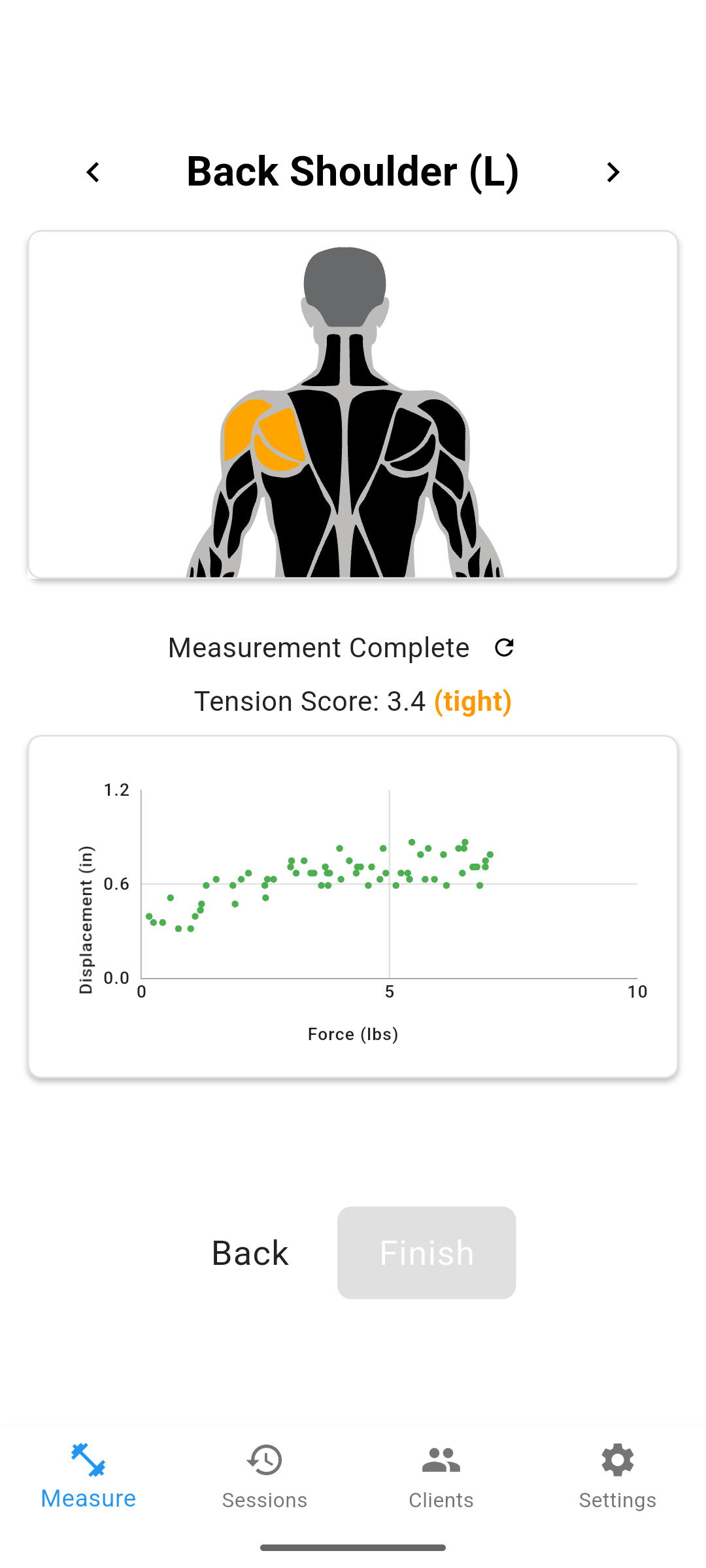
Because an objective reading gives you a second, independent channel. Myotonometry provides a repeatable number for how much the tissue resists deformation. A 2024 systematic review in Medicina evaluating MyotonPRO reliability pooled 48 studies across 31 muscles and reported consistently high intra-rater and inter-rater reliability for stiffness. That does not make the device a lie detector for how a patient feels. It means you can trend the mechanical property separately from the sensation and compare the two over time.
| Signal | What it captures | Reliability as an outcome |
|---|---|---|
| Patient-reported stiffness | Felt tightness and restriction | Useful, but subjective and variable |
| Measured stiffness (myotonometry) | Mechanical resistance of the tissue | High test-retest reliability |
| The two together | Experience plus tissue trend | Strongest, and hardest to argue with |
Survey data: In a 2026 survey of 455 patients who stopped chiropractic care, 58% cited perception-based reasons: 36% felt no progress, and 22% felt better and stopped. Neither group was told their measured soft tissue stiffness was still elevated.
How do you make stiffness a defensible outcome measure?
Record both channels on the same schedule. Use a consistent numeric scale for the patient's felt stiffness at each visit, and take an objective reading at baseline and each re-exam. When the two agree, you have a strong, convergent story. When they disagree, that gap is itself clinically useful: a patient who feels better while the reading stays elevated may benefit from finishing the plan rather than self-discharging.
Keep the clinical framing honest. A stiffness reading may reflect a change in the tissue, but it does not diagnose a condition, predict recurrence, or prove that stiffness caused the pain. Stiffness and pain are independent properties. The value of measuring is not certainty, it is a second data point the patient can see.
Frequently Asked Questions
Is patient-reported stiffness a reliable outcome measure?
It is a useful patient-reported outcome, but not a reliable proxy for measured tissue stiffness. What a patient calls stiffness reflects sensation, guarding, and mood as much as tissue mechanics, so it can move on its own. Track it, but do not treat it as an objective reading.
Does felt stiffness match measured stiffness?
Often not. Studies show the sensation of stiffness and mechanically measured stiffness can diverge, and can even move in opposite directions in some chronic pain groups. A patient can feel loose while the tissue reads elevated, or feel stiff when the reading is normal.
What do patients actually mean when they say stiff?
Patients use stiffness to describe limited movement or tightness, distinct from the sharp quality they label pain. It is a real, trackable experience, but it is a perception, not a direct measurement of how much the tissue resists deformation.
Should you stop asking patients about stiffness?
No. Patient-reported stiffness captures the experience that brings people in and keeps them in care. The point is to pair it with an objective channel so you are not relying on a single subjective number to judge whether care is working.
How do you turn stiffness into a defensible outcome measure?
Use a consistent scale for the felt report and add an objective measure alongside it, such as myotonometry, range-of-motion testing, or posture analysis. Recording both at baseline and re-exam lets you show change that does not depend on one channel.
Why does this matter for retention?
Most early dropout is perception-based. When a patient's felt stiffness is the only signal and it improves, they self-discharge; when it lingers, they assume failure. An objective reading gives them a reason to continue that does not swing with how they feel that week.
One approach is to add a second channel of objective data alongside subjective pain reports. Options include soft tissue stiffness measurement (such as MuscleMap), range-of-motion testing, and posture analysis. Each gives you something concrete to show the patient rather than asking them to take your word for it.