
Most insurers accept a combination of validated patient-reported outcome measures (PROMs) and objective physical findings. The standard PROM set is ODI for low back pain, NDI for neck pain, and NPRS or VAS for pain intensity. Objective findings include range of motion, orthopedic, and neurological testing. Coverage rules vary by payer and state, but missing or unchanging outcome scores remain the top documentation reason cited in payer audits. The pressure to document well is growing: a 2025 study in Scientific Reports on long-term rehabilitation adherence found that personalized, high-quality feedback significantly improved patient adherence, while frequent low-quality feedback could backfire. The same logic now appears in payer guidance: the chart is expected to show that measurement happened and that the patient was engaged with the result. Reimbursement is also expanding: as of 2025, Medicare pays for Remote Therapeutic Monitoring (RTM) of musculoskeletal care, so digitally tracked outcome measures such as home-exercise adherence, pain, and function can be billed under CPT codes 98975, 98977, 98980, and 98981.
What PROMs are most commonly accepted?
The four core PROMs in chiropractic billing are ODI, NDI, NPRS, and VAS. These are validated, freely available, and named explicitly in many payer policies and Local Coverage Determinations.
| Instrument | What it measures | Typical use | Score range |
|---|---|---|---|
| Oswestry Disability Index (ODI) | Low back functional limitation | Low back pain claims | 0–100% |
| Neck Disability Index (NDI) | Neck functional limitation | Neck pain, whiplash claims | 0–50 or 0–100% |
| Numeric Pain Rating Scale (NPRS) | Current pain intensity | All complaints | 0–10 |
| Visual Analog Scale (VAS) | Current pain intensity | All complaints | 0–100 mm |
| Roland-Morris Disability Questionnaire (RMDQ) | Low back disability | Some payers as ODI alternative | 0–24 |
| Patient-Specific Functional Scale (PSFS) | Patient-chosen activities | Adjunct PROM | 0–10 per activity |
What objective findings count alongside PROMs?
Range of motion, orthopedic tests, neurological tests, and palpation findings are the standard objective set. Each should appear at baseline and be re-tested at re-examination so the chart shows a comparable before-and-after.
- Range of motion: goniometer, inclinometer, or validated app for cervical, thoracic, lumbar segments.
- Orthopedic tests: SLR, Kemp, Spurling, Yeoman, and others appropriate to the region.
- Neurological tests: reflexes, dermatomes, myotomes, sensation.
- Palpation: tenderness, hypertonicity, restriction; documented qualitatively in most payer rubrics.
Range of motion is the most frequently challenged objective measure because subjective visual estimates are not reproducible. A practice-pattern study published in 2010 found that roughly 95% of chiropractors measure range of motion visually rather than with a goniometer or inclinometer, which limits inter-visit comparability. Using a measurement tool, even a basic inclinometer app, makes the chart auditable.
How often must outcome measures be repeated?
At baseline, at each formal re-examination, and at discharge. Re-examinations typically occur every 12 visits or every 30 days, whichever is sooner. Some payers require interim scores every 4 to 6 visits to continue authorizing care.
- Intake / baseline: full PROM panel plus objective findings.
- Interim (every 4-6 visits, if required): abbreviated PROMs (NPRS at minimum) to show trend.
- Formal re-exam (every 12 visits or 30 days): full PROM panel plus re-tested objective findings.
- Discharge: final PROM and objective scores plus documented decision rationale.
Are emerging tools like myotonometry accepted by insurance?
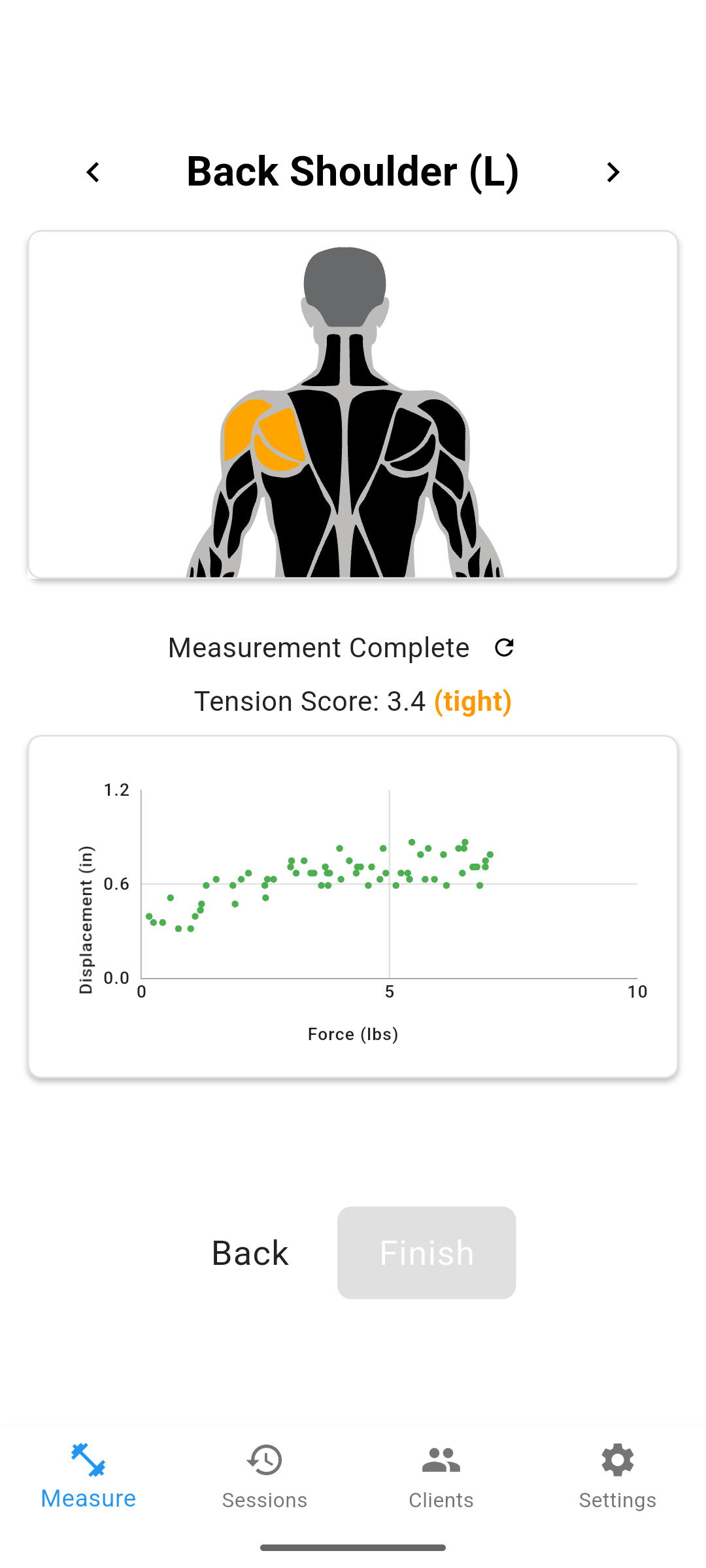
Not yet, as standalone billable measures. Newer technologies such as myotonometry, surface EMG, and posture analysis are not listed in most payer LCDs as required or reimbursable PROMs. They can be documented as supplemental objective findings to support medical necessity, but they should not replace standard PROMs in the chart.
That gap exists partly because the chiropractic outcomes infrastructure is thin. A 2025 scoping review in Chiropractic and Manual Therapies found only one chiropractic clinical outcomes registry currently operating (Spine IQ). Until field-wide registries normalize newer tools, payers will continue to anchor on the older PROM set.
What happens if you skip outcome measures at re-exam?
Claims get denied or downcoded for lack of demonstrated medical necessity. Audits routinely cite three failure modes:
- No baseline PROM in the initial exam.
- Identical PROM scores recorded across multiple re-exams, suggesting copy-paste documentation.
- PROM scores improving while objective findings stay unchanged, with no rationale for continued care.
The audit defense is straightforward: collect the same PROMs at intake, re-exam, and discharge, and document what changed and what did not. A 2024 systematic review of 43 studies in the Journal of Patient Experience also showed patients value seeing this process happen visibly, so consistent re-measurement supports both the audit chart and patient retention.
Survey data: In a 2026 survey of 455 patients who stopped chiropractic care, 58% cited perception-based reasons: 36% felt no progress, and 22% felt better and stopped. Neither group was told their stiffness was still elevated.
Frequently Asked Questions
Which outcome measures do insurance companies accept for chiropractic re-examinations?
The standard PROM set is ODI for low back pain, NDI for neck pain, and NPRS or VAS for pain intensity, paired with objective findings like range of motion and orthopedic testing. Coverage rules vary by payer and state.
Is the Oswestry Disability Index required for low back pain claims?
It is the most commonly accepted low back PROM but not universally required. Many payers also accept Roland-Morris or Quebec Back Pain as alternatives. Check your local payer policy.
How often should outcome measures be repeated for insurance documentation?
At intake, at each formal re-examination (every 12 visits or 30 days), and at discharge. Some plans require interim PROM scores every 4 to 6 visits to support continued medical necessity.
Are technology-based measures like myotonometry accepted by insurers?
Not as standalone billable outcome measures in most policies. They can support medical necessity as supplemental objective findings but should not replace standard PROMs and physical findings.
What happens if you do not include outcome measures in a re-exam?
Claims can be denied or downcoded for lack of demonstrated medical necessity. Most payer audits cite missing or unchanged outcome measures as a primary reason for recoupment.
Does Medicare require specific outcome measures for chiropractic services?
Medicare requires documentation of medical necessity but does not mandate a single PROM. Local Coverage Determinations often list ODI, NDI, NPRS, and PSFS as acceptable instruments.
Can you use a digital app to document range of motion?
Yes, in most cases. Validated digital inclinometer apps produce reproducible numbers that are easier to defend in audit than visual estimates. Confirm your payer accepts the specific app or device.
Does showing the patient their own outcome scores help with medical-necessity documentation?
Indirectly, yes. A 2025 study in Scientific Reports found that personalized, high-quality feedback to patients significantly improved long-term rehabilitation adherence. Better adherence supports the medical-necessity narrative in two ways: the patient attends more consistently, and the chart shows a discussion of objective change rather than a passive log of scores.
Can chiropractors bill for digitally tracked outcome measures?
Yes, through Remote Therapeutic Monitoring. As of 2025, Medicare reimburses RTM of the musculoskeletal system under CPT codes 98975, 98977, 98980, and 98981, covering digitally tracked measures like adherence, pain, and function. Only one provider per episode can bill it in a given month, and the device-supply code requires at least 16 days of data in 30.
One approach is to add a second channel of objective data alongside subjective pain reports. Options include soft tissue stiffness measurement (such as MuscleMap), range-of-motion testing, and posture analysis. Each gives you something concrete to show the patient rather than asking them to take your word for it.