
Within minutes. A 2025 study measuring the erector spinae found a significant drop in stiffness immediately after manual myofascial release. The harder question is durability, because short-term drops can return toward baseline within about 24 hours. That distinction decides when you should re-measure.
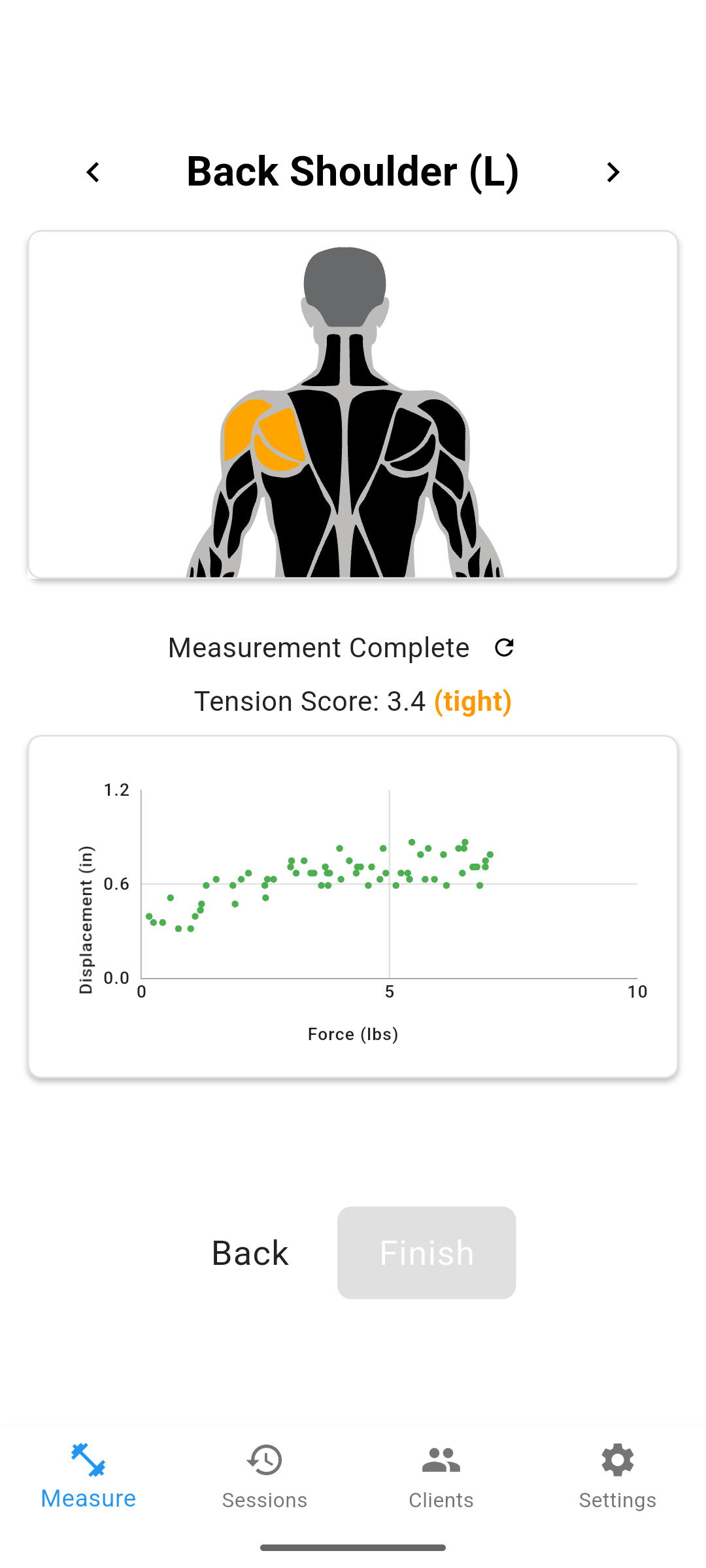
How Fast Is the Immediate Response?
Same session, same visit. A 2025 study in Sensors compared manual and tool-assisted soft tissue work on the erector spinae using a handheld device and reported a significant immediate reduction in stiffness and tone after manual myofascial release. The tool-assisted arm did not produce the same effect. The measurement device was sensitive enough to pick up the difference inside a single appointment.
A 2025 study on the masseter and upper trapezius found the same sensitivity after stretching, coordination exercise, and heavy chewing, with intervention-specific effects on stiffness, tone, creep, and relaxation time. Short interventions move the number.
How Long Does the Change Last?
Often not long, and that is the part clinicians skip. A controlled study in chronic back and neck pain found tissue stiffness reduced by cupping massage had returned to baseline by 24 hours. The immediate reading and the next-visit reading are answering two different questions.
Published myotonometry work also has a gap here. Most studies measure immediately post-intervention and stop. That means the honest answer for durability at the individual patient level is that it varies and it needs tracking, not a claim about how many hours the effect holds.
| Measurement timing | What it tells you | What it does not tell you |
|---|---|---|
| Immediately post-treatment | The tissue responded to what you just did | Whether the response persists |
| Next visit, pre-treatment | Where the tissue settled between visits | Which specific technique drove it |
| Every 2 to 4 weeks, pre-treatment | The direction of the case over time | Day to day variability |
| At discharge vs baseline | Total change across the course of care | When during care the change happened |
When Should You Actually Re-Measure?
At the start of the visit, before hands go on the patient. A pre-treatment reading at each appointment gives you a clean series. Comparing pre-treatment to post-treatment inside one visit measures the session. Comparing pre-treatment readings across weeks measures the case, and the case is what the patient is paying for.
Control the obvious confounders so the series stays interpretable:
- Same body position and probe location, documented at baseline.
- Similar time of day where scheduling allows.
- Ask about training, unusual activity, and sleep in the last 48 hours.
- Take multiple readings per site rather than trusting one.
- Measure both sides so the patient acts as their own reference.
Does a Falling Stiffness Reading Mean Less Pain?
No, and treating the two as the same number will eventually embarrass you. A systematic review of shear wave elastography in musculoskeletal pain found the relationship is inconsistent. Painful muscles measured stiffer than controls in some studies, equivalent in others, and less stiff in others.
That independence is a feature for clinical use. A stiffness reading may reflect mechanical change the patient cannot feel, which is exactly the information that is missing when pain is the only channel you have.
What Does Change Look Like Across a Full Course of Care?
It shows up over weeks, not sessions. A 2025 study of infants with congenital muscular torticollis measured sternocleidomastoid properties before and after a physiotherapy program and found significant change in muscle properties across the course, supporting the device as a follow-up tool. The unit of analysis was the program, not the appointment.
Set that expectation with the patient at baseline. If you tell them the number should drop every visit, a normal fluctuation reads as failure. If you tell them you are watching the trend across a month, a single flat visit is just a data point.
Survey data: In a 2026 survey of 455 patients who stopped chiropractic care, 58% cited perception-based reasons: 36% felt no progress, and 22% felt better and stopped. Neither group was told their stiffness was still elevated.
Frequently Asked Questions
How fast can a stiffness reading change after treatment?
Immediately. A 2025 study measuring the erector spinae with a handheld device found a significant reduction in stiffness and tone right after manual myofascial release. The change was detectable within the same visit.
Does an immediate drop in stiffness mean the treatment worked?
Not on its own. An immediate drop may reflect a short-term mechanical response rather than a durable change in the tissue. One controlled study found stiffness reduced after cupping massage returned to baseline within 24 hours.
When should you re-measure to track real progress?
At the start of a visit, before any hands-on work, and on a fixed interval across weeks. Comparing a pre-treatment reading to a post-treatment reading from the same visit measures the session, not the case.
Does a change in stiffness mean a change in pain?
No. A systematic review of shear wave elastography studies found musculoskeletal pain was inconsistently associated with muscle stiffness, with painful muscles measuring stiffer, equal, or less stiff across studies. Track the two independently.
How long does it take to see change across a course of care?
Weeks rather than visits, and it varies by case. A 2025 study of infants with congenital muscular torticollis found measurable change in sternocleidomastoid properties across a physiotherapy program, supporting myotonometry as a follow-up tool over a treatment course rather than a single session.
Can a stiffness reading go up between visits?
Yes, and it often does for benign reasons. Recent exercise, poor sleep, and time of day all move readings. Ask what the patient did in the 48 hours before the appointment before interpreting a rise as a setback.
Should you show the patient the immediate post-treatment reading?
Be careful with it. A dramatic same-visit drop is easy to over-sell and may not persist to the next appointment, which sets up disappointment. The comparison worth showing the patient is the one across weeks at a matched time and setup.
One approach is to add a second channel of objective data alongside subjective pain reports. Options include soft tissue stiffness measurement (such as MuscleMap), range-of-motion testing, and posture analysis. Each gives you something concrete to show the patient rather than asking them to take your word for it.