
Every two to four weeks for most outpatient caseloads, plus a baseline at evaluation and a reading at discharge. Shorter intervals mostly capture noise. Day-to-day variation from activity, time of day, and positioning can exceed the tissue change you are trying to detect, so a visit-to-visit comparison tells you very little.
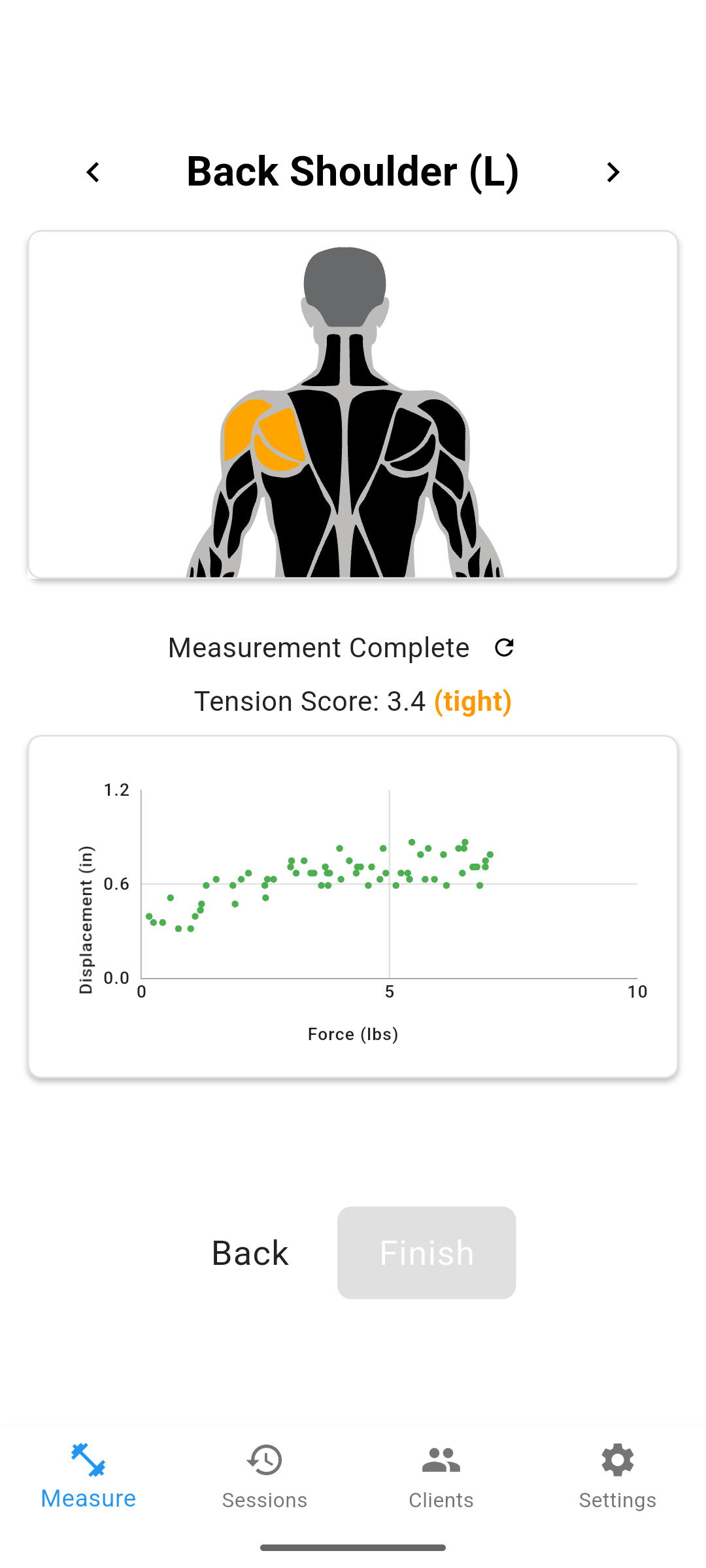
Why does measuring every visit backfire?
Because the signal you want is smaller than the noise you collect. Handheld myotonometry is reliable when the protocol is standardized, but reliability describes agreement under controlled conditions, not the absence of biological variation. A patient who walked in from a hot parking lot, sat for twenty minutes, or trained the night before will produce a different reading than the same patient under different conditions. None of that is tissue change.
Measure too often and you end up explaining fluctuations rather than trends. That is worse than not measuring, because a patient who watches a number bounce around loses confidence in the number. Spacing re-measurements out gives real change time to accumulate past the noise floor.
What interval fits which patient?
Match the interval to how fast the clinical picture is actually moving. Acute presentations change faster and tolerate a shorter interval. Chronic and maintenance-phase patients change slowly, so a longer interval produces a cleaner read.
| Patient stage | Re-measure interval | Reasoning |
|---|---|---|
| Initial evaluation | Baseline reading | Every later comparison depends on it |
| Acute, rapidly changing | Every 2 weeks | Clinical picture moves fast enough to outrun noise |
| Subacute, standard plan | Every 3 to 4 weeks | Aligns with routine re-evaluation cadence |
| Chronic or maintenance | Every 4 to 6 weeks | Slow change, longer window needed to read direction |
| Discharge | Final reading | Closes the trend and documents the episode |
What has to stay constant between measurements?
Everything except the tissue. Keep the marked site, the patient position, and the probe angle identical, and try to hold the time of day and activity state roughly consistent. A 2024 systematic review in Medicina evaluating MyotonPRO reliability pooled 48 studies across 31 muscles and found high intra-rater and inter-rater reliability, with standardized positioning as the recurring condition attached to those numbers. Drop the standardization and the reliability does not travel with you.
Comparison targets matter too. A 2025 pilot study in the Journal of Manual & Manipulative Therapy reported preliminary reference values for resting stiffness and found that sex significantly predicted stiffness, with small but measurable bilateral asymmetry in healthy adults. That points the same direction: compare the patient to their own baseline, not to a generic norm.
Survey data: In a 2026 survey of 455 patients who stopped chiropractic care, 58% cited perception-based reasons: 36% felt no progress, and 22% felt better and stopped. Neither group was shown a measured trend of where their tissue actually was.
Does re-measuring change anything for the patient?
Only if you show them the trend and explain it. The measurement is inert on its own. A 2025 study of an advanced orthopedic virtual physical therapy model reported high engagement and clinically significant functional improvement in a program built on structured, repeated outcome tracking shared back with patients. Repeated measurement that stays inside the chart does not produce that effect.
Set the expectation early about what a flat line means. Patients frequently gain range of motion and function without a matching drop in measured stiffness, and stiffness and pain move independently. If the patient hears that at the baseline visit, an unchanged reading at week four reads as normal rather than as failure.
Frequently Asked Questions
How often should a physical therapist re-measure muscle stiffness?
Every two to four weeks for most outpatient caseloads, plus a baseline at evaluation and a final reading at discharge. That spacing lets real change accumulate past normal day-to-day variation.
Why not measure stiffness every visit?
Because short-interval readings are dominated by noise. Time of day, recent activity, hydration, and small changes in patient position all move the number, so a visit-to-visit difference is usually measurement variation rather than tissue change.
Should acute patients be re-measured more often?
Slightly, yes. A two-week interval is reasonable for acute presentations where the clinical picture is moving quickly. For chronic or maintenance-phase patients, four to six weeks is usually enough to see a direction of change.
How much change in a stiffness reading is meaningful?
There is no single published threshold that applies across muscles and populations. Treat small differences cautiously, look for a consistent direction across two or more re-measurements, and interpret it alongside range of motion, strength, and reported function.
Does re-measuring stiffness improve patient adherence?
It may help, because patients who can see structured progress data tend to stay engaged. The measurement itself does not change behavior. Showing the trend and explaining what it means is the part that gives the patient something concrete.
What has to stay constant between re-measurements?
The marked site, the patient position, the probe angle, and roughly the time of day and activity state. Anything that changes between visits other than the tissue itself becomes a confound in the trend.
Does an unchanged stiffness reading mean therapy is not working?
No. Stiffness is one property among several, and patients often gain range of motion and function without a matching change in measured stiffness. A flat stiffness trend alongside improving function is a normal pattern, not a failure.
One approach is to add a second channel of objective data alongside subjective pain reports. Options include soft tissue stiffness measurement (such as MuscleMap), range-of-motion testing, and posture analysis. Each gives you something concrete to show the patient rather than asking them to take your word for it.