
The common chiropractic re-examination cadence is every 12 visits or every 30 days, whichever comes first. That cadence satisfies most payer documentation requirements but it is too slow to catch the early dropout window. A 2024 KMC University practice management review reaffirmed the 30-day interval as the defensible standard, in part because most validated outcome questionnaires are designed to detect change at roughly that interval. If you add an objective tissue measure to that schedule, a 2025 systematic review in the Journal of Bodywork and Movement Therapies pooled 15 studies of handheld myotonometry on neck and back muscles and found most reliability outcomes were good to excellent, including across time intervals, which is what makes repeat measurement worth scheduling at all. A 2024 shear wave elastography study in Frontiers in Bioengineering and Biotechnology on chronic low back pain found that objectively measured paraspinal stiffness and pain intensity correlate but follow different trajectories during care, which is exactly why a shorter interim check at visit 6 or week 2, layered on top of the formal 30-day re-exam, is what most retention-focused practices add.
What is the standard re-examination frequency?
The default cadence in U.S. chiropractic practice is every 12 visits or every 30 days, whichever comes first. This interval is widely used because it lines up with how most commercial payers expect medical necessity to be re-documented. Many state boards reference a similar interval in their record-keeping guidance.
The 30-day cadence works for documentation. It does not work especially well for retention. Most early dropout happens before the 30-day mark, which means the first formal re-examination often occurs after the patient has already decided.
What does a complete re-examination cadence look like?
A retention-focused cadence layers a quick interim check on top of the formal re-exam.
| Stage | Cadence | Format | Primary purpose |
|---|---|---|---|
| Baseline | Visit 1 | Full initial exam plus objective markers | Establish comparison anchor |
| Interim progress check | Visit 6 or week 2 | 5-minute review of objective and subjective change | Catch dropout risk early, adjust plan |
| Formal re-examination | Every 12 visits or 30 days | Repeat baseline tests, documented | Document medical necessity, decide on next phase |
| Phase transition | End of acute care | Full re-exam, written progress summary | Move to corrective or maintenance phase |
| Maintenance re-check | Every 3 months | Spot check of objective markers | Catch regression early |
Survey data: In a 2026 survey of 455 patients who stopped chiropractic care, 58% cited perception-based reasons: 36% felt no progress, and 22% felt better and stopped. Most of these decisions formed before the first formal 30-day re-examination.
What should each re-examination actually compare?
A re-examination is only as useful as the baseline it is compared against. If the baseline is "patient reports 6/10 low back pain," the re-exam can only compare pain. If the baseline also includes range of motion, posture, and a soft tissue stiffness reading, the re-exam has multiple channels of comparison.
A 2008 review in the Journal of Manipulative and Physiological Therapeutics divided chiropractic outcome assessments into subjective and objective determinations and argued that both are needed. A separate practice-pattern study found that roughly 95% of chiropractors estimate range of motion visually, which limits how meaningfully it can be tracked across re-exams.
How does soft tissue stiffness fit into the cadence?
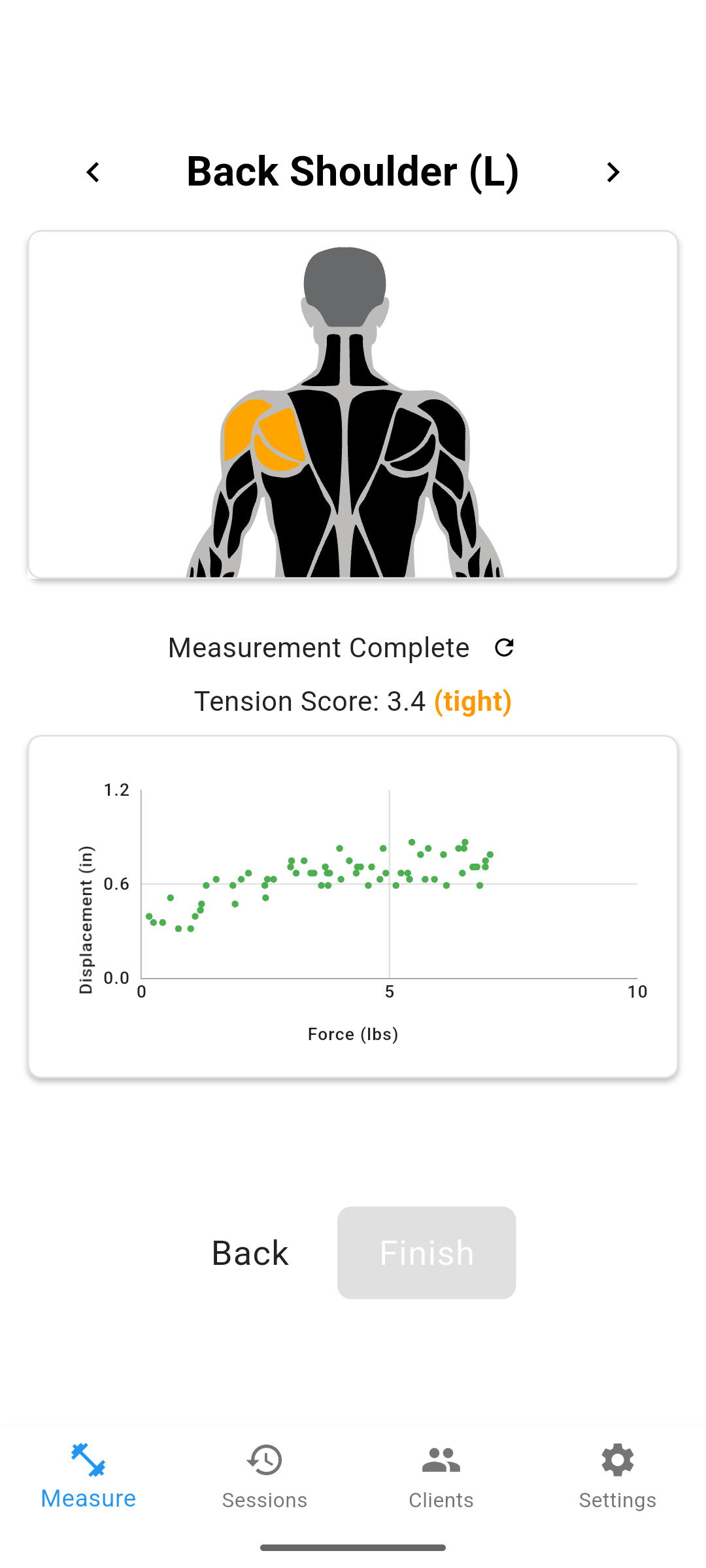
Soft tissue stiffness is a useful re-examination marker because it can change independently of pain. A patient may report pain has dropped from 6 to 3 while paraspinal stiffness remains elevated, which is clinically meaningful and supports continued care. The converse is also useful: stiffness may drop before pain does, which is reassuring to a patient who feels no different.
A 2024 systematic review of 48 MyotonPRO studies reported intraclass correlation coefficients above 0.75 across most muscle groups, supporting use in clinical re-examination. A 2024 study in adults with low back pain reached ICC values of 0.94 or higher for the lumbar multifidus, which is well within the range needed to track change over re-exams.
How does cadence affect insurance and documentation?
Payer policies vary, but the common pattern is:
- Medicare: progress and medical necessity documented at the visit level, with formal re-evaluation when status changes meaningfully.
- Commercial payers: re-examination expected every 30 days or every 6 to 12 visits, with documented objective findings.
- Workers compensation: tighter documentation often required, with formal progress reports on a defined cadence.
- Cash practices: cadence is fully under your control; many cash practices align with the 30-day standard for clinical consistency.
Check the specific policy for each payer before changing cadence.
Frequently Asked Questions
What is the standard chiropractic re-examination frequency?
The most common cadence in U.S. chiropractic practice is every 12 visits or every 30 days, whichever comes first. Many state boards and insurance payers expect documented re-examinations on roughly this interval for ongoing care to be considered medically necessary.
Is 30 days too long between re-examinations?
For documentation, 30 days is acceptable. For retention, 30 days may miss the early window when most dropouts decide to stop. An interim progress check at visit 6 or week 2 catches the perception drift earlier and lets you adjust the plan before the patient quietly disappears.
Do payers require a specific re-exam interval?
Requirements vary by payer and state. Medicare typically expects documentation of progress and medical necessity at the level of each visit, with a more formal re-evaluation when status changes meaningfully. Commercial payers often expect a re-examination every 30 days or every 6 to 12 visits. Always check the specific payer policy.
What should a chiropractic re-examination include?
A re-examination should compare against the baseline established at the initial visit. That typically includes pain rating, functional status, range of motion, and any objective measure already on the chart such as posture analysis or soft tissue stiffness. The point is comparison, not just a fresh exam in isolation.
How does cadence affect patient retention?
Shorter cadence with objective data tends to support retention because the patient gets earlier, more frequent evidence of progress. The visit becomes less about asking the patient how they feel and more about showing them what changed. Both perception-based dropout patterns, feeling no progress and feeling better, become harder to act on without information.
Should the re-examination cadence differ for acute vs maintenance patients?
Yes. Acute patients benefit from a tighter cadence in the first month while pain and function are changing fast. Maintenance patients can be on a longer cadence, often quarterly, since the goal is detecting regression rather than tracking acute recovery. The objective markers tracked can be similar in both cases.
Why is 30 days the standard interval and not 14 or 60?
A 2024 KMC University practice management review noted that most validated chiropractic outcome questionnaires are designed to detect change over roughly a 30-day window, which aligns the documentation cadence with the measurement window of the tools. Tighter intervals tend to fall below the minimum detectable change of the questionnaires; longer intervals risk falling outside payer expectations.
Should the interim check include objective tissue measurement?
It can. A 2024 shear wave elastography study in Frontiers in Bioengineering and Biotechnology found that paraspinal and thoracolumbar fascia stiffness in chronic low back pain patients correlates with pain and disability but follows a partly independent trajectory during care. A short stiffness measurement at the interim check (week 2 or visit 6) may surface tissue-level change before the formal 30-day questionnaire can detect it.
How reliable is a repeat stiffness measurement between visits?
Good enough to trend, if your setup holds. A 2025 systematic review in the Journal of Bodywork and Movement Therapies pooled 15 studies of handheld myotonometry on neck and back muscles and reported good to excellent reliability for most outcomes across intra-rater, inter-rater, and time-interval testing. Reliability depended on standardized site marking and positioning, not on the patient's age or sex.
One approach is to add a second channel of objective data alongside subjective pain reports. Options include soft tissue stiffness measurement (such as MuscleMap), range-of-motion testing, and posture analysis. Each gives you something concrete to compare at every re-examination rather than asking the patient to take your word for it.