
One or two, re-checked unchanged at every re-examination. Research on patient-reported outcome measures found a negative association between question burden and completion rate. Adding a third and fourth instrument does not give you a fuller picture. It gives you a partially filled one that you cannot compare across visits.
Why Does Adding More Measures Backfire?
Because completion rate falls as item count rises. A study on the utility of patient-reported outcome questionnaires examined the correlation between total question burden and response rate in surgically treated musculoskeletal patients. The relationship was negative and clear. The more items you put in front of a patient, the fewer of them come back completed.
This is worse than it sounds for a chiropractic practice. An outcome measure is only useful as a series. A baseline with no matching follow-up score is noise. If a patient completes four instruments at intake and two at re-examination, you have two usable comparisons and a pile of orphaned data.
What Does Long-Term Follow-Up Look Like in Practice?
Attrition is the default, and it compounds over months. Research on one-year outcome measure completion rates found follow-up completion drops enough that intensive prompting is required to keep the data usable. Work published in the Joint Commission Journal on optimizing outcome measure implementation in orthopedic clinics reaches a similar practical conclusion: collection design determines whether you get longitudinal data at all.
Your leverage is not in collecting more. It is in collecting the same small set reliably.
What Should the Two Measures Be?
One thing the patient reports, one thing you record yourself. That split gives you two independent channels without doubling the paperwork, because only one of them lands on the patient.
| Slot | Examples | Who completes it | What it tells you |
|---|---|---|---|
| Patient-reported function | Oswestry Disability Index, Neck Disability Index, Bournemouth Questionnaire, Patient-Specific Functional Scale | Patient | Whether daily activity has changed |
| Objective clinician-recorded | Range of motion, orthopedic testing, posture analysis, soft tissue stiffness measurement | You | Whether something measurable has changed independent of how the patient feels |
| Optional third | Global Rating of Change, a single pain scale | Patient, verbally | Low burden context, not a substitute for either slot above |
A pain scale asked out loud costs nothing and does not count against the burden budget. A second full questionnaire does.
Why Does the Objective Slot Matter So Much?
Because the patient-reported channel is the one that stalls first. Pain and function scores tend to improve early, then flatten while care continues. To the patient, a flat score reads as a stopped result. That is precisely the moment a second measure earns its place.
An objective reading may indicate mechanical change the patient has not noticed yet. It also survives the two failure modes that cost you patients: the one who feels nothing changed, and the one who feels fine and assumes the work is done.
Survey data: In a 2026 survey of 455 patients who stopped chiropractic care, 58% cited perception-based reasons: 36% felt no progress, and 22% felt better and stopped. Neither group was told their stiffness was still elevated.
Note what those two groups have in common. Both made a decision using only what they could feel. A measure they never completed and never saw could not have changed either decision.
How Often Should You Re-Administer?
On a fixed cadence, not when it feels useful. Every 12 visits or every 30 days, whichever comes first, is the common standard and lines up with what most payers expect for documented re-examination. A fixed schedule removes selection bias, because measuring only when you expect improvement produces a chart that flatters the care rather than describing it.
Keep the instrument identical across the series. Scores from different questionnaires are not interchangeable, so switching mid-course resets your comparison. If a patient's primary complaint moves to a different region and a switch is genuinely warranted, record both instruments at that one visit so the series stays connected.
Frequently Asked Questions
How many outcome measures should a chiropractor use per patient?
One or two, re-administered unchanged at every re-examination. Research on patient-reported outcome measures shows a negative association between total question burden and completion rate, so adding instruments reduces the amount of usable data you end up with.
Does adding more questionnaires give you a fuller picture?
Usually not. A study of question burden in surgically treated musculoskeletal patients found completion rates dropped as the number of items rose. A partially completed battery gives you less comparable data than one instrument completed every time.
Which measures should you pick?
One region-specific function questionnaire matched to the complaint, plus one objective measure you take yourself. That pairing covers what the patient reports and what you can observe without stacking paperwork.
Should you change instruments if a patient's complaint changes?
Only if the original instrument no longer covers the region. Switching resets the comparison, because scores from different instruments are not interchangeable. When you do switch, record both at that visit so the series stays connected.
How often should you re-administer them?
On a fixed schedule, commonly every 12 visits or every 30 days, whichever comes first. A fixed cadence makes the comparison clean and avoids the bias of only re-measuring when you expect good news.
Do objective measures count against the burden limit?
Less so, because you perform them rather than the patient. Range of motion, orthopedic testing, and soft tissue stiffness measurement add appointment time on your side rather than paperwork on theirs.
Is a pain score enough on its own?
No. Pain plateaus and fluctuates, and it is the measure patients already use to decide whether to keep attending. Pairing it with a function score and one objective reading gives you something to show when the pain number stops moving.
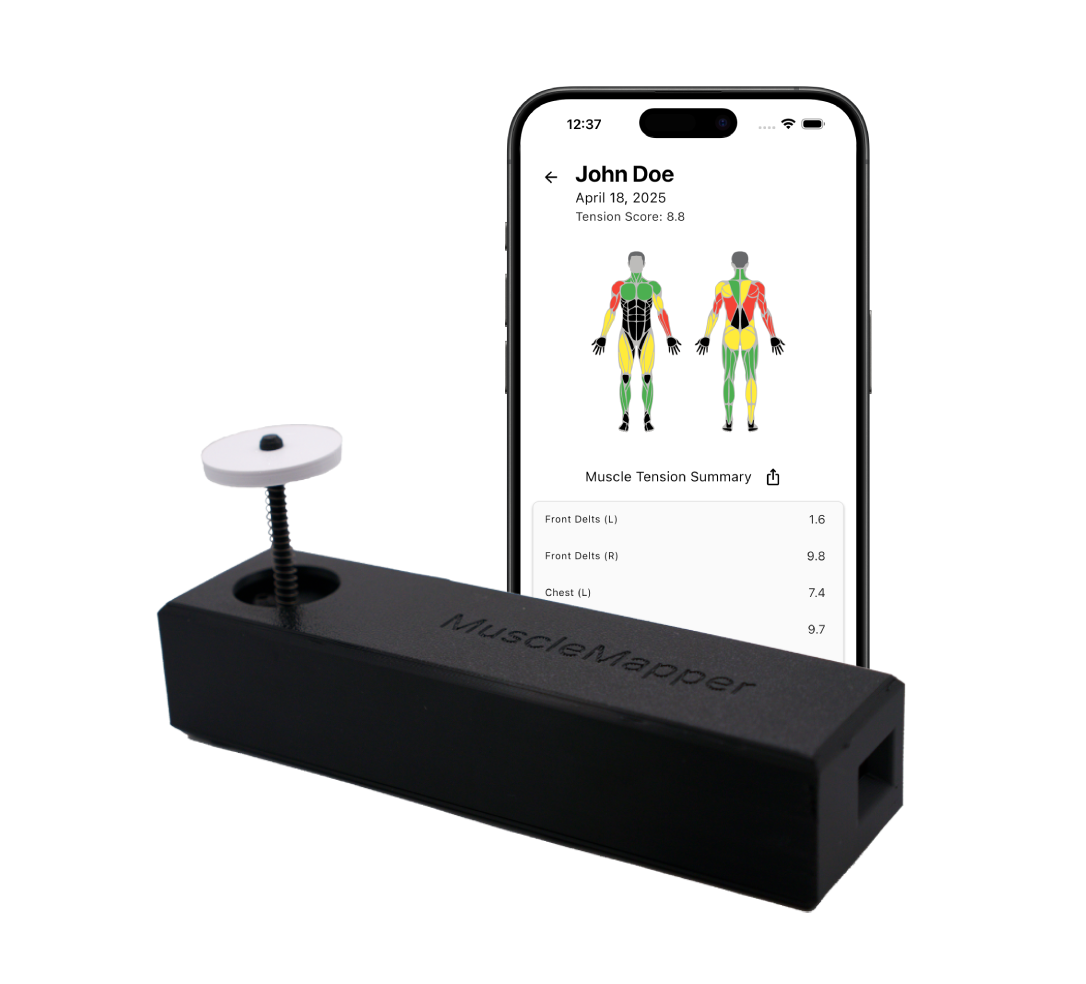
One approach is to add a second channel of objective data alongside subjective pain reports. Options include soft tissue stiffness measurement (such as MuscleMap), range-of-motion testing, and posture analysis. Each gives you something concrete to show the patient rather than asking them to take your word for it.