
Separate perception from measurement before changing the plan. Pull the patient's intake values for pain, range of motion, and any soft tissue stiffness readings, then compare visit by visit. In a 2026 survey of 455 dropouts, 36% cited "no progress" as the reason, yet most had never been shown their own objective data. A 2026 qualitative study in Musculoskeletal Care, titled from a patient quote reading "There's no improvement, I'm still bedridden," found that low back pain patients frequently judged their recovery against expectations nobody had calibrated for them, and rated their progress as failure on that basis. A 2025 meta-analysis in Frontiers in Bioengineering and Biotechnology found that personalized, technology-delivered feedback in musculoskeletal rehab significantly improved adherence and function across populations, which is the same mechanism in lower-tech form.
What does "no progress" usually mean?
It almost always means "I do not feel different." That is a perception statement, not a measurement statement. Treat it as the start of a conversation, not as a verdict on the plan.
Three common cases hide inside "no progress":
- The patient feels the same but has measurable improvement they have not noticed.
- The patient feels worse on a specific movement they care about, even though average pain is down.
- Both perception and measurement are flat. The plan really is not working.
You cannot tell which case you are in without pulling the objective data. Jumping straight to a plan change risks throwing away a working approach on a perception artifact.
How do you separate perception from measurement?
Pull the chart. Read the numbers out loud. Compare visit 1 to today.
The simplest version is to put intake-visit values for pain, range of motion, and any device readings side by side with today's values on a single page. Clinical resources on tracking progress agree on the same basic move: show the patient where they started and where they are now, in the same units, on the same form.
Why this works: perception of soft tissue state is built from somatosensory, motor, and visual signals that can lag actual tissue change. A 2025 paper in Imaging Neuroscience (MIT Press) on the neural substrates of multisensory stiffness perception showed that the felt sense of stiffness involves integration of multiple feedback channels, which is why a patient can have measurably looser tissue and still report feeling tight.
What objective signals matter most when a patient feels stuck?
Use at least two objective channels, not one. Pain alone is not enough. A study of 40 patients with chronic neck and back pain found no meaningful relationship between the most painful site and the stiffest site. Stiffness and pain are independent measures.
| Channel | Tool | What it captures |
|---|---|---|
| Pain | Numeric Pain Rating Scale, Oswestry Disability Index | Subjective intensity and functional impact |
| Mobility | Goniometer or inclinometer | Joint range of motion in degrees |
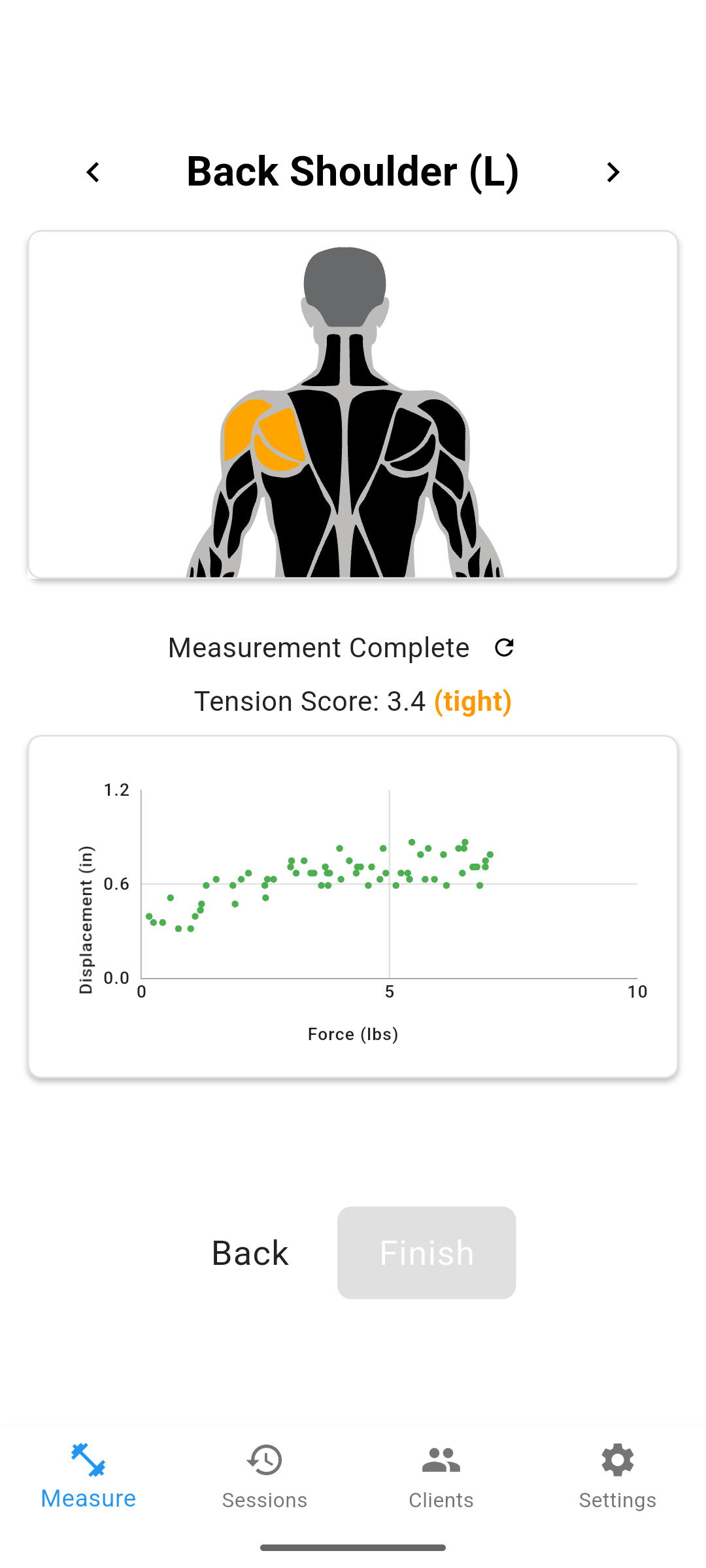
| Soft tissue stiffness | Handheld myotonometer (MyotonPRO, MuscleMap) | Resting tissue mechanical state in N/m |
| Posture | Side-on photo with reference grid | Static alignment changes over time |
If two of the four channels show change, you have a credible case to keep the plan as-is and adjust how you communicate progress. If none of them show change, the plan needs work.
Survey data: In a 2026 survey of 455 patients who stopped chiropractic care, 58% cited perception-based reasons: 36% felt no progress, and 22% felt better and stopped. Neither group was told their stiffness was still elevated.
What if there really is no measurable progress?
Then the patient is right, and the plan needs to change. A stalled objective signal is more actionable than a stalled feeling because it points to something specific.
Common pivots when objective measures confirm a stall:
- Adjust technique: change the segments targeted, switch from manual to instrument-assisted, or add soft tissue work to a primarily adjusting plan.
- Add active rehab: if the passive plan has plateaued, layer in strengthening or motor control work tied to the patient's complaint.
- Re-screen the differential: a stalled signal at 8 to 10 visits sometimes points to a missed contributor (visceral referral, central sensitization, hip or shoulder driver).
- Co-treat or refer: a co-managed plan with a PT, massage therapist, or pain physician can break a plateau without ending the chiropractic relationship.
An honest conversation that names the stall, anchored to the objective data, usually buys you more goodwill than a vague reassurance that things will improve.
How do you handle the patient who feels worse, not just flat?
Take it seriously and re-measure the same day. Worse perception with unchanged objective measures often means a flare on a specific movement or load. Worse perception with worse objective measures means the plan is moving the wrong direction and needs immediate change.
Document both perception and measurement in the SOAP note for that visit. If you change the plan, write down which measure you expect to move and by how much, so the next re-check has a clear pass/fail signal.
Frequently Asked Questions
How do you handle a chiropractic patient who says they feel no progress?
Separate perception from measurement. Pull intake values for pain, range of motion, and any soft tissue stiffness readings, and compare them visit by visit. Only change the plan if the objective data also confirms a stall.
Why do patients often miss progress they have measurably made?
Perception of stiffness and tightness involves multiple sensory and motor signals, which can lag tissue change. A patient can have looser tissue on measurement and still report feeling tight, especially after a long-standing complaint.
Which objective measures are most useful?
Range of motion in degrees, soft tissue stiffness in N/m, a side-on posture photo, and a validated questionnaire such as the Oswestry Disability Index. Use at least two channels so one weak channel does not dominate the read.
What if both perception and measurement are flat?
Then the patient is right and the plan needs to change. Common pivots include adjusting technique, adding active rehab, re-screening the differential, or co-managing with another provider.
How often should you re-measure to catch a stall?
Most protocols re-measure objective values every 4 to 6 visits, plus any visit where the patient reports no progress between formal re-exams. Catching a stall at visit 5 is easier to address than at visit 12.
Can pain alone tell you if the plan is working?
No. Pain and tissue stiffness move independently. A patient can have lower pain with unchanged stiffness, or vice versa. Tracking both channels gives a more reliable picture than either one alone.
How do you bring this up without making the patient defensive?
Lead with curiosity, not defense of the plan. "Tell me more about what you mean by no progress" surfaces specifics. Then move to the data: "Here is what you reported on day one, here is where you are now." The data does the talking.
When does a stalled patient actually need a different provider, not a different plan?
When perception and objective measures have both been flat for 4 to 6 visits and the differential diagnosis no longer fits the clinical picture. Up to 30 to 50% of chronic low back pain patients are non-responders to standard rehab approaches, according to the 2024-2025 personalized rehabilitation literature. Co-management, referral for imaging, or a different specialty is sometimes the most respectful next step rather than another 4 weeks of the same plan.
Is "no progress" sometimes an expectations problem rather than a clinical one?
Often. A 2026 qualitative study in Musculoskeletal Care found that low back pain patients judged their recovery against expectations that had never been calibrated for them, and read normal recovery timelines as failure. Setting the expected timeline early makes a slow week look like the plan rather than a breakdown of it.
One approach is to add a second channel of objective data alongside subjective pain reports. Options include soft tissue stiffness measurement (such as MuscleMap), range-of-motion testing, and posture analysis. Each gives you something concrete to show the patient rather than asking them to take your word for it.