
Tissue temperature is a recognized influence on viscoelastic measurement, and myotonometry guidance recommends standardizing it before measuring. Cooled tissue tends to read stiffer, warmed tissue more compliant. The size of that effect in humans is less well quantified than the roughly 20% shift documented for recent exercise.
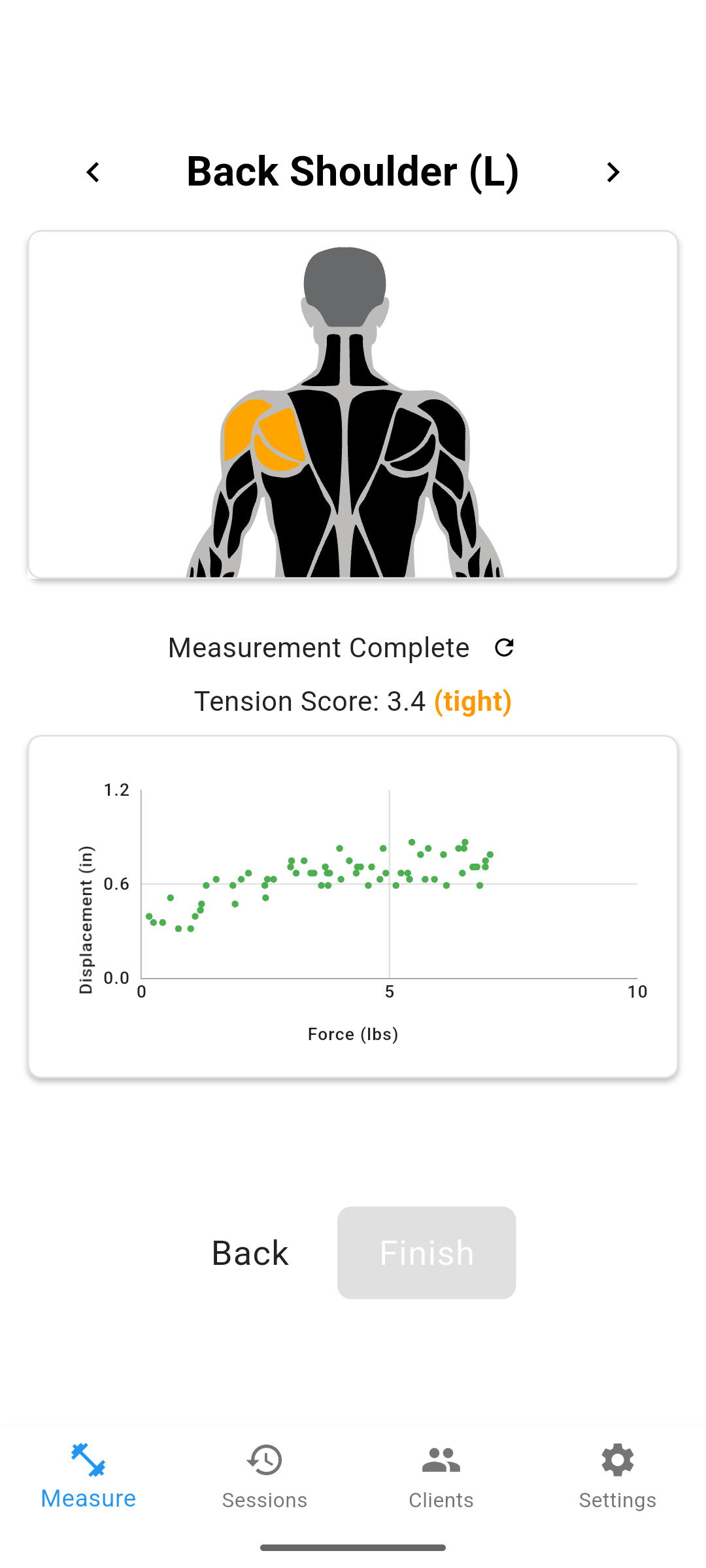
Why would temperature change a stiffness reading?
Because viscoelastic properties are temperature dependent. Muscle and connective tissue behave differently when cold. Cooling increases viscosity and reduces compliance, so a measurement taken on cold tissue may reflect the thermal state as much as the underlying condition. Warming produces the reverse.
This is why published guidance on myotonometry protocol recommends controlling temperature and recent activity level before taking a baseline. A narrative review of scapular myotonometry measurement lists standardized conditions as a prerequisite for comparable readings.
Is skin temperature a good proxy for the effect?
Not as clean a proxy as it sounds. A 2024 study in the Journal of Thermal Biology on masters athletes looked at skin temperature and muscle stiffness before and after sprinting. Sprint effort did not produce significant overall skin temperature change, and no significant correlation emerged between skin temperature and stiffness in the biceps femoris. The lower limb thermal profile was largely symmetric.
Skin temperature and deeper tissue temperature are not the same thing, and a thermal camera reading does not substitute for a controlled protocol. The practical conclusion is to standardize conditions rather than try to correct for temperature after the fact.
Does ice or heat before a reading matter?
Assume yes, and measure before either one. Direct human data quantifying the effect of a thermal modality on myotonometry is sparse. A 2024 review in the British Journal of Sports Medicine on cryotherapy for soft tissue injury found the evidence base for cryotherapy's tissue effects weaker than its widespread use implies.
The absence of quantified data is not a reason to ignore the confounder. It is a reason to remove it by sequencing. Taking the reading at the top of the visit, before any modality, costs nothing and eliminates the question.
| Confounder | Evidence strength | Documented magnitude | Fix |
|---|---|---|---|
| Recent exercise | Strong, 2026 crossover trial | About 20% | Measure before in-office exercise |
| Left-to-right asymmetry | Strong, 2025 reference values | About 10% to 14% | Compare a side to itself over time |
| Tissue temperature | Mechanistically supported, thinly quantified | Not established | Measure before heat or ice, fixed wait |
| Patient position | Well recognized | Varies by site | Same position every visit |
What about a patient walking in from the cold?
Give them the same settling interval every time and stop there. The goal is not to hit a target tissue temperature. It is to make visit six comparable to visit one. A patient who sat in the waiting room for five minutes in January and five minutes in July has been treated consistently, which is what the comparison requires.
Chasing an absolute standard is the wrong ambition for a clinic. A 2024 systematic review of MyotonPRO reliability reported good to excellent reliability across studies, which means the instrument is not the weak link. The protocol around it is.
Survey data: In a 2026 survey of 455 patients who stopped chiropractic care, 58% cited perception-based reasons: 36% felt no progress, and 22% felt better and stopped. Neither group was told their stiffness was still elevated.
Why does protocol discipline matter for retention?
Because a number you cannot defend is worse than no number. If a patient's reading improves at visit four and worsens at visit eight, and you cannot say whether the conditions matched, you have handed them a reason to doubt everything you showed them earlier.
The dropout survey says most patients leave over perception. An objective measure only corrects perception if the patient believes it. Belief comes from consistency, and consistency here is a scheduling and sequencing decision more than a clinical one.
What is the minimum viable protocol?
Four rules, all free. Measure at the same point in the visit. Measure before heat, ice, traction, or manual work. Use the same short settling interval every time. Keep the patient in the same position.
Anything beyond that is diminishing returns for a clinic. Research protocols control for more because they compare across people. A clinic compares a patient to their own earlier self, which is a much more forgiving comparison as long as the conditions are held fixed.
Frequently Asked Questions
Does temperature affect muscle stiffness measurements?
Tissue temperature is a recognized influence on viscoelastic measurement, and myotonometry guidance recommends standardizing temperature and prior activity before measuring. Cooled tissue tends to read stiffer and warmed tissue more compliant, though the quantified size of the effect in humans is not well established.
Should you measure a patient who just came in from the cold?
Give them the same few minutes you would give any patient before measuring, and keep that interval consistent visit to visit. The goal is not a specific temperature, it is the same conditions at every reading so the comparison stays clean.
Does ice or heat before a reading change the number?
It is a reasonable assumption that it does, since cooling and heating both change tissue viscoelasticity. Direct human data quantifying this with myotonometry is sparse. The safe protocol is to measure before any thermal modality rather than after.
Does room temperature in the clinic matter?
Less than the patient's own recent thermal exposure. A clinic that keeps a consistent room temperature and a consistent pre-measurement wait has already controlled most of what is controllable.
Is skin temperature correlated with muscle stiffness?
Not straightforwardly. A 2024 study in the Journal of Thermal Biology examining masters athletes found no significant correlation between skin temperature and muscle stiffness after sprinting, and no significant overall skin temperature change from the sprint effort.
How does temperature rank against other confounders?
Below recent exercise. A 2026 crossover trial documented roughly a 20% myotonometry stiffness shift after calf raises. Temperature is a plausible but less quantified influence, so it deserves protocol attention rather than alarm.
What is the simplest protocol that removes this?
Measure at the same point in every visit, before any heat, ice, traction, or manual work, after the same short settling interval, with the patient in the same position. Consistency between a patient's own readings matters more than matching an external standard.
One approach is to add a second channel of objective data alongside subjective pain reports. Options include soft tissue stiffness measurement (such as MuscleMap), range-of-motion testing, and posture analysis. Each gives you something concrete to show the patient rather than asking them to take your word for it.