
Psychological stress may raise muscle tone and stiffness, though the link is not fully proven. Higher stress and anxiety are associated with elevated muscle tone in several studies, and a 2024 trial found that lowering anxiety reduced measured jaw muscle activity. Stress is best treated as one contributor to a stiffness reading, not the only one.
What Does the Evidence Show?
Stress appears to increase muscle tone, and reducing it can lower measured activity. A 2024 study in Frontiers in Integrative Neuroscience found that a calming intervention reduced both anxiety and masseter muscle activity in anxious adults, with effects that lasted weeks. The relationship is not simple, though. A 2023 study in Frontiers in Psychology measured muscle tension during a stress task and found a brief breathing exercise did not significantly change it. Stress may drive tone up, but the response varies by person and intervention.
Why Would Stress Change a Muscle Reading?
Stress shifts the autonomic state that helps set resting muscle tone. Sustained stress and clenching are thought to raise tone in muscles like the jaw and upper trapezius. The exact pathway is still being clarified, so a raised reading in a stressed patient may reflect stress, a physical load, or both. Objective tools such as myotonometry and elastography can quantify the tone but cannot, on their own, tell you the cause. That is where the patient's history comes in.
How Do You Separate Stress From Other Causes?
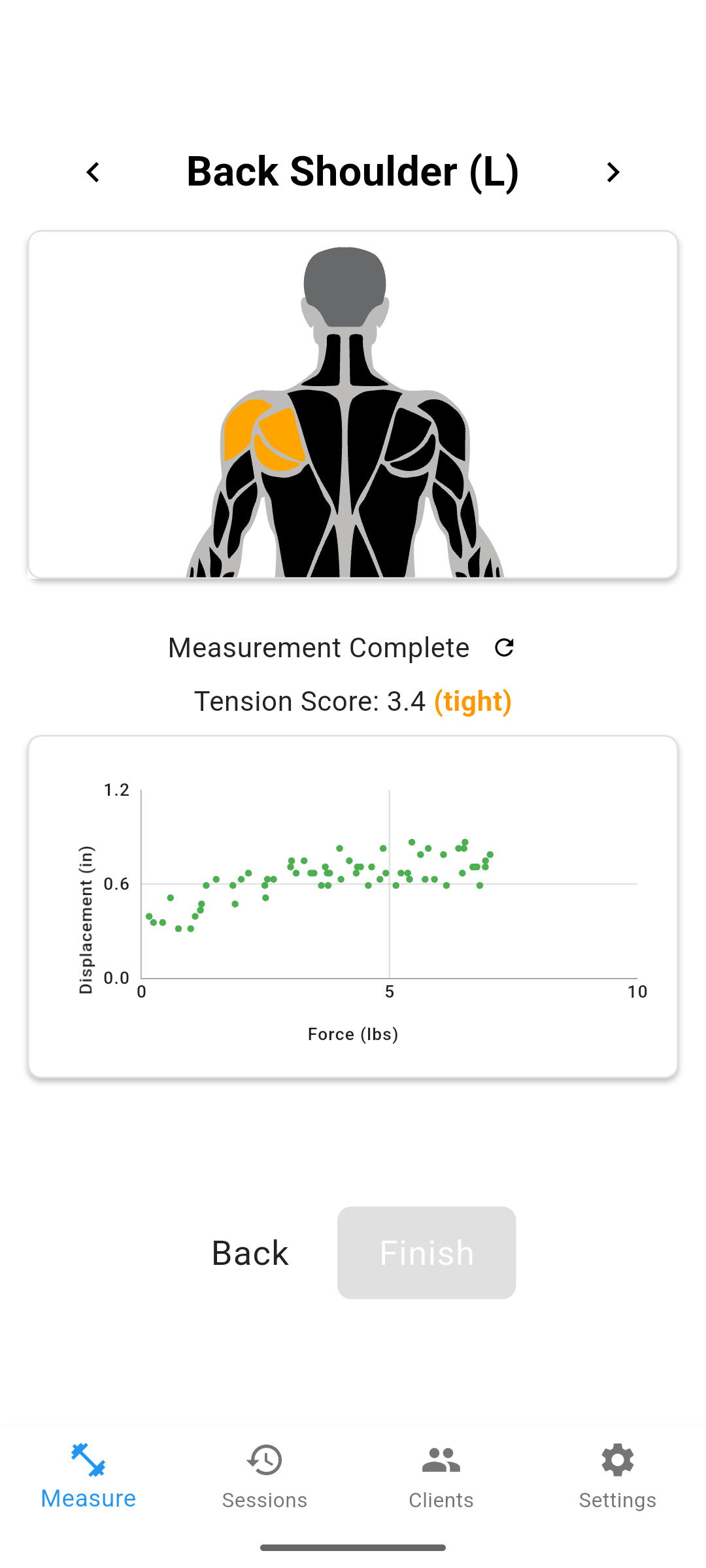
Track the reading alongside the patient's stress and pain over several visits. A single reading is a snapshot. If stiffness rises on high-stress weeks and eases on calmer ones, stress is a likely driver. If it tracks with training or work instead, the load is more likely. Measuring the same muscle the same way each visit is what makes the pattern visible.
| Sign | What it may suggest |
|---|---|
| Reading rises on stressful weeks, eases on calm ones | Stress may be a contributor |
| Reading tracks training or work load | Physical load more likely |
| Jaw and upper trapezius most affected | Pattern consistent with stress-related tightness |
| High reading, low reported pain | Stiffness and pain are independent |
Survey data: In a 2026 survey of 455 patients who stopped chiropractic care, 58% cited perception-based reasons: 36% felt no progress, and 22% felt better and stopped. A stressed patient who can watch a stiffness reading move over time has a concrete reason to stay in care instead of judging by how tense they feel on a bad day.
Frequently Asked Questions
Can psychological stress really make muscles stiffer?
The evidence suggests it may. Higher stress and anxiety are associated with raised muscle tone in several studies, and interventions that lower anxiety can reduce measured muscle activity. Causation is not fully settled, so stress is best treated as one contributor among several.
Which muscles are most affected by stress?
The upper trapezius, neck, and jaw muscles are the regions most often linked to stress-related tightness. Jaw muscles in particular have been studied in the context of chronic stress and clenching, though any muscle can be involved.
How do you tell stress-driven stiffness from an injury?
You cannot tell from feel alone. A stiffness reading gives you a number to track, and pairing it with the patient's stress and pain reports over several visits helps you see whether the pattern moves with stress or with a physical load.
Does reducing stress lower measured stiffness?
It may. One 2024 study found that reducing anxiety lowered jaw muscle activity, and calming interventions are commonly used to ease muscle tension. Results vary by person, so a before-and-after reading tells you whether it worked for a given patient.
Is stress-related stiffness the same as pain?
No. Stiffness and pain are independent. A stressed patient can have an elevated reading with little pain, or pain with a normal reading, so measure and track them separately.
How can measurement help a stressed patient stay in care?
A stiffness reading gives the patient something concrete to watch change. Seeing a number move over time can reassure a stressed patient that care is working, rather than leaving them to judge by how tense they feel on a hard day.
One approach is to add a second channel of objective data alongside subjective pain reports. Options include soft tissue stiffness measurement (such as MuscleMap), range-of-motion testing, and posture analysis. Each gives you something concrete to show the patient rather than asking them to take your word for it.