
Not reliably, and the relationship depends heavily on the tissue layer being measured. Muscle stiffness and pain are largely independent measures, but newer evidence suggests fascial stiffness tracks pain more closely than muscle stiffness does. A 2024 shear wave elastography study in Frontiers in Bioengineering and Biotechnology on chronic non-specific low back pain found a strong correlation between thoracolumbar fascia stiffness and pain (r = 0.57 to 0.65), and only moderate correlation for the erector spinae and multifidus muscles (r = 0.42 to 0.50). At the same time, a 2024 study in Frontiers in Medicine on a 10-week static stretching program in older adults found tissue hardness dropped significantly while the change did not correlate with range-of-motion improvement. Stiffness, pain, and mobility move on different tracks, and which layer you measure changes the picture. Newer 2025 data add a population angle: a study of elite athletes with and without low back pain found psoas major stiffness was 8.7 to 17.2% higher on the affected side, while strength and flexibility showed no such link, suggesting stiffness may flag a side-to-side difference other tests miss even when it does not neatly track pain intensity. A 2026 systematic review of 20 shear wave elastography studies in Diagnostics puts a boundary on all of this: resting muscle stiffness showed weak or absent correlation with maximal force, and the authors concluded the relationship between stiffness and neuromuscular output is heavily context-dependent, varying by muscle group, joint position, and whether the muscle is active or at rest.
Does higher stiffness mean more pain?
No, not in any consistent way. A controlled study in patients with chronic neck and back pain compared myofascial tissue stiffness side-to-side. The more painful side was not reliably stiffer than the contralateral side at baseline. Tissue mechanics and pain experience moved on different tracks.
A systematic review of shear wave elastography across several pain conditions reached the same picture from a different angle. Some studies found greater stiffness on the painful side. Some found no difference. A few found less stiffness on the painful side. The review concluded that a clear differentiation between pain, stiffness, and tenderness is difficult.
Why does felt stiffness not match measured stiffness?
What a patient feels as stiffness is built in the brain, not read off the muscle directly. A 2025 study in Imaging Neuroscience mapped the neural substrates of stiffness perception. It found perception integrates somatosensory, motor, and visual feedback, which is why a patient can feel tight without a corresponding change in the tissue.
That gap goes the other way too. A 2025 study in the Journal of Bodywork and Movement Therapies found that stiffness readings stayed elevated even as subjects reported less soreness after exercise-induced muscle damage. Pain resolved while the tissue was still mechanically changed.
How should a clinician treat stiffness and pain in the exam?
Treat them as two independent channels. A subjective pain score tells you how the patient feels. An objective stiffness reading tells you something about the tissue's mechanical state. They do not validate each other. They cover different ground.
| Scenario | Pain report | Stiffness reading | What it suggests |
|---|---|---|---|
| Symptom-led recovery | Down | Down | Both pain and tissue mechanics improving in step |
| Felt better, tissue not yet recovered | Down | Still elevated | May reflect tissue still in a remodeling phase |
| Persistent pain, tissue normalized | Unchanged | Down or normal | May suggest a sensitization or non-tissue driver |
| Both worse | Up | Up | Possible acute insult or flare |
What does this mean for tracking progress?
It means pain alone is a thin track record. A patient who feels better will not necessarily have tissue back to baseline. A patient who still hurts may have tissue that has already changed. A 2008 review in the Journal of Manipulative and Physiological Therapeutics framed this directly: chiropractic outcome assessment divides into subjective determinations and objective determinations, and both are needed to measure progress validly.
Survey data: In a 2026 survey of 455 patients who stopped chiropractic care, 58% cited perception-based reasons: 36% felt no progress, and 22% felt better and stopped. Both groups were responding to their own pain experience without a second, objective data point to compare against.
Is there ever a clear stiffness-pain link?
In specific tissue conditions, yes. A 2025 fascia review describes densification and fibrosis as changes that can coexist with pain in chronic myofascial pain syndrome, where the tissue is mechanically and chemically altered together. The point is not that stiffness and pain never travel together. They sometimes do. The point is that you cannot assume one from the other in any given patient on any given day.
Frequently Asked Questions
Does higher muscle stiffness mean more pain?
No. A controlled study in patients with chronic neck and back pain found the more painful side did not always show higher myofascial tissue stiffness than the opposite side. Stiffness and pain measure different things and should be tracked separately.
Why do patients feel stiff when their muscles measure normal?
Felt stiffness is a perception built from somatosensory, motor, and visual signals in the brain, not a direct readout of tissue mechanics. A 2025 study in Imaging Neuroscience showed the neural substrates of stiffness perception integrate multiple feedback channels, which is why felt stiffness can diverge from a measured stiffness reading.
Do stiffness measurements track pain reduction over time?
Not directly. A 2025 study in the Journal of Bodywork and Movement Therapies found that stiffness readings stayed elevated even as subjects reported less soreness after exercise-induced muscle damage. Pain can resolve while tissue mechanics are still changing.
Is muscle stiffness ever associated with pain?
Sometimes. A systematic review of shear wave elastography studies across several pain conditions found mixed results: some studies showed greater stiffness on the painful side, some showed no difference, and a few showed less stiffness. The association depends on the condition, the muscle, and the measurement method.
Why measure stiffness if it does not correlate cleanly with pain?
Because pain alone is unreliable for tracking tissue change. A patient can feel better and still have elevated stiffness, or feel worse and have normal stiffness. Measuring both gives a clinician two independent channels of information rather than one.
What does a stiffness reading actually tell me?
A stiffness reading describes a mechanical property of the tissue, specifically how it resists a brief applied force. It may reflect tissue tone, fluid content, or fibrosis. It does not, on its own, tell you whether the patient is in pain.
Can stiffness change without changes in range of motion?
Yes. A 2024 study in Frontiers in Medicine on a 10-week static stretching program in older adults found tissue hardness decreased significantly while the reduction did not correlate with range-of-motion gains. Mobility and stiffness are independent enough that a clinician should measure both rather than assume one tracks the other.
Is fascial stiffness more correlated with pain than muscle stiffness?
Recent evidence suggests yes, at least in chronic low back pain. A 2024 shear wave elastography study in Frontiers in Bioengineering and Biotechnology found a strong correlation between thoracolumbar fascia stiffness and pain (r = 0.57 to 0.65) and only a moderate correlation for the erector spinae and multifidus muscles (r = 0.42 to 0.50). The implication is that if a clinician is looking at muscle readings only and seeing no relationship to symptoms, the relevant signal may be in the fascial layer rather than the muscle.
Is muscle stiffness ever higher on a patient's painful side?
Sometimes. A 2025 study of elite athletes with low back pain found psoas major stiffness was about 8.7 to 17.2% higher on the affected side, while strength and flexibility were not linked to pain. A side-to-side stiffness difference can flag something other tests miss, but it does not prove the stiffness causes the pain.
Why do studies on stiffness and pain disagree with each other?
Because the relationship depends on the conditions of measurement. A 2026 systematic review of 20 shear wave elastography studies found resting stiffness correlated weakly or not at all with maximal force, and concluded the link between stiffness and neuromuscular output varies by muscle group, joint position, and whether the muscle is active or at rest. Studies using different setups are not measuring the same thing.
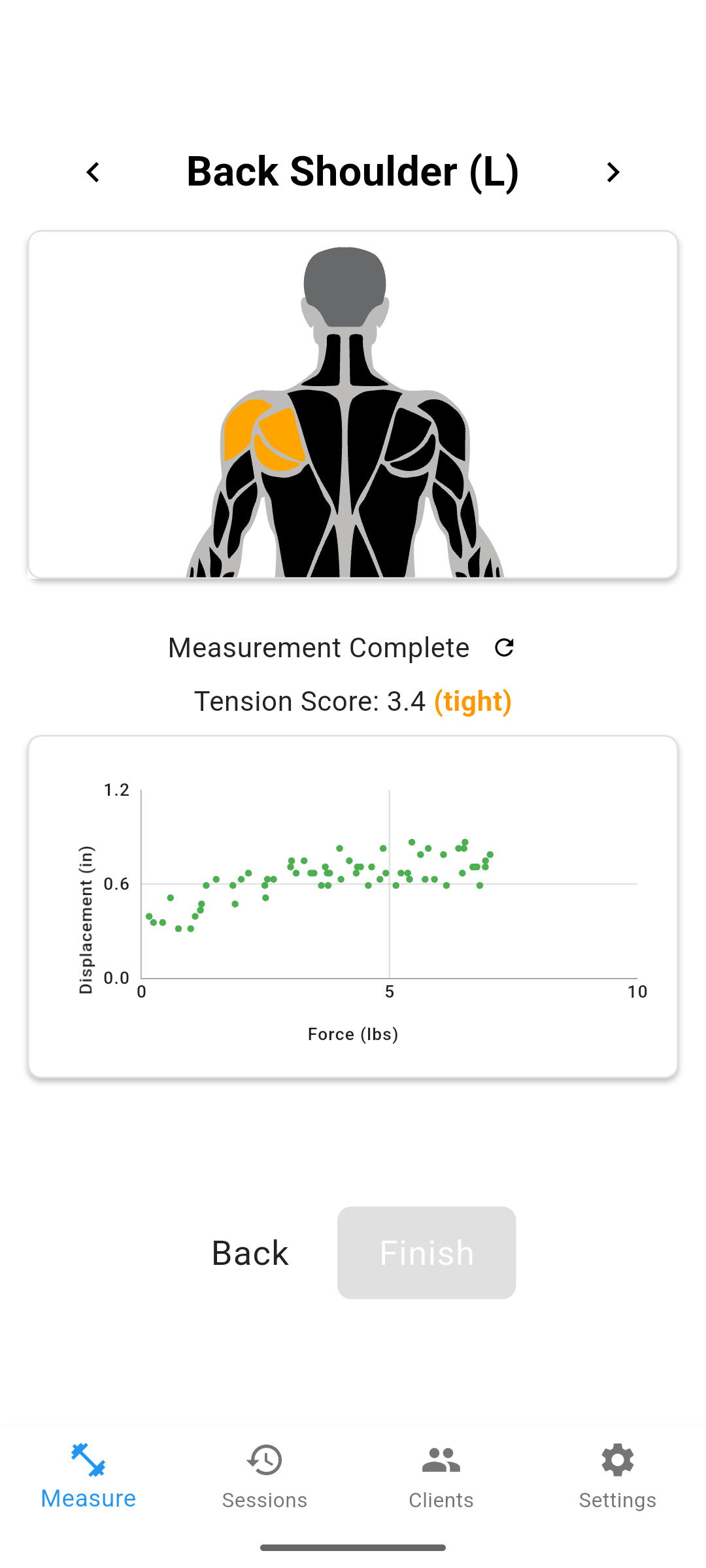
One approach is to add a tissue-level channel of objective data alongside the patient's subjective pain report. Options include soft tissue stiffness measurement (such as MuscleMap), shear wave elastography where an ultrasound system is available, and range-of-motion testing with an inclinometer. Each gives you something concrete that does not depend on how the patient feels that day.