
For routine outpatient use, handheld myotonometry is the practical choice. It produces a number in seconds at the treatment table, and published reliability for handheld devices sits in the good to excellent range, with intraclass correlation coefficients around 0.75 to 0.95. Elastography is stronger, and almost no outpatient clinic owns one.
What are the actual options?
Four methods show up in clinical practice, and they are not competing for the same job. Two produce numbers you can hand a patient. One produces an image. One produces an impression.
Handheld myotonometry applies a brief mechanical impulse to the skin and reads the tissue's damped oscillation. Shear wave elastography uses ultrasound to time a shear wave through tissue. Indentometry measures the force needed to deform tissue by a fixed depth. Palpation is the clinician's hands.
| Method | Depth reached | Setup cost and training | Best clinical fit |
|---|---|---|---|
| Handheld myotonometry | Superficial only | Low, minutes of training | Repeat tracking at re-exam |
| Shear wave elastography | Deep and superficial | High, requires sonography skill | Research and deep muscle questions |
| Indentometry | Superficial only | Low to moderate | Research protocols |
| Palpation | Clinician dependent | None | Fast screening, not tracking |
How reliable is handheld myotonometry?
Reliable enough to compare a patient against themselves, which is the only comparison that matters clinically. A 2024 reliability study of the MyotonPRO reported good to excellent intra-rater and inter-rater agreement across muscles.
A review in the Journal of Athletic Training on the utility of myotonometry reached a similar conclusion for musculoskeletal rehabilitation, noting the method is non-invasive, quick, and quantitative enough to track a course of care. That review also frames it correctly. Myotonometry belongs inside a broader assessment, not as a standalone answer.
Why does depth decide the choice more than accuracy?
A handheld device reads what is directly under the probe. If the clinical question is upper trapezius, gastrocnemius, or lumbar erector spinae, a handheld reading is usable. If the question is psoas or deep multifidus, it is not, and no amount of technique fixes that.
A 2023 study in Scientific Reports comparing stiffness measurement tools makes the same point from the validity side. Different tools have different sensitivity at different tissue layers, so agreement between them varies by site. Published comparisons with shear wave elastography report moderate to strong correlation in relaxed superficial muscle, which is the layer both methods actually share.
Survey data: In a 2026 survey of 455 patients who stopped chiropractic care, 58% cited perception-based reasons: 36% felt no progress, and 22% felt better and stopped. Neither group was shown that their soft tissue stiffness was still elevated.
Do you need reference values before you start?
No, if you are comparing a patient to their own baseline. Normative work is early. A 2025 pilot study in the Journal of Manual and Manipulative Therapy derived preliminary reference intervals from 26 healthy young adults across seven muscle groups, and found sex was the only significant predictor of resting stiffness. Age, BMI, and weekly exercise were not.
That study also reported normal bilateral asymmetry of roughly 10% to 14% in healthy participants. Useful context before you read a side-to-side difference as clinically meaningful. A small asymmetry may reflect normal physiology rather than a problem.
What actually determines whether the measurement is useful?
Protocol discipline beats device selection. Mark the same site. Use the same patient position. Take the reading at the same point relative to treatment. Keep the same examiner when scheduling allows.
Skip any of those and part of the change you see is method, not patient. Keep the interpretation narrow as well. A change in a stiffness reading may reflect a change in the tissue. It does not diagnose a condition, it does not predict recurrence, and stiffness and pain move independently, so one may improve while the other does not.
Frequently Asked Questions
What is the most practical way to measure muscle stiffness in a clinic?
Handheld myotonometry, for most outpatient settings. It takes seconds per site, needs no imaging suite, and published reliability for the MyotonPRO sits in the good to excellent range with intraclass correlation coefficients around 0.75 to 0.95.
Is shear wave elastography better than myotonometry?
It reaches deeper tissue and produces an absolute stiffness value, so it is stronger for research and deep muscle questions. It also requires an ultrasound system and operator training, which puts it out of reach for most outpatient clinics.
Can palpation substitute for an instrument?
Not for tracking change over time. Palpation gives a fast clinical impression but produces no number, so there is nothing to compare at the next visit and nothing to show the patient.
How deep can a handheld device measure?
Superficial tissue only. Handheld myotonometry reads the layer directly under the probe, so deep muscles such as psoas are outside its range. Overlying fat also affects the reading.
Do the methods agree with each other?
Partly. Published comparisons report moderate to strong agreement between myotonometry and shear wave elastography in relaxed superficial muscle. They are not interchangeable, so do not switch methods midway through a patient's course.
Do I need reference values to use a stiffness measurement?
Not to track a single patient. Reference work is still early. A 2025 pilot study in the Journal of Manual and Manipulative Therapy found sex was the only significant predictor of resting stiffness and reported normal bilateral asymmetry of roughly 10% to 14%.
What matters more than the method choice?
Protocol consistency. Same site, same patient position, same timing relative to treatment. An inconsistent measurement from an excellent device is less useful than a consistent one from a modest device.
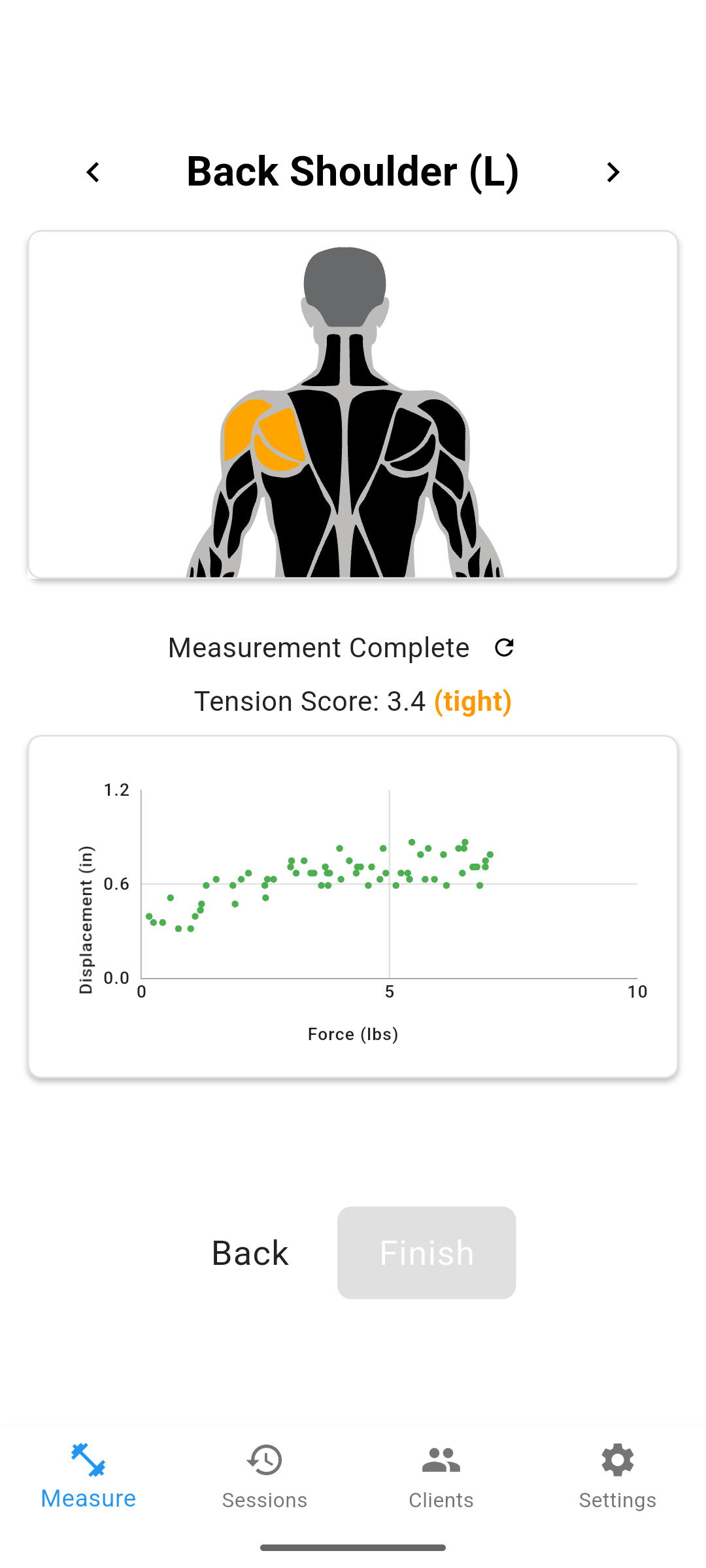
One approach is to add a second channel of objective data alongside subjective pain reports. Options include soft tissue stiffness measurement (such as MuscleMap), range-of-motion testing, and posture analysis. Each gives you something concrete to show the patient rather than asking them to take your word for it.