
Communicate progress at a chiropractic re-examination by pairing what the patient feels with at least one objective measurement they can see. Re-exams typically happen around every 30 days. In a 2026 survey of 455 patients who stopped chiropractic care, 58% quit for perception-based reasons, so the re-exam is your chance to replace a vague feeling with a number the patient can hold onto. A 2024 pilot study on patient-facing data visualization found patients preferred stacked area charts for reading their own lab trends, while clinicians preferred line charts for the same data, showing that how you show the number matters, not just that you show it. A 2024 study in Brain Sciences using PROMIS-29 and wearable devices to track chronic low back pain patients under chiropractic care showed neurological and quality-of-life gains alongside neuroplastic changes, supporting the case for combining patient-reported outcome measures with objective tracking tools at every re-exam. A 2024 study on objective stiffness measures and patient pain ratings found that objective and subjective measures frequently diverge, confirming that a patient's self-report alone is an unreliable indicator of tissue state. A 2025 mixed-methods study in Physical Therapy on adherence to evidence-based care for musculoskeletal shoulder pain reinforces the other half: clear communication, shared decisions, and regular feedback on progress were central to whether patients stayed adherent.
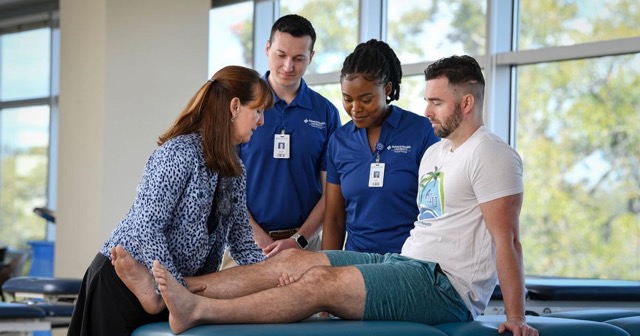
Why does the re-examination matter so much for retention?
The re-examination is the visit where a patient decides, consciously or not, whether care is worth continuing. Most guideline parameters call for a progress re-evaluation at least every 30 days, so this checkpoint comes around often. Practice guidance on re-examinations frames the visit as both a documentation requirement and an educational opportunity.
The problem is what most patients have to go on between exams: a feeling. A 2025 study in the Journal of Bodywork and Movement Therapies found that objective stiffness readings stayed elevated even after subjects reported less soreness. A patient running only on how they feel can decide they are done before the tissue has finished responding, or decide nothing is working when the measurements say otherwise.
What should you actually show the patient?
Replace the general statement with the specific one. Instead of "you are doing better," show the change from baseline: range of motion that improved from 35 to 55 degrees, a disability questionnaire score that dropped, or a stiffness reading that moved. A survey of outcome measure use in chiropractic practice found that about 95% of chiropractors measure range of motion visually rather than with an instrument, which limits how reproducible that number is from visit to visit. A measurement you record the same way each time is one the patient can trust.
Work on outcome assessment in chiropractic divides progress measurement into subjective determinations and objective determinations, and argues both are needed for a valid picture. The re-exam is where you put them side by side.
How do you handle the patient who feels better and wants to stop?
This is the 22% from the survey: the patient who feels improvement and concludes they are finished. Pain frequently resolves before function and tissue fully recover. Show this patient an objective measure that has not yet returned to baseline. A stiffness reading or range-of-motion value that is still changing gives a concrete, non-opinion reason to continue. You are not asking them to take your word for it. You are showing them their own number.
How do you handle the patient who feels no progress?
This is the larger group, the 36% who felt no progress and stopped. Often something has measurably improved even when the patient does not feel it yet, because feeling is a noisy signal. Walk this patient through the objective change first, then connect it to function: the reading moved, and here is what that means for the task they care about. When the only evidence is a feeling, a flat-feeling week reads as failure. An objective measure can show movement that the feeling missed.
What objective measures work at a re-examination?
No single measure captures everything. Using two together gives the patient a fuller picture and gives you a backup when one measure is flat.
| Measure | What it captures | Watch-out |
|---|---|---|
| Range of motion (instrumented) | Change in joint mobility | About 95% measure it visually, which lowers reproducibility |
| Validated questionnaire (ODI, NDI) | Self-reported disability and function | Standardized, but still a subjective report |
| Soft tissue stiffness | Mechanical change in the tissue | Does not equal pain; needs a consistent protocol |
| Posture or photo comparison | Visible alignment change | Lighting and positioning vary between visits |
One caution on stiffness: it is not a pain meter. A controlled study in patients with chronic neck and back pain found that the more painful side did not always show higher tissue stiffness than the contralateral side. A stiffness reading may reflect a mechanical change in the tissue, but it does not tell you how much the patient hurts. Present it as one channel of information, not the whole story.
Survey data: In a 2026 survey of 455 patients who stopped chiropractic care, 58% cited perception-based reasons: 36% felt no progress, and 22% felt better and stopped. Neither group was shown an objective measurement of where their progress actually stood.
How do you make the re-exam feel like a report, not a charge?
Patients sometimes resist re-examinations because of the added cost and time. The reframe is to present the visit as an educational report on their own data. A 2024 systematic review in the Journal of Patient Experience found that chiropractic patient satisfaction is driven by clinical interaction and clinician attributes as much as by clinical outcomes. When you sit with the patient and walk through their baseline and current numbers, the re-exam becomes the most informative conversation in their plan, not a line item.
Frequently Asked Questions
How often should a chiropractic re-examination happen?
Re-examinations to determine patient progress are commonly performed at least every 30 days from the initial examination, in line with widely cited chiropractic guideline parameters. The exact interval depends on the condition and the treatment plan, but a roughly monthly re-exam gives you a regular checkpoint to document change and reset expectations.
What is the best way to show a patient they are making progress?
Pair the patient's own report with at least one objective measurement from baseline. Instead of saying "you are doing better," show the specific change: range of motion improved from 35 to 55 degrees, or a stiffness reading dropped by a measurable amount. A concrete number the patient can see is more persuasive than a general reassurance.
How do I keep a patient who feels better from self-discharging?
Show them an objective measure that has not yet returned to baseline. Pain often resolves before tissue and function fully recover, and a measurement that is still changing gives the patient a concrete reason to continue. Frame the remaining work around the number, not around your opinion.
What objective measures can I use at a re-examination?
Common options include range-of-motion testing, validated disability questionnaires such as the Oswestry Disability Index or Neck Disability Index, soft tissue stiffness measurement, and posture or photo comparison. Each captures a different dimension of change, and using two together is more informative than relying on one.
Does soft tissue stiffness tell me whether the patient is in pain?
No. Stiffness and pain are independent measures. Research in patients with chronic neck and back pain found that the more painful side did not always show higher tissue stiffness than the other side. Stiffness is a mechanical property of the tissue, not a direct readout of how much the patient hurts.
Why do patients stop chiropractic care even when they have not fully recovered?
In a 2026 survey of 455 patients who stopped chiropractic care, 58% cited perception-based reasons: 36% felt no progress and 22% felt better and stopped. Both groups were acting on how they felt rather than on an objective measurement of their progress. A re-examination that shows objective change addresses both.
How do I make a re-examination feel valuable rather than like an upsell?
Present the re-exam as an educational report on the patient's own data. When you walk the patient through their baseline numbers and current numbers, the visit becomes a progress review rather than a charge. Patient satisfaction research links satisfaction strongly to clinical interaction and clear communication, not only to outcomes.
Do patients' pain ratings reliably reflect what is happening in the tissue at a re-examination?
Not reliably. A 2024 study examining objective stiffness measures and patient pain ratings found that objective and subjective measures frequently diverge in clinical practice. A patient may rate their pain as unchanged while their tissue stiffness has measurably improved, or vice versa. This is why showing objective data at re-examination is more informative than asking the patient how they feel.
Are there 2024 studies on using PROMs and wearables to track chiropractic progress?
Yes. A 2024 study in Brain Sciences used PROMIS-29 and wearable devices to track chronic low back pain patients receiving chiropractic care. The study reported neurological and quality-of-life gains alongside neuroplastic changes, and demonstrated that combining a validated patient-reported outcome measure with continuous wearable data is feasible in routine practice. The practical takeaway for re-examinations is to use at least one PROM and at least one objective measure consistently across visits.
Does the format you use to show a patient their data change how well they understand it?
Yes. A 2024 pilot study on patient-facing data visualization found patients preferred stacked area charts for viewing their own lab trends, while their clinicians preferred line charts for the same data. Showing a patient a chart format built for how patients read data, not the format built for clinicians, may improve how well a re-examination lands.
Does giving patients regular feedback on progress actually improve adherence?
The evidence points that way. A 2025 mixed-methods study in Physical Therapy on adherence to evidence-based care for musculoskeletal shoulder pain found that clear communication, involving the patient in decisions, and giving regular feedback on progress were central to sustaining adherence. Feedback on its own is not enough if the patient does not understand what is being measured.
One approach is to add a second channel of objective data alongside subjective pain reports at every re-exam. Options include soft tissue stiffness measurement (such as MuscleMap), range-of-motion testing, and posture analysis. Each gives you something concrete to show the patient rather than asking them to take your word for it.