
Treat both findings as real, name the divergence directly, and let the data set the case for the rest of the plan. Pain and stiffness measure different things, and a 2025 double-blind randomized trial in Physiotherapy Theory and Practice showed how far apart they can move: the sham group improved significantly in pain and range of motion while measured muscle stiffness did not change at all. When pain resolves before objective stiffness does, that is not a contradiction. It is the most important conversation you can have at re-exam, because it is the moment most patients quietly decide to stop care.
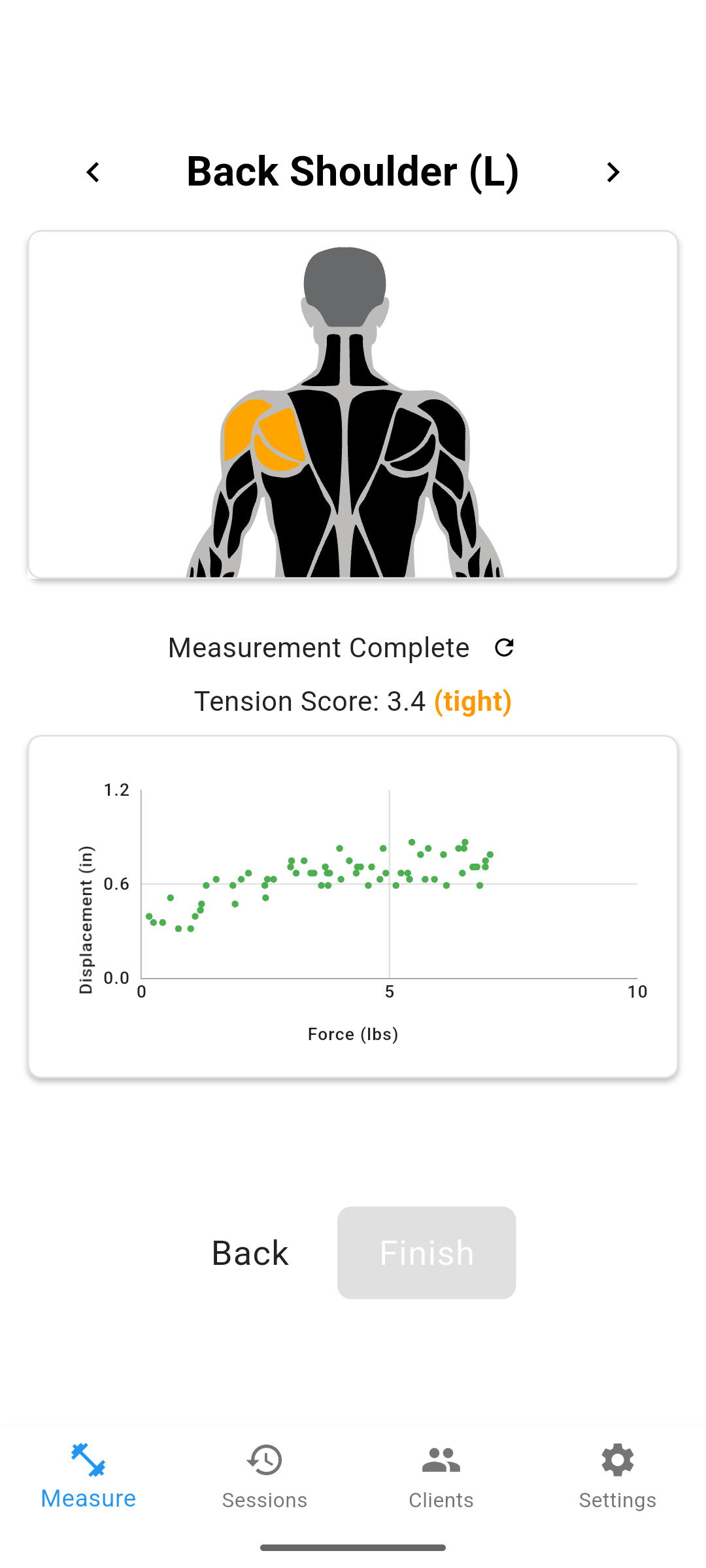
Why would pain improve before stiffness does?
Pain is a neural output. Stiffness is a mechanical property. The two are linked but not the same. Acute pain often resolves through reduced muscle guarding, lowered nervous system sensitization, and context change, all of which can happen well before the underlying tissue fully normalizes.
A 2025 study in the Journal of Bodywork and Movement Therapies on delayed onset muscle soreness in the gastrocnemii demonstrated this directly: objectively measured stiffness remained elevated even as subjects reported decreasing soreness. The same dissociation shows up in a 2026 prospective cohort study in JoVE on subacute stroke patients, where myotonometric tone changes showed only weak correlations with Fugl-Meyer motor recovery. Different signals, different timelines.
What does the divergence look like at re-exam?
The most common version of this scenario at the 4 to 6 visit re-exam:
| Measure | Visit 1 (baseline) | Visit 5 (re-exam) | Change |
|---|---|---|---|
| Numeric Pain Rating Scale (0-10) | 6 | 1 | -5 points (large improvement) |
| Oswestry Disability Index | 34% | 14% | -20 points (clinically meaningful) |
| Right lumbar paraspinal stiffness (N/m) | 340 | 320 | -6% (minimal change) |
| Right vs left stiffness asymmetry | 22% higher right | 19% higher right | Mostly unchanged |
| Lumbar flexion ROM | 40° | 55° | +15° (clear improvement) |
Four of the five measures moved meaningfully. One did not. That is a real clinical pattern, not a measurement error, and it deserves a real conversation.
How do you talk about it without sounding like you are upselling?
The trap is recommending continued care immediately. The patient hears that as a sales pitch even when it is clinically correct. Lead with the data and let the patient draw the implication.
A safer script:
- Show both numbers. "Your pain dropped from 6 to 1. Your stiffness on the right is still about 19 percent above the left."
- Name the pattern. "Pain and stiffness do not always move together. Pain often resolves first."
- State what the research suggests. "Elevated stiffness after pain resolves may reflect tissue that is still recovering. Some research links residual asymmetry to recurrence risk, though it is not predictive in any individual case."
- Present options, not a recommendation. "We could continue the current plan for another 4 visits and re-measure. We could shift to a maintenance frequency. Or we could stop here and you contact us if symptoms return."
- Let the patient choose. Document the choice and the reasoning.
This framing matches the findings of a 2024 systematic review in the Journal of Patient Experience, which found that perceived clinician attributes (listening, autonomy support, clarity) explained as much variance in chiropractic patient satisfaction as clinical outcomes did. Autonomy support is the move that protects the relationship even when the patient chooses to stop.
What if the patient just wants to stop?
That is a legitimate decision. The work is to make it an informed one.
- Document the residual finding. "Stiffness asymmetry of 19% remains at discharge. Pain at baseline 6/10, at discharge 1/10. Patient elected to discontinue active care."
- Give the patient a single sheet showing baseline, current, and any remaining elevated values. Something they can hand to a future clinician if they re-present.
- Set a contact trigger. "If pain returns or if you notice stiffness or restriction, come back within 2 weeks rather than waiting for it to escalate."
- Avoid the all-or-nothing framing. Maintenance care at 1 visit per month is a real option that often retains patients who would otherwise disappear entirely.
Survey data: In a 2026 survey of 455 patients who stopped chiropractic care, 58% cited perception-based reasons: 36% felt no progress, and 22% felt better and stopped. The "felt better and stopped" group is the exact group this conversation is for. They are not unhappy. They are missing a piece of information about their own tissue that would change the decision.
What objective measure should you actually use?
For most chiropractic offices, two options are practical:
- Range of motion in degrees using an inclinometer or app. Free, fast, well-understood by patients. Limitation: insensitive to soft tissue change that does not affect gross movement.
- Handheld myotonometry producing stiffness values in newtons per meter. A 2024 systematic review in Medicina of 48 studies across 31 muscle groups found good-to-excellent intra-rater and inter-rater reliability for handheld myotonometry. Strength: directly captures the tissue-level signal that diverges from pain.
Shear wave elastography is the research gold standard but requires ultrasound equipment most chiropractic clinics do not have. A handheld device that fits in the workflow of a 15-minute visit is the practical choice for tracking stiffness across a care plan.
How does this conversation affect retention?
This is one of the highest-leverage conversations in the care plan. Patients in the "felt better and stopped" bucket are the most preventable form of dropout, because they are not dissatisfied. They are uninformed.
When the conversation goes well, the patient leaves with either a renewed reason to continue care or a structured maintenance plan. When it does not happen at all, the patient quietly cancels, returns 6 months later with a recurrence, and may or may not return to your practice when they do. The difference between those two trajectories is whether you had a second number on the page.
Frequently Asked Questions
How do you handle a chiropractic patient whose pain is improving but their stiffness is not?
Treat both findings as real. Pain and stiffness move on partly independent tracks. Name the divergence directly, show both numbers, and explain that residual stiffness after pain resolution may indicate continued tissue recovery. Use the data to frame the remaining visits.
Why would pain improve before stiffness does?
Pain is a neural output influenced by sensitization and context. Stiffness is a mechanical property. Acute pain often resolves before tissue mechanics normalize, especially when manual therapy reduces guarding quickly.
Should I keep treating if pain is gone?
It depends on the patient's goals and the objective findings. If stiffness or ROM remains clearly abnormal and the goal includes recurrence reduction, continued care is defensible. If all objective measures are normal, transition to maintenance or discharge.
How do I explain this without sounding like I am upselling?
Lead with the data and the decision criteria, not the recommendation. Show both numbers, name the pattern, present options, and let the patient choose with full information. Autonomy support protects the relationship.
Is there research on pain resolving before stiffness?
Yes. A 2025 Journal of Bodywork and Movement Therapies study found that gastrocnemius stiffness remained elevated as DOMS soreness resolved. Similar patterns appear in post-stroke literature where tone and function changes do not track tightly.
What objective measure should I use to track stiffness?
Handheld myotonometers produce stiffness values in newtons per meter. A 2024 systematic review of MyotonPRO across 31 muscles found good-to-excellent reliability. Shear wave elastography is more accurate but requires ultrasound equipment.
What happens if I discharge the patient with stiffness still elevated?
Recurrence risk is the main concern. Patients who self-discharge often return months later with the same complaint. Documenting residual stiffness at discharge protects the chart and gives the patient an informed reason to consider maintenance care.
Can pain improve without any measured change in muscle stiffness?
Yes, and it has been demonstrated directly. In a 2025 double-blind randomized trial in Physiotherapy Theory and Practice, the sham group improved significantly in both pain and cervical range of motion while measured muscle stiffness showed no significant change. Pain relief alone does not confirm the tissue has changed.
One approach is to add a second channel of objective data alongside subjective pain reports. Options include soft tissue stiffness measurement (such as MuscleMap), range-of-motion testing, and posture analysis. Each gives you something concrete to compare against pain reports rather than asking the patient to take your word for it.