
Only track change. In a blinded study of 52 patients across five neuromuscular disease groups plus 21 healthy controls, myotonometry could not separate patients from controls. Traditional strength testing could. The tool measures a real property well. It does not tell you what is wrong.
What Did the Study Actually Find?
Three separate failures of diagnostic discrimination. A 2023 study in the Journal of Neurology used a handheld myotonometer on 52 patients with neuromuscular disorders and 21 healthy controls. The readings could not distinguish patients from controls. They could not distinguish the five disease groups from each other. They showed no correlation with clinical muscle strength or with ultrasound findings.
Meanwhile the ordinary tools worked. Manual muscle testing on the Medical Research Council scale and handheld dynamometry both separated the disease groups from healthy controls cleanly. That is the honest comparison, and it should shape how you position the device in your workflow.
Why Is a Reliable Tool Still Not Diagnostic?
Reliability and discrimination are different properties. Reliability asks whether you get the same number twice on the same tissue. Discrimination asks whether that number tells you which group the patient belongs to. A device can score very high on the first and near zero on the second.
The reliability evidence is genuinely strong. A 2024 systematic review in Medicina reported good to excellent intra-rater and inter-rater reliability across upper and lower extremity muscle groups. A 2025 reliability study of cervico-mandibular musculature reported intra-session ICC values of 0.753 to 0.976, inter-rater values of 0.686 to 0.896, and inter-session values of 0.585 to 0.888.
Read that carefully. The same examiner measuring the same muscle in the same session is highly consistent. Consistency across days drops. Neither number says anything about pathology.
What Can and Cannot Be Claimed From a Reading?
| Use case | Supported by evidence? | Why |
|---|---|---|
| Compare a patient to their own baseline | Yes | Intra-session reliability is high, so change beyond measurement error may reflect real tissue change |
| Show a patient a trend across a course of care | Yes | Repeated measurement on one person is the design the device supports |
| Identify which condition a patient has | No | Readings did not separate five distinct neuromuscular disease groups |
| Confirm a patient is healthy from a single reading | No | Readings did not separate patients from healthy controls |
| Explain the patient's pain level | No | Stiffness and pain are not consistently associated |
| Estimate muscle strength | No | No correlation with dynamometry was found |
Does Stiffness at Least Track With Pain?
No, and treating it as though it does will get you into trouble. A systematic review of shear wave elastography studies in people with musculoskeletal pain found conflicting results across the literature. Some studies reported higher stiffness in painful tissue, some reported lower, and some found no difference at all. The authors concluded the association is not consistent.
That finding is useful rather than discouraging. If stiffness moved in lockstep with pain, measuring it would add nothing you did not already get from a pain score. Because the two move independently, a stiffness reading may indicate mechanical change during a stretch where the pain score has flattened.
Why Do Reference Values Not Close the Gap?
Because the ranges depend on how the measurement was taken. Methodological work on reference values for muscle stiffness highlights how much probe placement, muscle selection, participant positioning, and population sampling shift the published numbers. Age, sex, subcutaneous tissue thickness, hydration, and recent activity all move a reading before any pathology does.
This is why comparing a patient to a published range is the weakest way to use the device, and comparing a patient to their own reading from three weeks ago is the strongest.
Survey data: In a 2026 survey of 455 patients who stopped chiropractic care, 58% cited perception-based reasons: 36% felt no progress, and 22% felt better and stopped. Neither group was told their stiffness was still elevated.
That survey points at the practical use case. The patient who quits at visit six is not waiting for a diagnosis. They are deciding whether anything has changed. A monitoring tool answers that question. A diagnostic claim you cannot support does not.
Frequently Asked Questions
Can a myotonometer diagnose a muscle condition?
No. A blinded cross-sectional study of 52 patients across five neuromuscular disease groups and 21 healthy controls found myotonometry could not separate patients from controls, and could not separate the disease groups from each other. Traditional strength testing did.
If it cannot diagnose, what is myotonometry good for?
Tracking change within one patient over time. Reliability studies report intra-session ICC values from 0.753 to 0.976, which means a repeated reading on the same person is stable enough to compare against that person's own baseline.
Does a high stiffness reading mean something is wrong?
Not on its own. A single reading has no diagnostic threshold behind it. Stiffness varies with age, sex, body composition, time of day, and recent activity, so a number in isolation may reflect normal variation rather than pathology.
Can you use stiffness readings to explain a patient's pain?
No. A systematic review of shear wave elastography studies found musculoskeletal pain was not consistently associated with increased muscle stiffness. Some studies found higher stiffness, some lower, some no difference. Treat stiffness and pain as separate measurements.
Why do reference values not solve this?
Published reference ranges depend heavily on the device, probe placement, muscle, and population sampled. Methodological reviews note this variability directly, which is why cross-patient comparison against a published range is weaker than comparison against the same patient's earlier reading.
How does myotonometry compare to palpation then?
It trades interpretive skill for repeatability. Palpation captures more information in the hands of an experienced clinician but produces no number the patient can see change. Myotonometry produces a repeatable number that carries less clinical meaning per reading.
Should a chiropractor or physical therapist use one?
Only if the goal is monitoring rather than diagnosis. It is useful when you need a second objective channel to show a patient over a course of care. It is the wrong tool if you expect it to identify what is wrong on visit one.
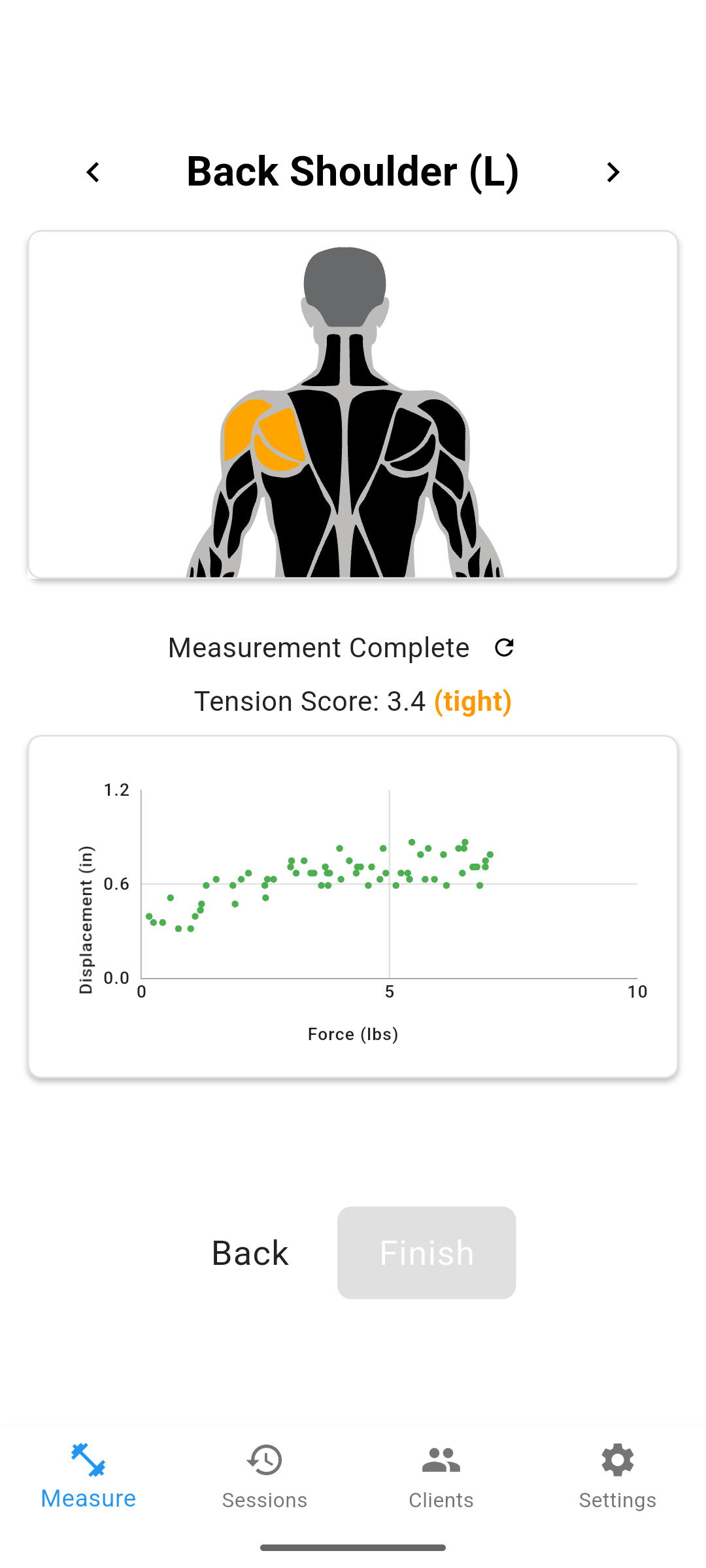
One approach is to add a second channel of objective data alongside subjective pain reports. Options include soft tissue stiffness measurement (such as MuscleMap), range-of-motion testing, and posture analysis. Each gives you something concrete to show the patient rather than asking them to take your word for it.