
What the MuscleMapper Can (and Can't) Do
A 2024 systematic review covering 48 studies and 31 muscle groups found that handheld myotonometry devices achieve intraclass correlation coefficients above 0.75 in most measurements, indicating good to excellent reliability. Reliable is not the same as unconditional. A 2025 study comparing MyotonPRO against shear wave elastography reported that handheld stiffness values are negatively correlated with the thickness of the overlying subcutaneous fat layer, so a reading on a well-padded site may under-represent the muscle beneath it. A 2025 study in the Journal of Bodywork and Movement Therapies sharpens what that reliability is good for: stiffness readings stayed elevated even as subjects reported less soreness after exercise-induced muscle damage. And a 2026 prospective cohort study in JoVE on subacute stroke patients showed that myotonometric tone and elasticity changes had only weak correlations with Fugl-Meyer motor recovery scores, reinforcing that a stiffness reading is one channel of information, not a stand-in for function. Here is what MuscleMap can and cannot do.
The MuscleMapper is a handheld device designed to measure muscle tension. By "tension," we mean how much a muscle pushes back when you apply pressure. To measure this, the device records two things:
- The force applied to the muscle
- How much the muscle moves (displaces) in response
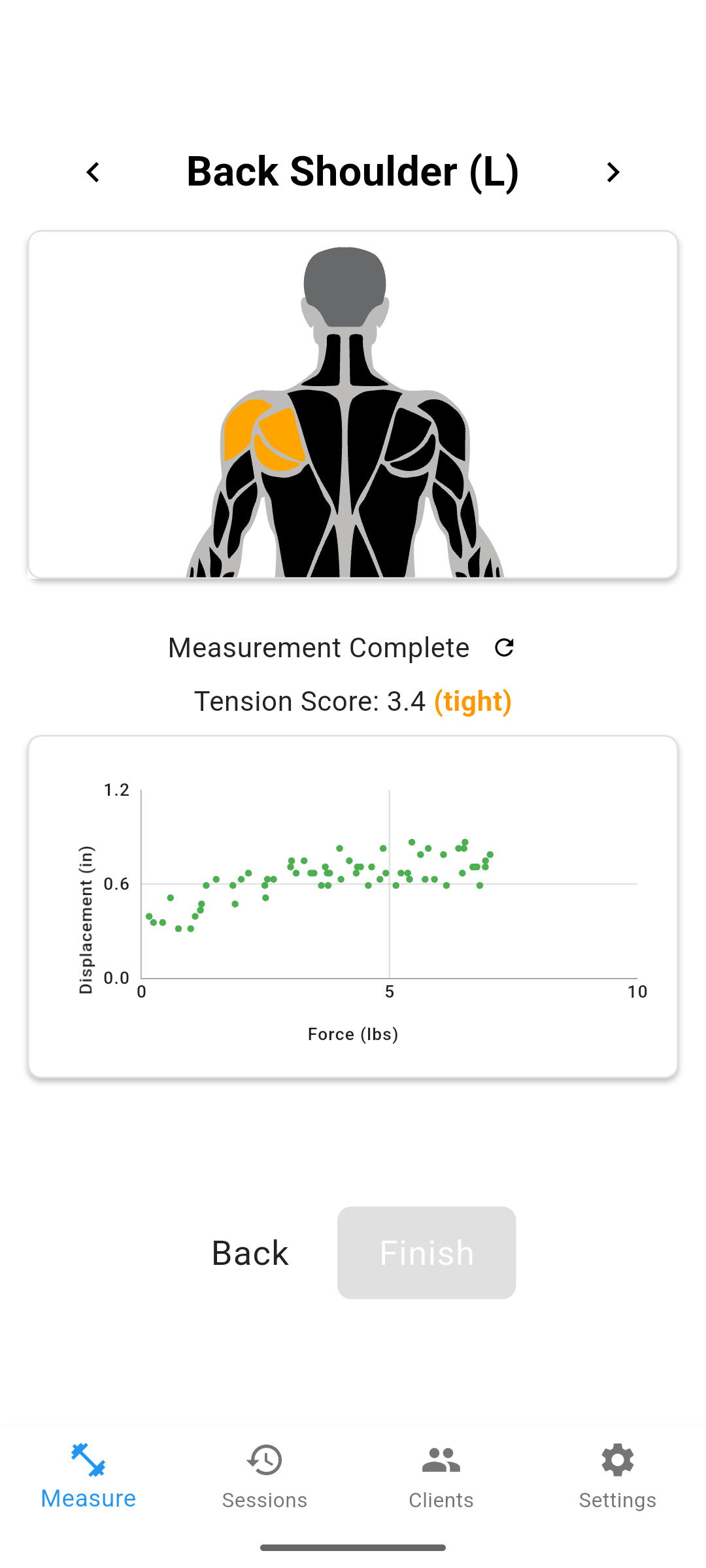
What MuscleMap Measures
MuscleMap focuses on the muscle belly, the contractile tissue that sits beneath skin and fat. This is the same "push-back" you feel when you press your finger into a muscle.
The device collects force and displacement data. But not all of that data comes from the muscle belly. Some of it comes from skin, fascia, or subcutaneous fat. To handle this, MuscleMap runs an analysis on the full force-displacement curve. It identifies which section represents the muscle belly and then calculates a tension score from that segment.
See How It Works for a breakdown of how the score is created.
What It Doesn't Measure
There are important things MuscleMap doesn't measure:
- Soreness – how tender a muscle feels to touch. This isn't purely physical; it's influenced by local tissue chemistry and how the brain interprets those signals.
- Range of motion (ROM) – how far a joint can move comfortably. ROM depends on many factors, and often leans more neurological than purely mechanical.
See Why Your Muscles "Feel Tight" (Even If They Aren't)
Another thing MuscleMap doesn't measure is tissue oscillation or elasticity, basically, how much the tissue "wobbles" after being tapped. Other tools, like the MyotonPRO, measure this by applying a quick mechanical tap to the skin and recording how the tissue vibrates. Reliability across muscles is also uneven for any handheld device. A 2024 study in Frontiers in Sports and Active Living reported ICC values from 0.74 to 0.99 across most lower-extremity muscles in athletes, with vastus medialis stiffness as a notable exception. Some muscles produce cleaner readings than others, and that varies by landmark, tissue depth, and patient positioning.
- Pros: Fast, repeatable, and widely used in research.
- Cons: It mainly reflects what's happening in the superficial layers. For example, in regions like the erector spinae, where the muscle sits beneath the thick thoracolumbar fascia, the readings can be dominated more by fascia than by the muscle belly itself.
By contrast, MuscleMap uses a slow press to measure how much the tissue resists displacement (stiffness). That makes it more suited to looking at muscle belly resistance, especially in areas where fascia would otherwise mask the signal.
See MuscleMap vs. Alternatives
Why Can't I Measure Every Muscle?
Right now, MuscleMap supports a set of larger, clinically useful muscles. Some regions are simply too small, thin, or surrounded by tricky structures for clean, repeatable readings. To keep the workflow fast and reliable, we started with the most commonly requested sites.
We also create muscle profiles for each region. These are weighting models built from testing a sample of muscles to figure out which part of the force–displacement curve represents the muscle belly most accurately. In other words, every time we add a new muscle region, we need to develop a custom profile so the device knows how to interpret the data. That's why expanding to new regions takes time.
If there's a region you really want to see, email harrisonshu@getmusclemap.com!
Current Supported Muscles (both left and right):
- Upper Traps & Neck
- Lower Traps
- Front Delts
- Chest
- Back Shoulders
- Biceps
- Triceps
- Forearms
- Lats
- Quads
- Hamstrings
- Calves
- Front Lower Leg (shin)
- Glutes
- Lower Back
- Outer Hip
- Foot
Other Limitations
Like any measurement tool, MuscleMap isn't perfect. A few sources of "noise" can affect the readings:
- User technique: The device needs to be pressed slowly and perpendicular to the skin. Tilting the disk or pressing too quickly can throw off the data.
- Sensor noise: The displacement sensor and load cell both have a small amount of electronic noise built in. While we filter and average the signals, some variability is inevitable.
- Client factors: If the client suddenly relaxes or tenses the muscle during a measurement, that change shows up in the curve and can affect the score.
We design around these limits by focusing on repeatable workflows and filtering, but it's worth keeping in mind that no measurement is 100% noise-free.
See Tips for Accurate Measurements
Why We Still Built It
MuscleMap does not capture the full picture of a muscle, and no tool can guarantee 100% accuracy. What it does provide is something that is often missing in hands-on work: an objective measure of muscle tension.
That is valuable for two big reasons:
- Client trust and communication – Clients often describe their muscles as "tight," but that word can mean very different things. Having a clear number helps shift the conversation from a vague feeling to something concrete. Even if the result confirms that tension is normal, the ability to show rather than just tell builds confidence and trust.
- Tracking progress over time – A single measurement is useful, but the real power comes from seeing trends. Clients might not notice day-to-day changes, but when you can pull up a graph showing how their muscle tension has decreased over several sessions, it makes progress visible. That visibility helps motivate clients to stick with their care plan and reminds them that their efforts are paying off.
At the end of the day, MuscleMap is not about replacing your hands or judgment. It is about giving you one more tool: a physical, objective metric you can use to communicate more clearly, track progress, and build stronger patient relationships. That mission, bringing clarity and trust to muscle care, is why we built it.
Frequently Asked Questions
How reliable are handheld muscle stiffness measurement devices?
A 2024 systematic review covering 48 studies and 31 muscle groups found that the MyotonPRO achieved intraclass correlation coefficients above 0.75 in most measurements, indicating good to excellent intra-rater and inter-rater reliability. Consistent technique is the largest variable practitioners can control.
Does MuscleMap measure the same thing as palpation?
They measure a related but distinct property. Palpation combines your sense of tissue resistance with the patient's pain response and your clinical experience. MuscleMap isolates the mechanical resistance component and converts it to a number. The number is objective and reproducible; palpation is faster and captures more information but cannot produce a comparable number across sessions or practitioners.
Can a stiffness reading replace clinical judgment?
No. A stiffness reading is one data point. It does not capture pain sensitivity, range of motion, activation patterns, or the clinical context that experienced practitioners integrate during every session. MuscleMap adds a trackable objective signal to your existing clinical picture; it does not replace the rest of it.
Does a stiffness measurement track pain?
Not reliably. A 2025 study in the Journal of Bodywork and Movement Therapies found stiffness readings stayed elevated even as subjects reported less soreness after exercise-induced muscle damage. Stiffness and pain are independent measures and should be tracked as separate channels in any plan of care.
Are all muscles equally well-measured by handheld stiffness devices?
No. A 2024 study in Frontiers in Sports and Active Living reported ICC values from 0.74 to 0.99 across most lower-extremity muscles in athletes, but the vastus medialis stiffness was a notable exception with weaker reliability. The practical implication: anchor measurements to landmarks where readings are consistent, and treat thin or deep muscles with more caution.
Does a change in stiffness predict a change in function?
Not directly. A 2026 prospective cohort study in JoVE on subacute stroke patients found that myotonometric tone and elasticity parameters had only weak correlations with Fugl-Meyer upper limb motor recovery scores. Stiffness measures tissue mechanics; function depends on motor control, coordination, and neural inputs that mechanics alone do not capture. Track stiffness and function as separate channels.
Does body composition change what a stiffness reading means?
Yes, and it is one of the clearer limitations. A 2025 comparison of MyotonPRO against shear wave elastography found handheld stiffness values negatively correlated with subcutaneous fat thickness, meaning the same muscle may read softer through a thicker layer. Compare a patient against their own baseline at a marked site rather than against another patient or a population norm.
Citations
- Superficial vs. deep tissue measurement limits (MyotonPRO overview)
https://myoton.com/technology/ - Small / thin muscle limitation (<3 mm thickness, MyotonPRO)
https://myoton.com/technology/ - Layered tissue crosstalk – phantom study showing masking effects
https://www.nature.com/articles/s41598-023-27742-w - Oscillation vs. stiffness differences – MyotonPRO vs. elastography
https://onlinelibrary.wiley.com/doi/10.1111/sms.70095 - General measurement error and noise in sensors
https://arxiv.org/abs/1004.0874 - Massage decreases upper trapezius stiffness (5-week intervention, elastography) – Jelen et al. (2024). The effect of a 5-week therapeutic massage on erector spinae and upper trapezius muscle stiffness as determined by shear-wave elastography: a randomized controlled trial.
https://pubmed.ncbi.nlm.nih.gov/39253625/